

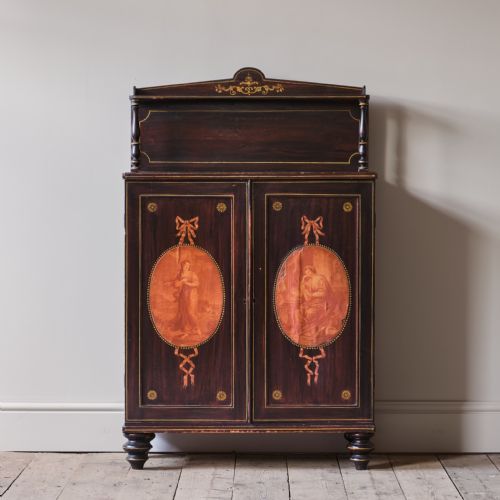


Classical Brown Sideboard
A classical brown sideboard brings gravitas to a dining room, offering substantial timber surfaces and deep storage built to last.
Classical Brown Sideboard
A classical brown sideboard encompasses large timber serving tables, pedestal sideboards, chiffoniers, and side cabinets drawn from Georgian, Regency, and nineteenth-century traditions. These pieces serve as functional storage for dining ware while anchoring a room with dark wood presence and formal proportions.
The versions most commonly met on this page span the Regency and nineteenth-century periods, alongside early twentieth-century interpretations in neoclassical and Italian classical styles. Formats range from pedestal sideboards with brass galleries to painted simulated rosewood chiffoniers and large walnut cabinets.
How they were made
Construction relies heavily on rich timbers such as mahogany, flame mahogany, walnut, and satinwood, often enhanced with intricate inlay work. Structural elements utilise pine, while decorative accents incorporate brass galleries and carved details.
Surface finishes include traditional polish alongside painted simulations, such as pine finished to resemble rosewood. Craftsmanship spans Georgian proportions and nineteenth-century pedestal designs up to twentieth-century Italian exhibition pieces.
Classical Brown Sideboard Retail Price Guide 2026
Typical asking prices for classical brown sideboard among the pieces listed under this phrase on Sellingantiques today, from the lower quarter to the upper quarter. They describe what is for sale here now, not the wider market.
Listings feature mahogany, walnut, and satinwood alongside decorative brass elements spanning the Regency, Georgian, and 1930 periods.
What varies in quality
Quality separates ordinary utility furniture from pieces of exhibition standard through the crispness of timber carving, the selection of figured veneers like flame mahogany, and the refinement of secondary woods. Superior examples demonstrate precise inlay work and harmonious proportions that reflect high-end cabinet-making traditions.
The integrity of decorative hardware, such as brass galleries, and the fidelity to neoclassical design principles further distinguish finer workshops. Pieces associated with named makers or specific revival periods often exhibit a higher degree of sculptural ambition and finish.
Pietro Ferrario·Edwards and Roberts·George Hepplewhite·Gillows
The Classical Brown Sideboard Glossary
- Pedestal sideboard
- A form featuring distinct flanking pedestals united by a central counter or table section. This layout became prominent during the Georgian and Regency eras.
- Chiffonier
- A compact low sideboard or cabinet featuring shelves or enclosed storage beneath. These pieces often included a mirror or gallery on the upper surface.
- Satinwood
- A pale, lustrous timber utilised for contrasting stringing, marquetry, and inlay details on dark mahogany surfaces. It provides bright visual accents across classical furniture.
- Neoclassical
- A style drawing inspiration from classical antiquity, featuring restrained symmetry, architectural motifs, and formal balance. It heavily influenced late eighteenth and nineteenth-century design.
- Brass gallery
- A decorative metal railing mounted along the top surface of a sideboard or server. This feature prevented serving dishes from sliding off during use.
Classical Brown Sideboard: Frequently Asked Questions
What is a classical brown sideboard used for?
These pieces function primarily as dining room servers and storage units for heavy ceramics, silver, and glassware. The top surface provides an area for displaying dishes or serving food during gatherings.
Historically, they also offered concealed storage behind panelled cabinet doors or within deep pedestal drawers for linens and bottles.
How do I distinguish Regency from Georgian sideboards?
Georgian pieces often display balanced, architectural proportions with classical mahogany veneers and refined carving influenced by designers like Hepplewhite. They tend to feel grounded and formal in their structural layout.
Regency examples frequently incorporate bolder neoclassical elements, such as brass galleries, lion paw feet, and contrasting satinwood inlays reflecting a more archaeological design influence.
What woods were used in these sideboards?
Primary construction relies on dense, durable hardwoods including mahogany, flame mahogany, and walnut. These timbers provide a dark, rich surface that deepens in tone over time.
Secondary woods like pine appear in internal framing, while satinwood and painted finishes provide contrast and decorative detail.