


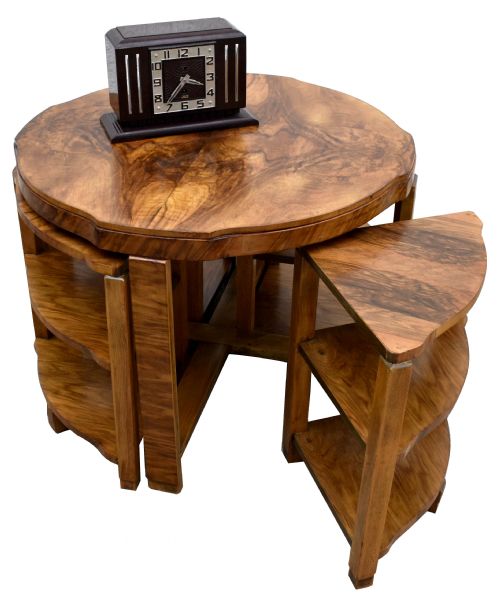
Circular Nesting Coffee Tables
Circular nesting coffee tables combine multi-tiered practicality with striking geometric form, offering flexible surface space that tucks neatly away when not in use.
Circular Nesting Coffee Tables
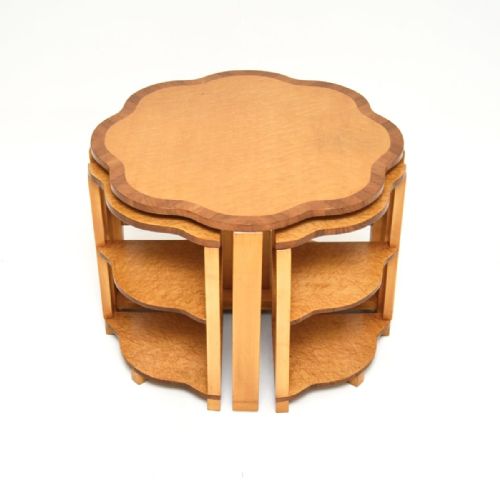
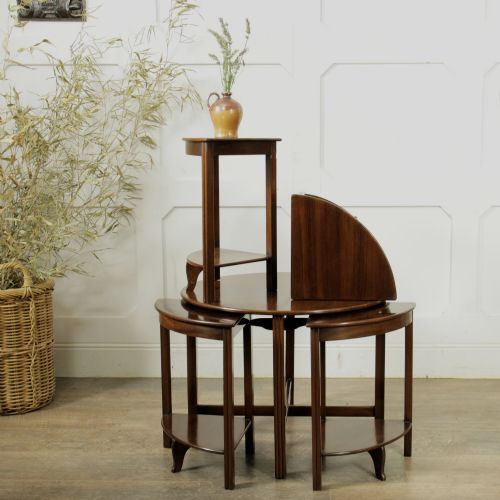
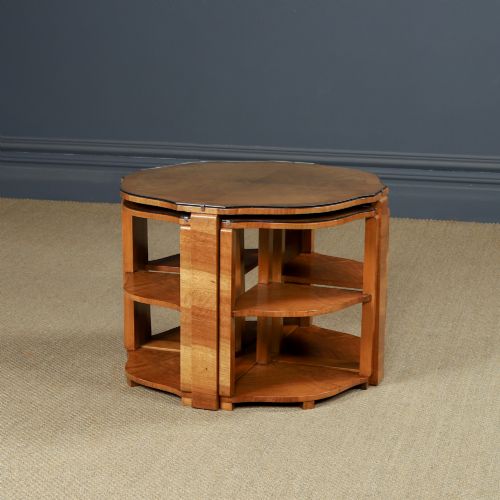
Circular nesting coffee tables are multi-piece sets designed to fit together compactly while providing adaptable table space for living areas. The listings show forms primarily from the Edwardian period and the 1920s to 1940s, spanning Art Deco, Queen Anne style, and Chinese Export traditions.
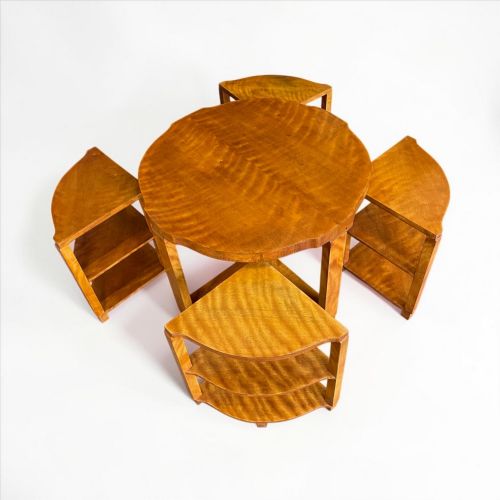
Buyers will most frequently encounter sets comprising four or five round or circular tables constructed from various woods and veneers. These range from substantial Edwardian mahogany nests to streamlined Art Deco sets in walnut and birds-eye maple.
How they were made
These tables were constructed using traditional cabinet-making techniques, often employing solid timbers alongside decorative veneers like burr walnut and satinwood. Artisans shaped figured wood and oak to create curved frames that fit precisely beneath the primary table.
Glass inserts and carved wooden details frequently complement the veneered surfaces, particularly in Oriental-influenced or Art Deco designs. The construction requires careful scaling so each smaller tier slides smoothly into the recess of the next.
Walnut, burr walnut, mahogany, and birds-eye maple are the predominant timbers utilised across these multi-tier table sets.
What varies in quality
Quality in these nests rests upon the choice of timber and the precision of the veneering, particularly on curved circular surfaces. Matched grains across multiple graduating tiers indicate a higher standard of workshop production than mismatched or plain boards.
The sophistication of the joinery and the harmony of the nested proportion dictate the distinction between standard utilitarian sets and masterworks by renowned makers. Finer examples maintain structural integrity and smooth sliding action across all five graduating components.
Harry and Lou Epstein
The Circular Nesting Coffee Tables Glossary
- Nest of tables
- A set of graduating tables designed to slide one beneath another for compact storage. This form became particularly popular during the Edwardian era and the Art Deco period.
- Veneer
- A thin layer of finely figured wood applied to a secondary timber base to create decorative surfaces. Burr walnut and birds-eye maple are notable examples seen on these tables.
- Quintetto
- A set of five tables designed to nest together. This term is specifically associated with certain Art Deco multi-tier sets.
- Edwardian
- The period spanning the reign of King Edward VII from 1901 to 1910, known in these listings for mahogany multi-table nests.
- Art Deco
- A design style dominant in the 1920s and 1930s characterised by streamlined geometric shapes and exotic wood veneers.
Circular Nesting Coffee Tables: Frequently Asked Questions
How do circular nesting coffee tables function?
These tables operate by allowing smaller auxiliary surfaces to slide underneath the main table when space is required. They pull out individually to serve guests or hold items across a room.
This design provides a large surface area without permanently occupying floor space in a living room or drawing room.
What periods do these tables come from?
The pieces span from the Edwardian era through the 1920s, 1930s, and into the 1940s. Art Deco and Edwardian designs predominate in this selection.
Materials and silhouettes shift from traditional mahogany sets to sleek walnut and birds-eye maple geometric forms.
How many tables are typically in a set?
Sets commonly feature four or five graduating tables that fit together beneath a master top. Some variations include round nests specifically labelled as quintetto sets.
Each tier scales down incrementally to achieve the compact nested profile.
Where were these tables made?
The listings show English, French, and Chinese Export origins. European makers utilised local and exotic veneers like satinwood and burr walnut.
Oriental pieces incorporate traditional carving techniques distinct from Western cabinet-making styles.
How should I care for veneered surfaces?
Veneered tables require protection from direct sunlight and excessive moisture to prevent warping or lifting of the grain. Regular dusting with a soft, dry cloth preserves the polished finish.
Avoid placing hot cups or wet glasses directly onto antique polished wood without protective coasters.