
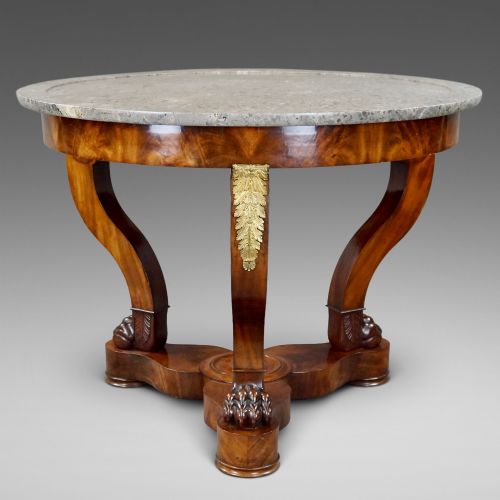
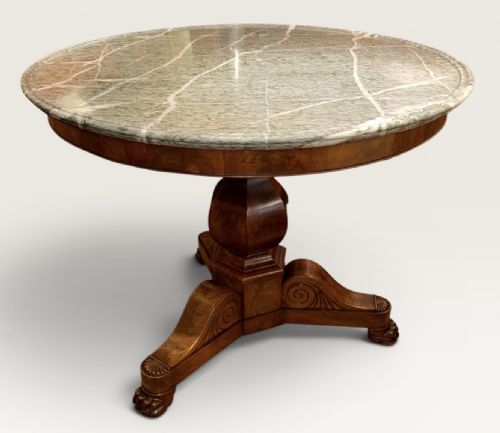


Circular Marble Foyer Table
A circular marble foyer table brings immediate presence to an entrance hall, offering a solid stone surface set upon timber frames from the nineteenth century.
Circular Marble Foyer Table
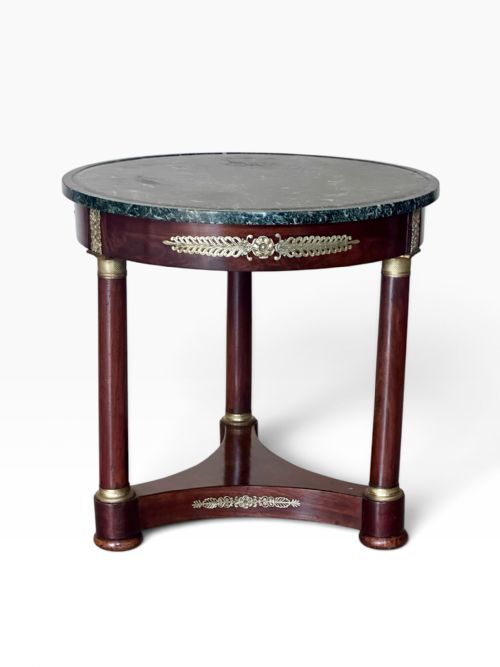
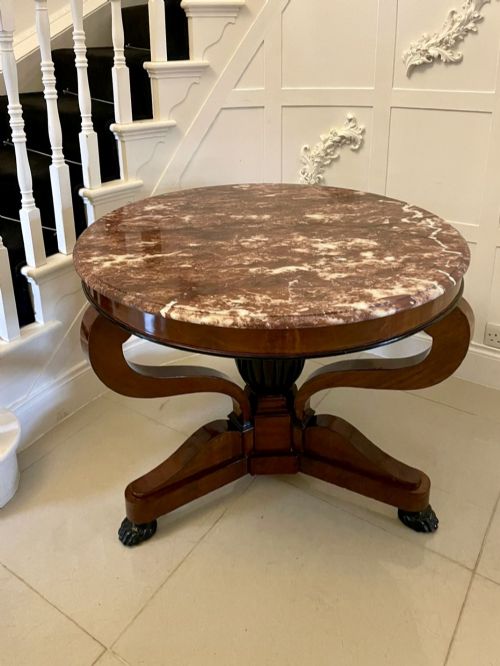
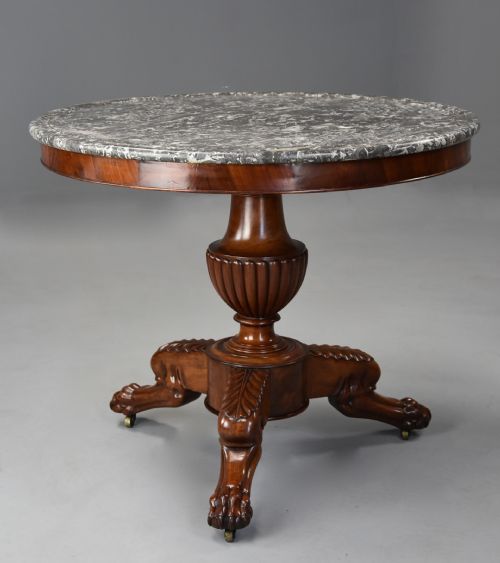
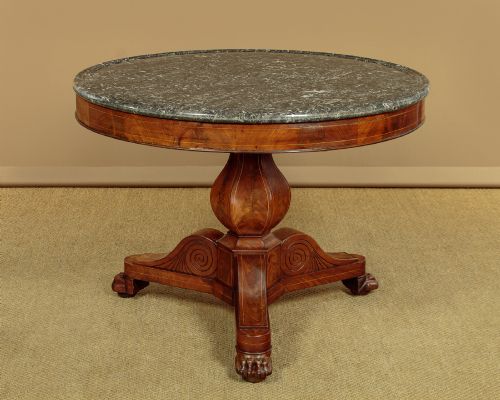
A circular marble foyer table is typically encountered here as a nineteenth-century French gueridon or centre table, designed to anchor a grand hallway with a round stone top. These tables appear across periods such as the Regency, William IV, French Empire, and Italian Neoclassical styles, spanning dates from eighteen hundred to nineteen hundred. The form functions primarily as a centre table or occasional table, offering a substantial circular footprint suited to a spacious entrance.
Most examples combine a heavy circular marble top with timber bases constructed in mahogany, walnut, or painted wood. Varieties range from standard occasional proportions to unusually large iterations, some featuring distinct ornamental additions such as rams heads or pietra dura specimen work. The combination of veined marble and polished wood defines the visual weight of these pieces within a room.
Distinctions in Quality
Quality in these pieces rests largely on the selection and figuring of the timber, particularly flame mahogany and walnut, alongside the choice of marble. Superior examples feature original veined or specialised purple marble tops that sit evenly within the wooden frame, paired with crisp carving on the pedestals. The presence of sophisticated decorative work, such as cast bronze mounts or detailed inlay, separates standard tables from finer productions.
Proportion and scale also dictate the hierarchy among these tables, as unusually large formats or disciplined neoclassical styling demand greater engineering from the maker. The integrity of the original components, from the stone slab to the timber base, determines the overall standing of an individual piece. Lesser examples rely on simpler painted surfaces or standard timber without the intricate mounts seen on top-tier creations.
Materials recorded across the inventory include mahogany, walnut, brass, ormolu, inlay, gilt bronze, and various types of marble.
The Circular Marble Foyer Table Glossary
- Gueridon
- A small French table, typically circular, supported by a single central pillar or a set of columns. The form became prominent during the seventeenth century and remained popular through the nineteenth century.
- Pietra dura
- An artistic technique using cut and fitted, highly polished coloured stones to create images or geometric patterns. This decorative work often appears on high-status table tops.
- Ormolu
- Gilded bronze applications used as decorative mounts on furniture. The technique involves applying a finely ground high-carat gold-mercury amalgam to bronze.
- Mahogany
- A durable, reddish-brown tropical hardwood favored by nineteenth-century cabinetmakers for its rich grain and ability to take a fine polish.
Circular Marble Foyer Table: Frequently Asked Questions
How do I style a circular marble table in an entrance?
A round table works best placed directly in the middle of a spacious hallway to create a striking focal point upon entry. The stone surface provides a durable landing space for daily items while establishing the period character of the room.
Keep surrounding items balanced to allow the circular silhouette and timber base to remain the primary visual anchor. Large hallways accommodate these substantial nineteenth-century forms without crowding the surrounding architectural pathways.
What is the difference between a gueridon and a centre table?
A gueridon specifically denotes a round table on a central pillar, whereas a centre table describes any table designed to stand free in the middle of a room rather than against a wall. Many nineteenth-century French pieces answer to both descriptions.
The distinction lies mainly in the pedestal construction, with gueridons strictly utilising a central column design to support the heavy marble top.
Are these tables sturdy enough for daily use?
Nineteenth-century tables were built using dense hardwoods like mahogany and walnut to safely carry heavy stone tops. Their original construction was intended to withstand robust domestic environments.
However, the primary weight comes from the marble slab, so care must be taken when moving the assembled piece across uneven flooring.
How do I identify a French Empire piece?
French Empire furniture displays distinct neoclassical influences, often incorporating architectural columns, dark mahogany timbers, and prominent metal mounts in brass or ormolu. Motifs such as rams heads frequently appear on the pedestals.
These characteristics reflect the design trends of the early nineteenth century under Napoleon, emphasising formal symmetry and classical grandeur.