

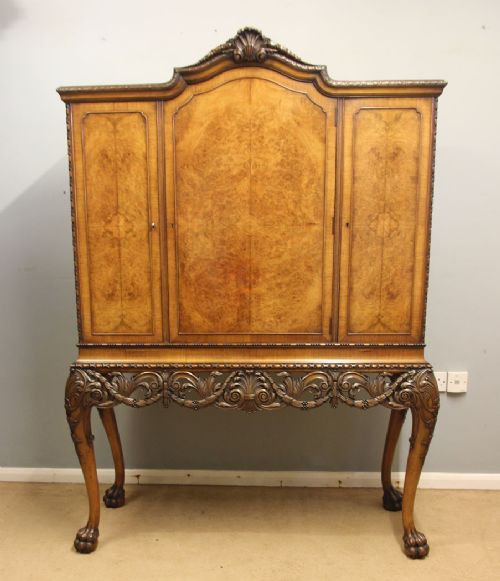


Chippendale Style Highboy
These Chippendale style highboy examples combine tall proportions with classical cabinetwork, bringing stately presence and traditional storage to a room.
Chippendale Style Highboy
A chippendale style highboy typically takes the form of a chest on chest or a tallboy, stacking multiple drawers in two distinct sections to maximise vertical storage. These pieces emerge in formats ranging from late eighteenth century origins to later revival periods, offering substantial capacity within a commanding footprint.
The style draws heavily upon eighteenth century cabinetmaking traditions, blending utilitarian drawer arrangements with architectural mouldings. Examples span from genuine Georgian period items to early twentieth century revivals executed in matching timbers.
Materials and construction
Makers relied primarily on solid mahogany and oak for structural integrity, frequently applying flame mahogany or burr walnut veneers to primary drawer fronts for visual depth. These timbers were selected for stability and grain figure, allowing for precise mitres and flush drawer joints.
Brass hardware, including batwing plates, drop handles, and escutcheons, punctuate the dark timber surfaces and secure the internal locking mechanisms. Secondary woods support internal drawer linings, while intricate line inlay occasionally defines the perimeters of lower stands and panels.
Chippendale Style Highboy Retail Price Guide 2026
Typical asking prices for chippendale style highboy among the pieces listed under this phrase on Sellingantiques today, from the lower quarter to the upper quarter. They describe what is for sale here now, not the wider market.
Materials documented across the inventory include brass hardware, burr walnut veneer, flame mahogany, and leather surfaces.
Judging quality in a chippendale style highboy
Quality rests significantly on the selection of timber veneers and the crispness of carved cornices or applied mouldings. Superior examples demonstrate continuous grain matching across drawer tiers and precise joinery that maintains structural alignment over centuries of expansion and contraction.
The integration of original brass hardware and functional locking mechanisms with matching keys elevates a piece beyond those altered or fitted with modern replacements. Finer instances retain their original standing bases and undisturbed surface patination, reflecting careful historic maintenance.
The Chippendale Style Highboy Glossary
- Tallboy
- A traditional British term for a tall chest of drawers, usually constructed in two stacked sections. It often serves the same functional purpose as a highboy.
- Chest on chest
- A heavy furniture form comprising a wider lower chest supporting a slightly narrower upper chest. This design increases vertical storage while maintaining classical proportions.
- Cornice
- The decorative mouldings running along the top edge of a tall cabinet. They often incorporate classical architectural details such as dentils or Greek key patterns.
- Bracket foot
- A simple foot shape formed by two pieces of wood joined at a right angle, supporting the corners of case pieces. They replace heavier cabriole legs on many tallboy designs.
- Secretaire
- A cabinet or chest featuring a pull-down writing drawer that conceals small pigeonholes and letter compartments. This dual-purpose feature appears within several taller drawer configurations.
Chippendale Style Highboy: Frequently Asked Questions
What is a chippendale style highboy?
A chippendale style highboy is a tall stacked storage unit featuring multiple drawers, influenced by eighteenth-century English design principles.
These pieces combine stately proportions with practical compartmentalisation, making them prominent focal points in traditional rooms.
How were tallboys used historically?
Historically, these tall chests provided essential wardrobe storage for garments and linens in domestic bedchambers.
The compartmentalised drawers allowed owners to sort clothing systematically while keeping valuable items secure behind lockable doors.
How do I live with a tall chest?
Living with a tall chest involves placing it against a secure wall where its height can anchor the room's proportions.
Regular application of suitable furniture wax maintains the timber's finish while preventing the dry air of modern heating from affecting historical joints.
How can I tell periods apart?
Distinguishing periods relies on observing timber choices, construction methods, and hardware styles alongside overall carcass proportions.
Earlier examples often display hand-cut dovetails and native cabinet timbers, whereas twentieth-century revivals utilise mechanical manufacturing indicators and specific revival styling cues.