

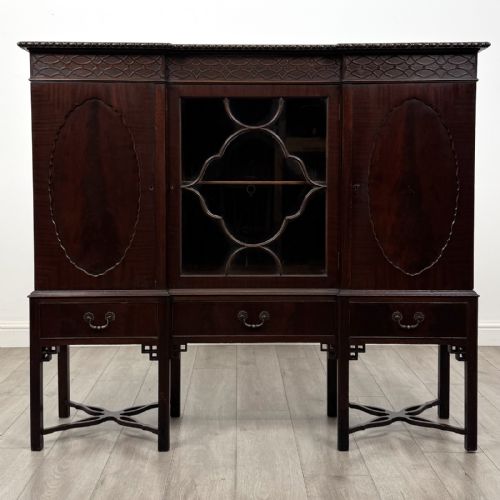


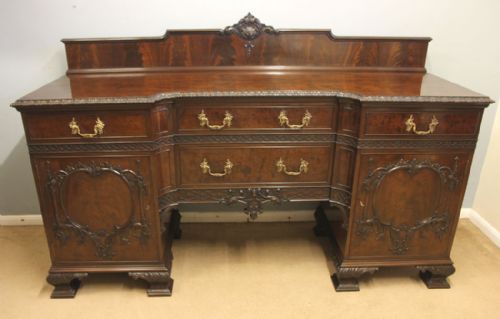


Chippendale Sideboard
A chippendale sideboard brings robust mahogany timber and classic carved detail into a dining space.
Chippendale Sideboard
A chippendale sideboard represents a sturdy serving piece built from rich mahogany timber. These forms serve dining rooms and living spaces by offering surface area for serving and enclosed storage beneath.
The selections span from original 18th Century and Georgian pieces to later Victorian, Edwardian, and 20th Century revival interpretations. Alongside traditional sideboards, buyers encounter related serving tables, display cabinets, and console tables sharing the same aesthetic lineage.
Revival iterations from the late 19th Century and early 20th Century adopt the signature carved vocabulary of the Georgian period. Mahogany remains the dominant timber across these eras, occasionally enhanced by flame mahogany veneer and satinwood.
Materials and construction
Makers relied primarily on solid mahogany and flame mahogany veneer to construct these substantial items. Brass hardware frequently appears on drawers and doors, providing structural function and visual contrast against the dark timber.
Glass panels are integrated into upper display cabinets and silver cabinets, whilst internal shelves organise storage. Structural integrity relies on traditional joinery methods suited to heavy hardwoods.
Chippendale Sideboard Retail Price Guide 2026
Typical asking prices for chippendale sideboard among the pieces listed under this phrase on Sellingantiques today, from the lower quarter to the upper quarter. They describe what is for sale here now, not the wider market.
Some sideboards hide their silver behind glass, whilst others keep cutlery safely tucked away inside a fitted canteen.
Assessing quality and execution
The distinction between standard items and superior examples lies in the depth and crispness of the hand carving. Pieces executed with confident serpentine lines and finely detailed mouldings demonstrate greater artisan skill.
Selection of timber grain defines the visual appeal, particularly where book-matched flame mahogany veneer or contrasting satinwood inlay is employed. The integration of solid brass mounts and well-fitted internal components further separates finer workshops from mass production.
Elkington & Co
The Chippendale Sideboard Glossary
- Serpentine front
- A furniture front curving outward in the centre and inward at the sides, creating a fluid silhouette. This contour requires precise woodworking skill to execute properly.
- Flame mahogany
- A distinct timber figure displaying a flickering, flame-like pattern caused by the grain growth of the wood. Cabinet makers prized this veneer for principal drawer fronts and doors.
- Chippendale Revival
- A later stylistic movement reproducing or reinterpreting 18th Century designs during the Victorian and Edwardian periods. These pieces adapt classic carved motifs to contemporary room scales.
- Satinwood
- A pale, durable exotic timber used for contrasting inlay and stringing on mahogany furniture. It provides a bright accent against darker primary woods.
Chippendale Sideboard: Frequently Asked Questions
How do I date a chippendale sideboard?
Dating relies on examining construction methods, timber selection, and hardware styles. 18th Century and Georgian examples show hand-cut joinery and period-appropriate timber characteristics.
Revival pieces from the Victorian, Edwardian, and 19th Century eras often incorporate machine-finished components alongside traditional carving techniques.
Where should I place a serving table?
These pieces fit naturally against dining room walls to hold dishes and serving platters during meals. Console tables and side cabinets also function effectively in hallways and living areas.
Ensure the room dimensions accommodate the serpentine front projection and any associated display cabinets.
What is the difference between revival and original pieces?
Original 18th Century and Georgian items date directly from the period associated with Thomas Chippendale's design influence. They carry the patina and structural traits of early hand manufacture.
Revival pieces date from later decades such as 1900 or 1910, reproducing the classic aesthetic using the manufacturing standards of their own time.
How do I care for mahogany furniture?
Maintain the timber by keeping the surface clean with a soft, dry cloth and avoiding excessive moisture. Protect the finish by placing the piece away from direct heat sources and strong sunlight.
Occasional treatment with appropriate wax preserves the depth of the mahogany and flame veneer.