

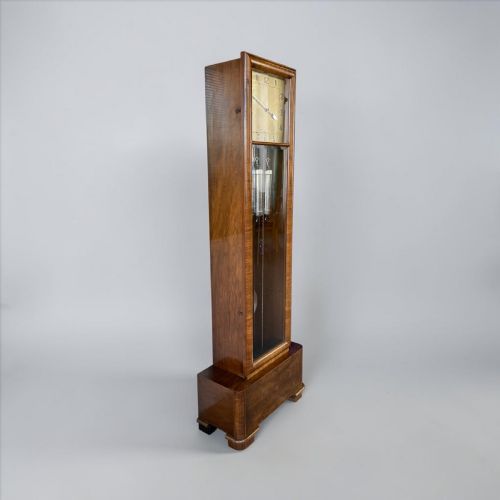
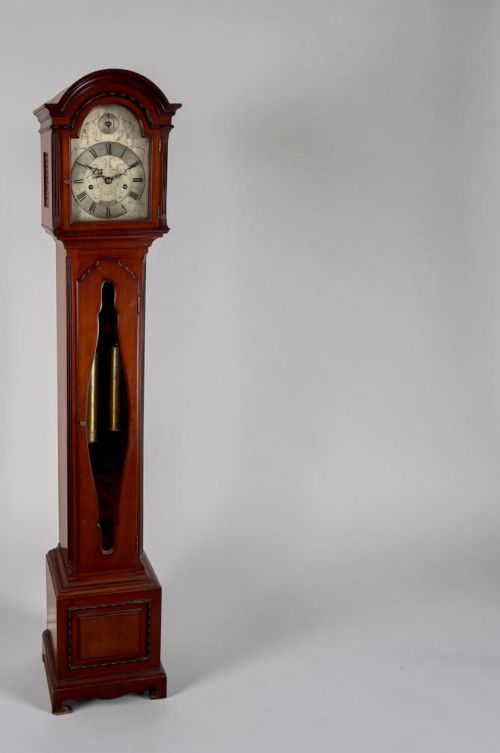
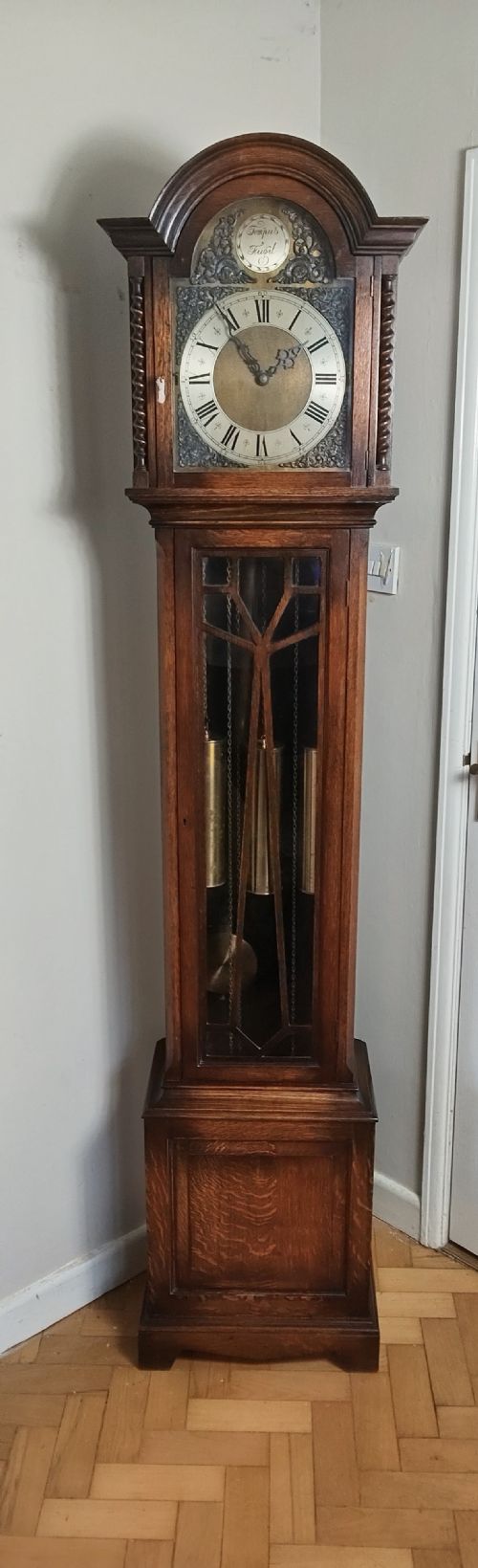
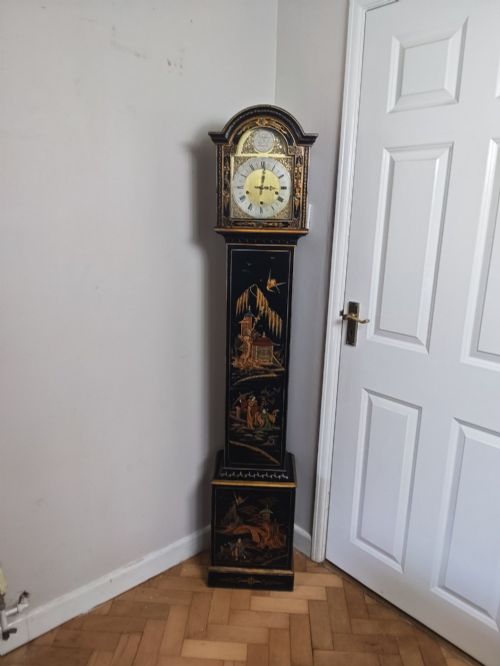


Chiming Tall Case Clock
A chiming tall case clock brings acoustic presence and mechanical rhythm into a room, measured through pendulum swing and striking chimes.
Chiming Tall Case Clock
A chiming tall case clock stands upright on the floor, housing a weight-driven or spring-driven movement within a wooden trunk. These pieces appear in forms such as grandfather clocks, grandmother clocks, and longcase clocks.
The selection here spans from the Georgian period through Victorian, Edwardian, and Art Deco eras. Buyers most frequently meet Edwardian and 1930s examples constructed in mahogany, oak, and walnut.
Styles range from traditional English designs to Chinoiserie decoration and Jacobean Revival carving. Floor clocks in this group often feature musical movements or quarter-chiming mechanisms.
Materials and construction
Cases are built from hardwoods including mahogany, oak, and walnut, sometimes finished with veneer or inlay work. Glazed doors protect the dial face, while brass and steel components form the intricate internal gear trains.
Movements incorporate weights, pendulums, and carillons to produce musical melodies and hour strikes. Dial faces combine painted metal, brass chapter rings, and subsidiary hands for tune selection.
Chiming Tall Case Clock Retail Price Guide 2026
Typical asking prices for chiming tall case clock among the pieces listed under this phrase on Sellingantiques today, from the lower quarter to the upper quarter. They describe what is for sale here now, not the wider market.
Movements range from simple time-and-strike configurations to complex mechanisms playing up to four carillons and melodies.
Distinctions in quality
The refinement of the cabinetry defines the upper tier, seen in carved mahogany details, burr walnut grain, and hand-painted dials. Musical complexity sets apart advanced movements, particularly those playing multiple tunes or utilising triple weights and nine-tube chime configurations.
Proportion and scale distinguish smaller grandmother clocks from standard grandfathers. Maker attribution adds substance, with established firms like Gillett & Johnston representing specific mechanical standards.
Gillett & Johnston of Croydon·Bravingtons·Lister & Sons·Geo Tarratt of Leicester·William Smith, Keighley
The Chiming Tall Case Clock Glossary
- Longcase clock
- A tall pendulum clock enclosed in a wooden case standing directly on the floor. These instruments are also known as grandfather or grandmother clocks depending on their height.
- Grandmother clock
- A scaled-down version of the traditional longcase clock produced widely during the Edwardian period and the early twentieth century. They occupy less floor space while retaining weight-driven movements.
- Carillon
- A set of tuned bells or tubes mechanism within a clock that plays musical melodies prior to the hour strike. These systems often feature multiple tune selections.
- Triple weight
- A weight-driven clock movement utilising three separate weights to power the timekeeping, the hour strike, and the chiming melodies separately. This setup ensures consistent energy delivery to each train.
Chiming Tall Case Clock: Frequently Asked Questions
What is a grandmother clock?
A grandmother clock is a smaller variation of the traditional longcase clock, typically produced during the Edwardian era and the 1920s or 1930s.
They offer the mechanical complexity of full-sized grandfather clocks within reduced proportions suited to modern ceiling heights and floor spaces.
How do chiming mechanisms work?
These clocks use weight-driven or spring-driven trains connected to hammers that strike bells, gongs, or metal tubes. Musical versions utilise pinned cylinders or discs to play specific melodies before the hour.
Triple weight systems separate the timekeeping power from the striking and chiming functions to maintain timekeeping accuracy.
Where should I place a tall case clock?
Tall case clocks require a stable, level floor surface against a secure wall to allow the pendulum to swing freely without interference. Placing them away from direct sunlight and temperature fluctuations protects the wooden veneer and internal oils.
Proximity to living areas allows the owner to hear the Westminster or multiple-tune chimes clearly throughout the day.
How do I date a tall case clock?
Dating relies on stylistic clues such as Art Deco geometric lines from 1930, Edwardian mahogany inlay, Victorian proportions, or Georgian painted dials. Maker signatures on the dial face or movement plates provide direct chronological reference points.
Materials like chrome and distinct dial typography also indicate whether a piece belongs to the 1920s or earlier centuries.