






Child and Dog Portrait
A child and dog portrait captures a companionable bond between youth and pet across centuries of oil painting, pastel, and print.
Child and Dog Portrait
A child and dog portrait brings together young subjects and their canine companions across centuries of painting and printmaking. The pieces span from the seventeenth century through the Victorian era to the mid-twentieth century, recording formal commissions and vernacular studies alike.
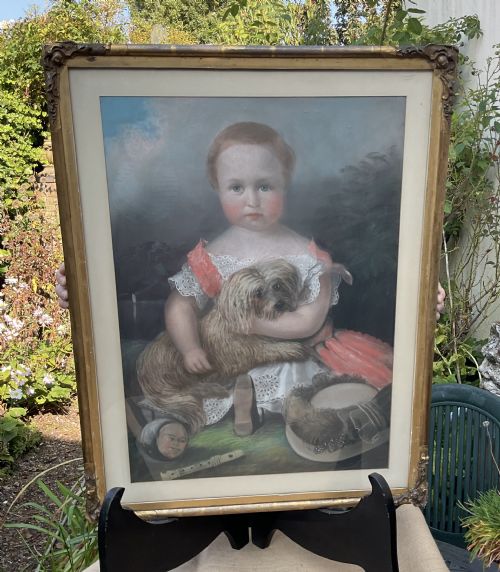
Most examples encountered on this page belong to the nineteenth century, taking the form of oil on canvas, framed prints, or works on paper. Provincial and naive interpretations sit alongside academic compositions.
Subjects range from named figures with specific pets, such as King William III as a boy or Louisa Cooke with her dog Mr Quiz, to anonymous children depicted with spaniels, terriers, and ponies.
How they were made
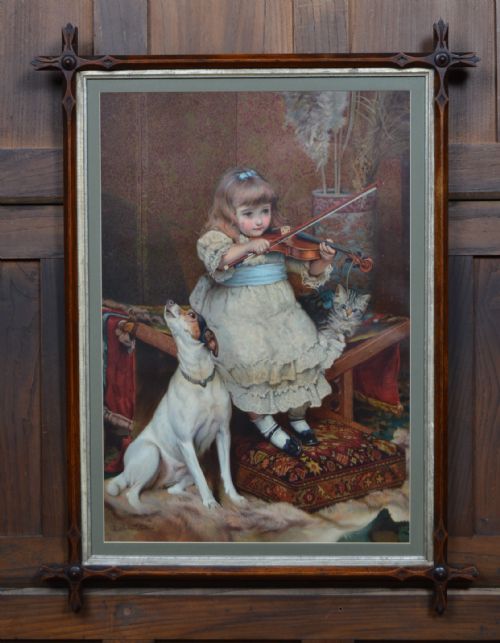
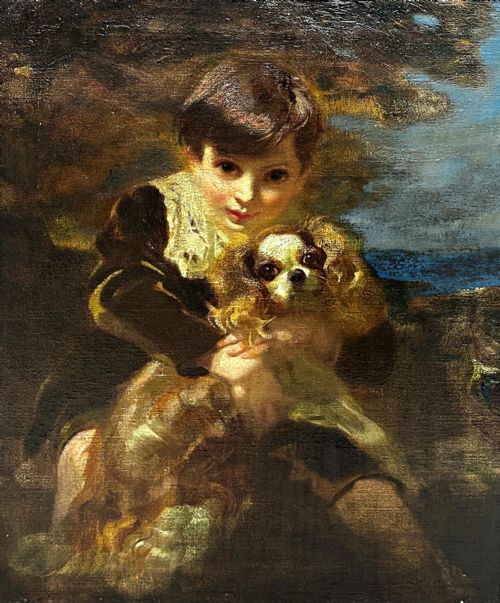
Artists painted primarily in oil on canvas, building pigment over stretched fabric to achieve depth in garments and animal coats. Watercolours, pastels, and chromolithographs also appear across the periods represented.
Frames form an integral part of the physical object, utilising gilded wood, maple, and giltwood to enclose and protect the canvas or paper. Glazed mounts appear on works on paper and silhouettes to guard against atmospheric damage.
Mr Quiz joins Louisa Cooke on canvas, ensuring an anonymous terrier achieves immortality alongside his young owner.
What varies in quality
The sophistication of the draughtsmanship separates academic commissions from provincial naive works. Hand-rendered oil paintings display nuanced handling of light on fabric and animal fur, whereas naive pieces rely on flat planes and simpler outlines.
The preservation of the original surface and its mounting affects the integrity of the piece. Intact period frames of gilded wood or maple contribute to the physical completeness of the artwork.
John Alfred Wheeler·Mary Beale·Charles Burton Barber·Delacroix·Frank Owen Salisbury·Richard Buckner
The Child and Dog Portrait Glossary
- Naive folk art
- An artistic approach characterised by a rejection of perspective and academic proportion, often produced by self-taught painters working outside metropolitan centres. These pieces rely on direct observation and linear clarity rather than anatomical precision.
- Chromolithograph
- A multicoloured print produced through lithography using a separate stone for each ink colour. This technique gained popularity in the nineteenth century for reproducing oil paintings and watercolours for domestic interiors.
- Provincial school
- Art produced outside major urban academies, typically reflecting regional tastes and traditional methods. The execution often shows charming local idiosyncrasies distinct from London or continental standards.
- Equestrian portrait
- An artwork depicting a subject on horseback, frequently accompanied by hunting dogs or pets. In child portraits, this format denotes social standing and equestrian training.
Child and Dog Portrait: Frequently Asked Questions
How do I date a child and dog portrait?
Dating relies on the costume of the child, the breed of the dog, and the framing materials. Seventeenth-century subjects often wear distinctive lace collars, whilst Victorian pieces feature characteristic fabrics and hairstyles.
Supporting evidence such as signatures, inscriptions on the reverse, and period stretcher frames help narrow the decade of creation.
What is naive folk art?
Naive folk art refers to paintings created without formal academic training. These works prioritise direct expression over strict anatomical accuracy.
Such pieces often originate from provincial schools and possess a distinctive charm through simplified forms and unpretentious composition.
How were these portraits displayed?
Portraits of children and pets traditionally hung in domestic reception rooms or private family spaces. They served as permanent records of childhood and cherished animals.
Original frames of gilded wood or maple indicate that the piece was intended for prominent wall display from the time of creation.
Are all the paintings original oils?
While oil on canvas forms a large part of the selection, the category includes other mediums. Watercolours, pastels, silhouette pictures, and chromolithographs are also represented.
Each medium offers a different textural quality, from the dense pigment of oils to the delicate precision of paper and glass mounts.