


Cherub Bronze Timepiece
A cherub bronze timepiece is a figural clock combining metalwork and classical ornamentation, sought after for its decorative presence on a mantelpiece.
Cherub Bronze Timepiece
A cherub bronze timepiece unites sculptural metal figures with functional timekeeping, emerging most frequently from nineteenth-century French and English workshops. These objects take the form of mantel clocks, table clocks, and garnitures designed to anchor the visual weight of a room.
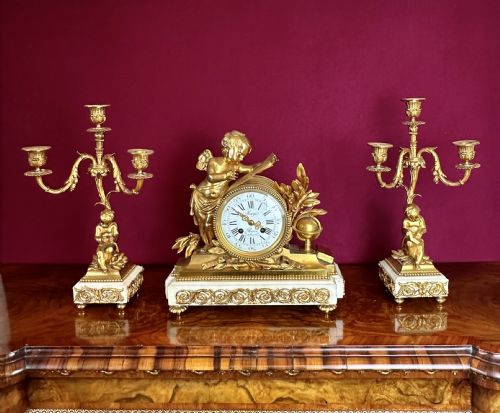
The dominant style on this page is French revival, drawing heavily on Rococo, Louis XVI, and Empire aesthetics. Figures of winged putti or cherubs appear alongside classical motifs, often engaged in symbolic activities like music or reaching for birds.
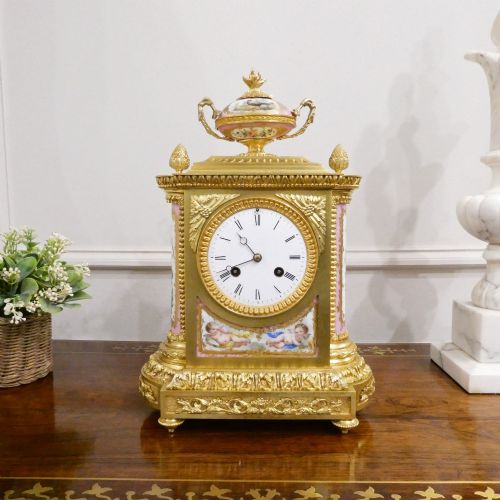
Most examples rely on gilt bronze, ormolu, or patinated bronze, frequently mounted upon substantial marble or porcelain bases. The horological mechanism is usually enclosed within a decorative case that subordinates the dial to the sculptural composition.
Quality factors
The integration between the sculptural cherub and the clock housing indicates ambition; better pieces treat the figure as an integral architectural component rather than an applied afterthought standing detached from the movement case.
The listings on this page span the nineteenth century, encompassing Victorian, Regency, and French Empire stylistic revivals.
Jean-Baptiste Delettrez·Le Roy, Paris·Leon Message·Jollet et Cie·Samuel Marti·Le Roy and Fils·John Bennett Cheapside London·Henry Berkeley Square London·Baetens London·Farcot·Japy Freres
The Cherub Bronze Timepiece Glossary
- Ormolu
- Gilded bronze produced through an amalgamation of mercury and gold applied to a copper alloy base, creating a durable golden matte surface. This technique was widely practiced in eighteenth and nineteenth-century French foundries.
- Fusee
- A conical pulley used in clock mechanisms to maintain equal drive force as the mainspring unwinds. This device ensures consistent timekeeping accuracy across the duration of the winding cycle.
- Garniture
- A set comprising a central clock flanked by matching decorative objects such as vases or candelabra designed for display together. These ensembles dominated formal nineteenth-century mantel arrangements.
- Champleve
- An enamelling technique where troughs or cells are carved into the surface of a metal object and filled with vitreous paste before firing. The resulting coloured patterns often accent clock bezels and dials.
- Patinated bronze
- Metal treated with chemical solutions to darken the surface and create deep brown or greenish tones. This finish contrasts sharply with bright gilt bronze mounts.
Cherub Bronze Timepiece: Frequently Asked Questions
How do I wind my cherub bronze timepiece?
Use the designated winding key on the dial face to turn the arbors clockwise until gentle resistance indicates the mainspring is fully tensioned.
Avoid over-winding the mechanism, as forcing the spring past its limit can damage the teeth within the train.
What is a single fusee movement?
A single fusee movement uses a conical drum and cord or chain to equalise the power delivered from the mainspring to the escapement as it runs down.
This mechanical refinement helps the clock maintain steady timekeeping accuracy throughout the winding interval.
Where should I place a heavy marble clock?
Position the clock on a stable, level surface capable of supporting considerable weight from the marble base and bronze superstructure.
Keep the piece away from direct sunlight and moisture fluctuations to protect the delicate enamel dial and fire-gilded finish.
How do I identify a nineteenth-century French clock?
Look for foundry stamps on the backplate of the movement, such as maker marks from Paris workshops or medal awards stamped into the brass.
The presence of hand-chased ormolu, Sevres-style porcelain panels, and classical revival motifs also points to nineteenth-century manufacture.