







Charcoal Nude Study Paper
Charcoal nude study paper works capture the human form through direct draughtsmanship, offering buyers immediate intimacy with the artist's hand.
Charcoal Nude Study Paper
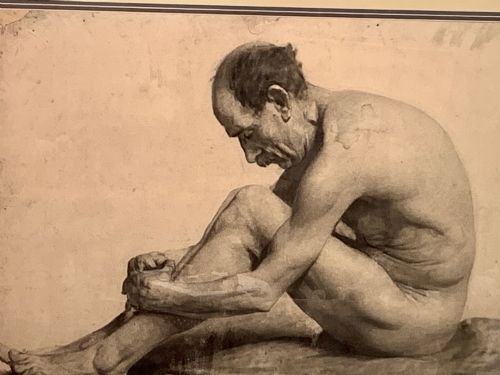
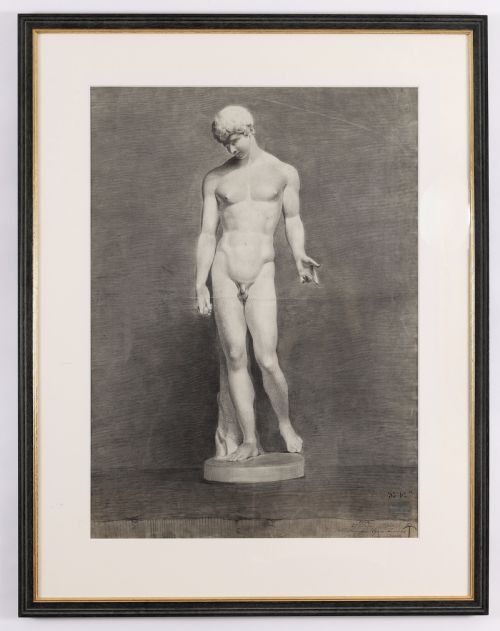
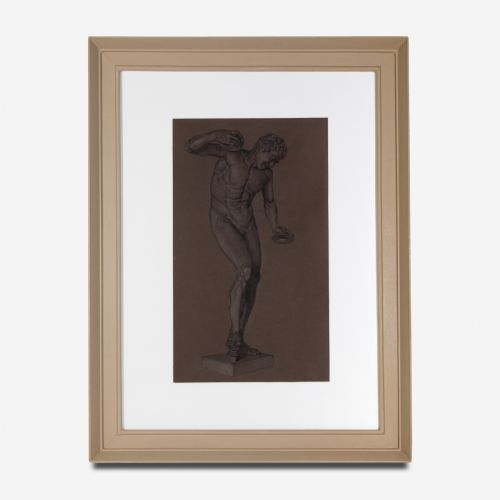
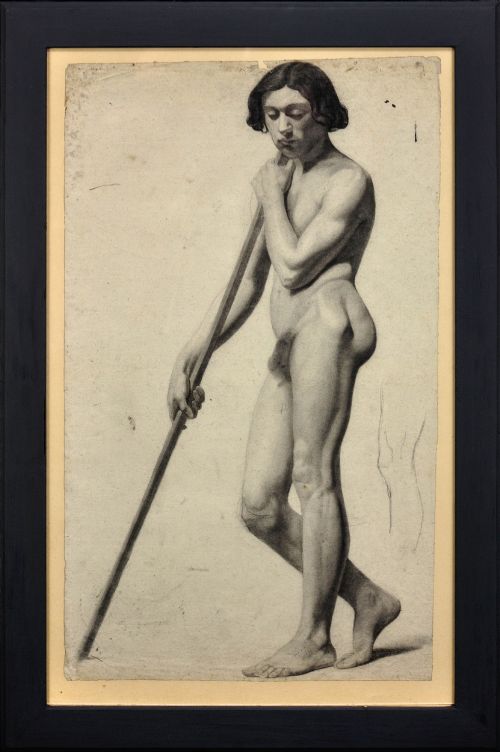
When you search for charcoal nude study paper, you are looking at original life studies rendered in charcoal, chalk, graphite, and pastel on various paper supports. These pieces range from nineteenth-century academic exercises to mid-century modern interpretations.
You are most likely to meet framed drawings from the nineteenth century and the twentieth century, created within academic settings or by individual artists working from life.
The subjects span male and female figures, including seated poses, standing stances, and reclining studies, often presented in wood and glass frames.
How they were made
Artists executed these works using charcoal, chalk, and graphite directly onto paper supports, occasionally utilising toned paper to enhance tonal contrast. These media allowed for rapid gesture drawing and delicate shading during live sittings.
Many surviving examples are housed beneath glass within wood frames, preserving the fragile charcoal and pastel particles from smudging over decades of handling.
Charcoal Nude Study Paper Retail Price Guide 2026
Typical asking prices for charcoal nude study paper among the pieces listed under this phrase on Sellingantiques today, from the lower quarter to the upper quarter. They describe what is for sale here now, not the wider market.
Artists sometimes left stray thumbprints in charcoal near the margins, offering a direct physical trace of the hand that drew the model over a century ago.
What varies in quality
Quality rests upon the sureness of the draughtsmanship and the artist's grasp of anatomical proportion and light. Stronger works demonstrate confident line work and subtle tonal gradation that define musculature and form without unnecessary hesitation.
The preservation of the paper support and the stability of the charcoal media also separate superior examples from weaker student exercises.
Samuel Rabin·Henry Arthur Roberts·Demetrios Galanis·Winifred Eugene Ballard·Frank Dobson
The Charcoal Nude Study Paper Glossary
- Academic Realism
- A style of painting and drawing produced under the influence of European academies of art, emphasising precise anatomical accuracy and classical proportions. It forms the basis of many nineteenth-century life studies.
- Toned Paper
- Paper that possesses a natural colour other than white or cream, such as grey, tan, or blue. Artists use it to build up highlights with white chalk and shadows with charcoal.
- Life Study
- A drawing or painting executed directly from a live nude model. These exercises record the immediate observations of the artist in a studio setting.
- Deux Crayon
- A drawing technique employing two coloured pencils or chalks, typically black and red or black and white, on tinted paper. It creates depth through contrasting warm and cool tones.
- Graphite
- A form of crystalline carbon used as a drawing medium, producing grey or black marks with a metallic sheen. It appears frequently in nineteenth-century studies alongside charcoal.
Charcoal Nude Study Paper: Frequently Asked Questions
How should I hang a charcoal drawing?
Keep charcoal and paper works away from direct sunlight to prevent the paper from yellowing and the media from fading. Glazing protects the delicate surface particles from atmospheric dust and accidental contact.
Ensure the room humidity remains stable to avoid warping the paper or damaging the wood frame. Professional framing with acid-free mounts preserves the integrity of antique drawings over time.
What is an academic life study?
An academic life study is a drawing produced within an institutional setting where artists practiced rendering the human anatomy from a live model. These exercises formed a core component of nineteenth-century artistic training.
Students learned to master proportion, shading, and gesture before progressing to finished compositions. Consequently, these drawings record the rigorous technical standards of historic art schools.
How do I date a charcoal drawing?
Dating relies on stylistic markers, framing materials, and the characteristics of the paper support. Nineteenth-century works often reflect strict academic realism, while twentieth-century examples embrace modernist or cubist tendencies.
Inscribed dates, signatures, or biographical details of the artist provide definitive chronological anchors. The watermark and texture of the paper further assist in determining the period of manufacture.
Why use toned paper for studies?
Toned paper provides a middle-value background that allows artists to work in both directions simultaneously. They apply dark charcoal for shadows and white chalk for highlights.
This method speeds up the rendering of volume and light compared to starting on a stark white sheet. It creates a harmonious tonal balance characteristic of classical life drawing.