

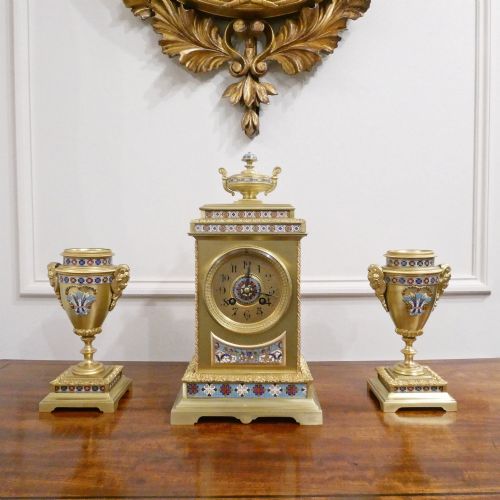
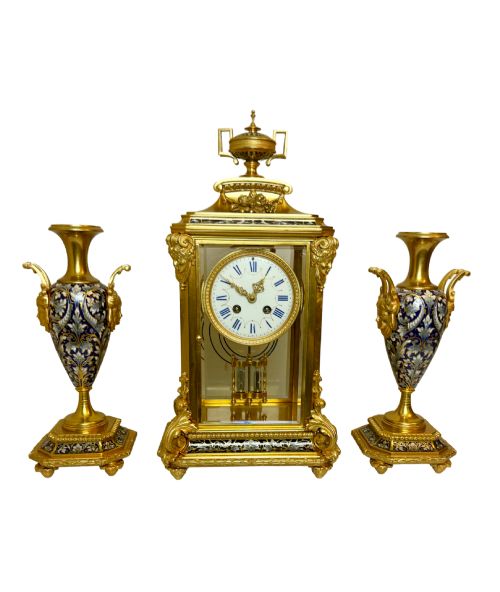


Champleve Enamelled Clock
A champleve enamelled clock brings rich polychrome metalwork and heavy gilt bronze into a room.
Champleve Enamelled Clock
A champleve enamelled clock combines heavy metal cases with deep recessed colour work, spanning mantel clocks, carriage clocks, and crystal regulators. These pieces trace back through the nineteenth century, with French examples dominating the selection.
Mantel clocks and garniture sets form the core of what meets the eye, often featuring matching side pieces or elaborate gilt bronze mounts. Smaller desk and carriage clocks appear frequently, showing intricate enamel banding around the dial and glass panels.
Materials and Construction
Craftsmen sank troughs into brass or bronze bases, filling the hollows with powdered glass enamel before firing the metal to a glossy finish. Ormolu, gilt bronze, and gilt brass frames then house these vibrant panels alongside glass sides and hand-painted dials.
Foundations rely on solid brass and bronze structures, sometimes paired with onyx bases or crystal panels. The enamel work itself integrates directly into the metal body rather than sitting as a separate plaque.
Champleve Enamelled Clock Retail Price Guide 2026
Typical asking prices for champleve enamelled clock among the pieces listed under this phrase on Sellingantiques today, from the lower quarter to the upper quarter. They describe what is for sale here now, not the wider market.
Some miniature bedside clocks include diamontes and hand-painted dials, proving that Victorian travellers refused to abandon luxury while away from home.
Judging Quality
The precision of the metal casting and the crispness of the champleve recesses dictate the caliber of the piece. Heavy gilt bronze and ormolu mounts show deeper relief and sharper chiselling than lighter brass alternatives.
The complexity of the enamel palette and the condition of the glass panels separate standard production from superior examples. Complete clock garniture sets with matching side pieces represent a higher tier of period interior decoration.
Le Roy and Fils·Barwise London
The Champleve Enamelled Clock Glossary
- Champleve enamel
- A technique where troughs are dug into a metal surface and filled with enamel before firing. This creates raised metal lines between blocks of colour.
- Ormolu
- Finely ground high-carat gold applied to a bronze base using mercury. It gives the metal a rich, warm yellow lustre.
- Crystal regulator
- A mantel clock featuring glass panels on four sides that expose the interior movement. These often incorporate enamel dial bands or column decorations.
- Clock garniture
- A set comprising a central clock accompanied by matching decorative pieces such as urns or vases. They were designed to sit together on a mantelpiece.
- Carriage clock
- A small, portable spring-driven timepiece with a carrying handle on top. Many period examples feature glass panels and enamel dial surrounds.
Champleve Enamelled Clock: Frequently Asked Questions
How do I wind my champleve enamelled clock?
Use the matching key on the winding arbours found on the dial face or movement backplate. Turn gently until resistance signals the mainspring is fully wound.
Avoid over-winding to protect the historical movement. Most mechanical clocks require a weekly wind to maintain accurate timekeeping.
Where should I place a crystal regulator?
Position the clock on a stable, level mantelpiece or sideboard away from direct sunlight and draughts. Heavy glass and brass structures need a secure foundation to prevent tipping.
Keep the piece clear of exterior walls that suffer from dampness. A stable indoor climate protects the delicate enamel and metal gilding over time.
How do I date a nineteenth-century clock?
Examine the style of the gilt bronze mounts and the casting techniques used on the brass case. Makers often stamped movement backplates with serial numbers or foundry marks.
Compare the enamel colours and case shapes against documented French and Victorian design periods. Crystal regulators and carriage clocks generally point to the later decades of the era.