




Certified Diamond Ring
A certified diamond ring brings together documented gemstone grading and enduring craftsmanship, offering absolute clarity on quality.
Certified Diamond Ring
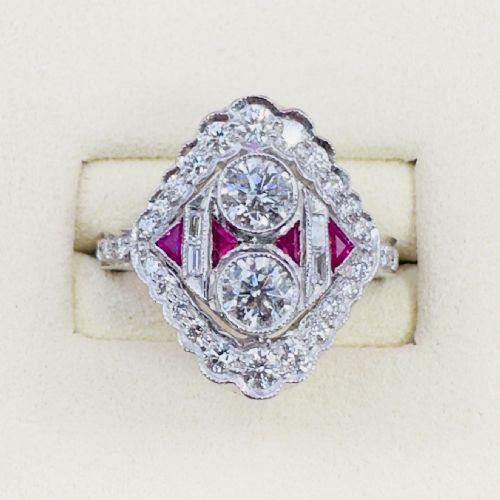
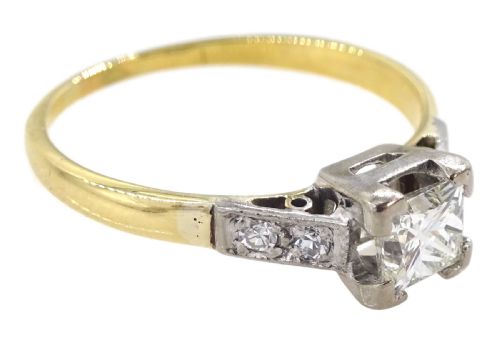
A certified diamond ring is a piece of jewellery accompanied by independent gemological documentation verifying stone grading and authenticity. When searching for a certified diamond ring, buyers encounter pieces spanning the Edwardian era, Art Deco period, mid-century decades, and later twentieth-century designs.
The selections on this page range from classic solitaire engagement rings to cluster settings featuring diamonds alongside sapphires, rubies, emeralds, beryl, and topaz. Forms include navette and oval top silhouettes set in platinum, yellow gold, white gold, and combinations of platinum with yellow gold.
Origins represented in the inventory trace back through the 1870s, 1920s, 1930s, 1940s, 1950s, 1960s, and later periods. Solitaire rings and cluster configurations predominate, offering buyers both single-stone focal points and multi-gem arrangements.
Materials and Construction
Metals utilised across these rings include platinum, 18ct white gold, 18ct yellow gold, and 9ct gold. Platinum provides a strong, durable setting for securing stones in intricate Art Deco and Edwardian designs, while gold offers traditional warmth and structural support.
Gemstones are integrated through various mounting techniques, holding central diamonds alongside accent stones such as sapphires, emeralds, rubies, and topaz. Diamond cuts observed include old mine cut, brilliant cut, and cushion cut.
Diamonds retain starlight trapped inside their crystal lattices for billions of years before resting quietly on a finger.
Evaluating Quality
Quality in these pieces is dictated by the precise grading of the central diamond, including colour, clarity, carat weight, and cut, as verified by independent laboratory certification. The proportion and symmetry of the stone directly influence its brilliance.
The integrity of the metalwork and the precision of the setting further distinguish pieces across the range. Hand-finished platinum or gold mountings that securely hold complex cluster arrangements or delicate solitaire shoulders represent superior craftsmanship.
The Certified Diamond Ring Glossary
- Certification
- An official document issued by an independent gemological laboratory detailing a diamond or gemstone's specific grading characteristics. This report provides objective verification of quality.
- Solitaire
- A ring featuring a single central gemstone, most commonly a diamond. This traditional setting focuses attention entirely on the primary stone.
- Cluster
- A ring design where a central stone is surrounded by a group of smaller gems, often diamonds framing a sapphire, ruby, or emerald. This arrangement maximises visual impact and colour contrast.
- Navette
- A boat-shaped ring setting that tapers to points at both ends. It elongates the appearance of the finger.
- Old Mine Cut
- An early diamond cut characterised by a cushion shape, high crown, small table, and large culet. This cut is typical of nineteenth-century and early twentieth-century jewellery.
Certified Diamond Ring: Frequently Asked Questions
What does diamond certification mean?
Certification is a formal evaluation issued by an independent gemological laboratory detailing the exact characteristics of a stone. It provides an unbiased record of colour, clarity, cut, and carat weight.
Having this documentation removes guesswork for the buyer, confirming the precise quality and authenticity of the gemstone set in the ring.
How do I care for a vintage diamond ring?
Regular gentle cleaning with warm water, mild soap, and a soft brush helps maintain the brilliance of both the diamond and the surrounding metal. Professional inspection of the prongs and settings every few years prevents stone loss.
Store the ring in a lined box separately from other jewellery to avoid potential scratching of softer accent stones or the mounting metal.
How do I identify an Art Deco ring?
Art Deco rings typically display geometric motifs, symmetrical patterns, and strong vertical or horizontal lines. Platinum is frequently used to create crisp, architectural settings that hold diamonds alongside calibre-cut coloured gems.
This style emerged following the First World War and reflects the modernist design principles of the nineteen-twenties and nineteen-thirties.