
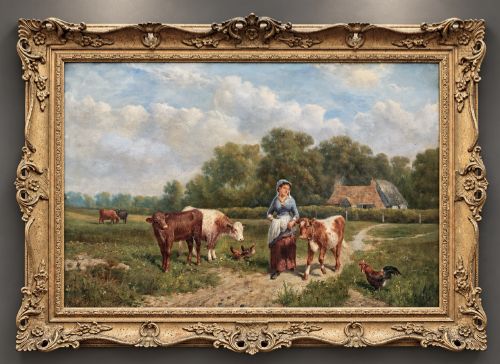
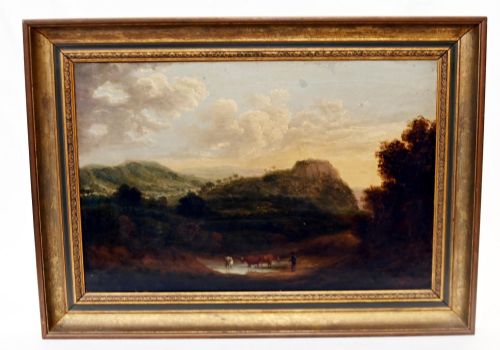

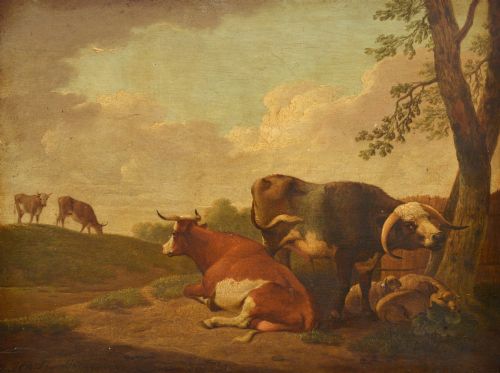
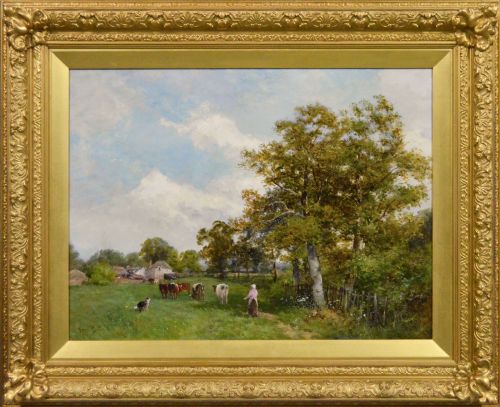
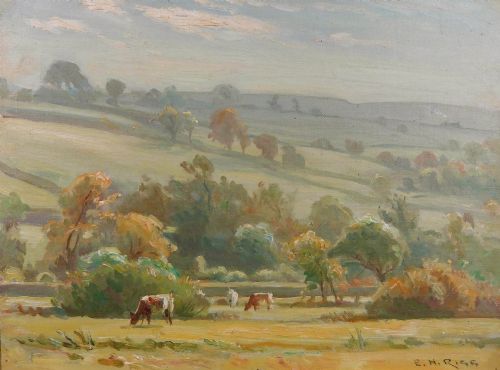


Cattle Countryside Oil Painting
A cattle countryside oil painting captures pastoral life through brushwork, recording herds in rural landscapes from the eighteenth century onwards.
Cattle Countryside Oil Painting
A cattle countryside oil painting depicts rural scenes featuring cows, rivers, and pastures, often populated by figures or herders. These works span several periods, reaching from the eighteenth century through the Victorian and Edwardian eras into the early twentieth century.
The most common examples on this page are nineteenth-century works and early twentieth-century pastoral scenes by British and Dutch artists. Canvases portray settings ranging from Welsh valleys and Yorkshire pastures to Scottish highlands and Kentish marshes.
How they were made
Artists painted primarily with oil paint on canvas, applying pigments to build texture and depth in landscapes and animal forms. Some works utilise panel as a support instead of woven fabric.
Finished canvases were mounted within frames constructed from wood, gesso, and giltwood, frequently incorporating gold leaf finishes to complement the painted imagery.
Listings include works from the eighteenth, nineteenth, and early twentieth centuries, executed in oil on canvas or panel.
What varies in quality
Quality rests in the handling of light, atmospheric perspective, and the anatomical rendering of animals within the landscape. Finer works display confident brushwork that captures movement and weather conditions convincingly.
The sophistication of the framing also marks differences across the range, with period giltwood and gesso frames adding substantial character to superior canvases.
Hendrik Willem Schweickhardt·David Bates·Ernest Higgins Rigg·William Sydney Cooper·Robert Thorne Waite·James de Rijk·Eugene Verboeckhoven·Arthur Charles Dodd·George Turner·Henry Brittan Willis·Frederick William Jackson·Walter J Watson·Owen Bowen·William Greaves·Thomas Thomas·Thomas E Francis·Thomas Creswick·Thomas Baker of Leamington
The Cattle Countryside Oil Painting Glossary
- Oil paint
- A slow-drying paint made by combining pigment particles with a drying oil, commonly linseed. This medium allows artists to blend colours smoothly and build rich textures.
- Canvas
- A heavy woven fabric stretched across a wooden frame to serve as a support for painting. It provides a durable surface favoured by artists for centuries.
- Giltwood
- Wood that has been coated with a thin layer of gold leaf or gilt powder. It is frequently found on traditional picture frames.
- Gesso
- A plaster-like mixture applied to wood or canvas surfaces to prepare them for painting or gilding. It creates a smooth base for decorative mouldings.
- Pastoral
- A genre of art that idealises rural life and shepherd or farming scenes. These works focus on peaceful countryside settings with livestock.
Cattle Countryside Oil Painting: Frequently Asked Questions
What periods do these paintings cover?
The works span from the eighteenth century through the Victorian and Edwardian periods up to the early twentieth century.
Most examples originate from the nineteenth century and the decades immediately following.
Where were these scenes usually painted?
Artists painted landscapes across Britain and Europe, capturing specific regional views in Wales, Yorkshire, Scotland, and Kent.
Dutch landscapes also feature prominently among the available works.
How should I frame these canvases?
Many pieces retain their original wood, gesso, and giltwood frames, which suit the traditional aesthetic of the artwork.
Matching a period frame preserves the historical integrity of the painting.
What subjects appear alongside cattle?
Compositions frequently incorporate figures, farm workers, dogs, and sheep within riverbanks, woodlands, and pasture settings.
These elements help establish scale and narrative within the rural landscape.