

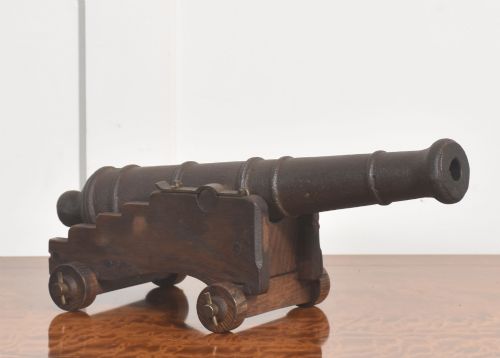
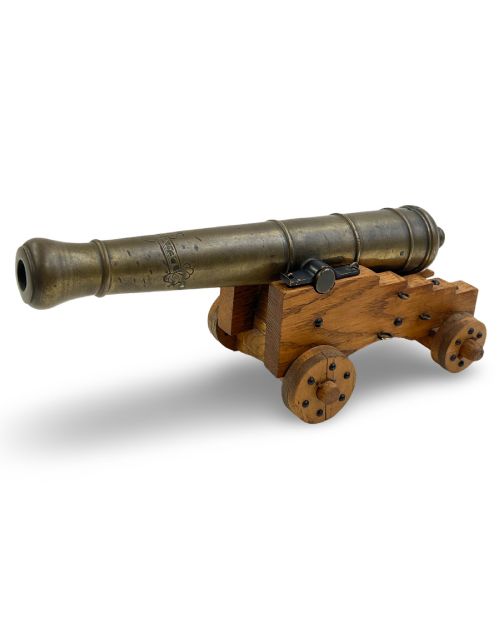


Cast Metal Cannon
These cast metal cannon models are heavy decorative items and signal pieces that bring robust historical presence to a desk or garden.
Cast Metal Cannon
A cast metal cannon bridges the gap between maritime militaria and decorative desk ornaments, serving as both a display object and a functional signal piece. Buyers searching for a cast metal cannon encounter scaled representations of field guns, fort cannons, and naval ordnance designed for both indoor display and outdoor placement.
The pieces appearing on this page span the eighteenth, nineteenth, and early twentieth centuries, including Victorian and Edwardian examples. Forms range from small brass desk models mounted on mahogany carriages to heavy cast iron garden cannons and French bronze signal pieces.
Makers produced these objects as scale models, commemorative pieces, and garden ornaments, often utilising woods like oak or mahogany for the carriages. The most common varieties met here are nineteenth-century signal cannons and decorative bronze or iron field gun models.
Construction and materials
Foundries cast the barrels primarily in brass, bronze, cast iron, and polished steel, achieving rigid metallic forms through traditional casting techniques. These metal barrels are paired with wooden carriages fashioned from oak, mahogany, or general timber.
Makers combined cast metals with fitted metal wheels, straps, and iron or bronze reinforcing bands to replicate full-sized ordnance accurately. Surface finishing involves polishing the bronze or steel components, while iron versions often retain a dark cast finish suited to garden or desk display.
Cast Metal Cannon Retail Price Guide 2026
Typical asking prices for cast metal cannon among the pieces listed under this phrase on Sellingantiques today, from the lower quarter to the upper quarter. They describe what is for sale here now, not the wider market.
The selection includes specific nineteenth-century military styles, French marine designs, and commemorative Crimean War pieces.
Assessing quality
Lower quality pieces often show crude casting marks, simplified wooden mounts, or mismatched components that lack historical proportion. The integration between the metal barrel and its undercarriage distinguishes an ordinary decorative object from a finely rendered model.
The Cast Metal Cannon Glossary
- Signal cannon
- A small cannon designed specifically to produce a loud report for signaling, starting races, or marking occasions rather than for combat. These pieces often feature heavier metal walls to withstand powder charges.
- Gribeauval system
- A standardised artillery system introduced in France by Jean-Baptiste Vaquette de Gribeauval, noted for lighter, more uniform bronze barrels and interchangeable parts. Model replicas often reflect these specific military proportions.
- Undercarriage
- The wooden or metal mounting framework that supports the cannon barrel and wheels. These range from simple mahogany desk blocks to detailed wheeled field carriages made of oak.
- Colubrina da Fortezza
- A historic type of fortress culverin cannon reproduced in smaller decorative or model formats by later metalworkers. Such pieces replicate longer-barrelled historical ordnance.
- Militaria
- Antiques and collectibles relating to military items, weaponry, and armed forces history. Cast metal cannons fall directly into this collecting category alongside medals and uniform items.
Cast Metal Cannon: Frequently Asked Questions
Were these cannons actually fired?
Many examples classed as signal cannons or commemorative pieces were indeed manufactured to discharge blank powder charges for noise. Others are purely decorative scale models designed for visual display on a desk or in a garden.
Examining the bore and vent hole helps determine if a piece was built as a functioning signal cannon or simply cast as a solid decorative model.
How do I date a cast metal cannon?
Dating relies on stylistic clues, inscriptions, and the materials used in both the barrel and the carriage. Nineteenth-century and Victorian examples often feature specific markings, such as commemorations of historical events or distinct foundry styles.
The wood of the undercarriage and the type of metal finishing also provide reliable indicators of whether a piece originates from the eighteenth, nineteenth, or early twentieth century.
What is the difference between a desk cannon and a garden cannon?
Desk cannons are smaller, finer items typically mounted on polished mahogany or brass bases suited for indoor display. Garden cannons are heavier, larger pieces cast in robust iron or bronze designed to withstand outdoor conditions.
The scale and weight dictate their placement, with garden versions built substantially heavier to sit securely on lawns or terraces.
How should I clean a brass or bronze cannon?
Maintenance depends entirely on whether you prefer a bright polished look or an aged historical patina. Gentle dusting and occasional wiping with a soft cloth preserve the surface without removing historical character.
Harsh chemical metal polishes should be avoided on antique bronzes to protect any original surface oxidation and maker inscriptions.