

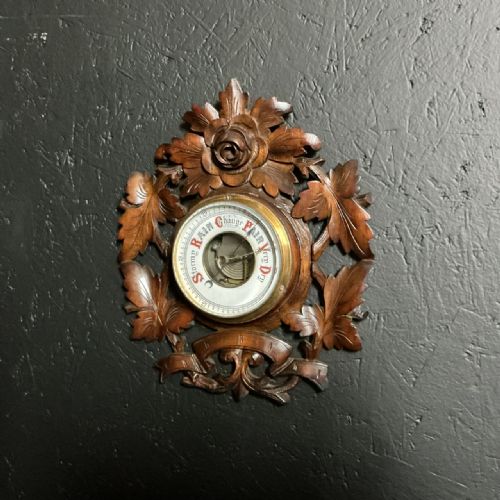
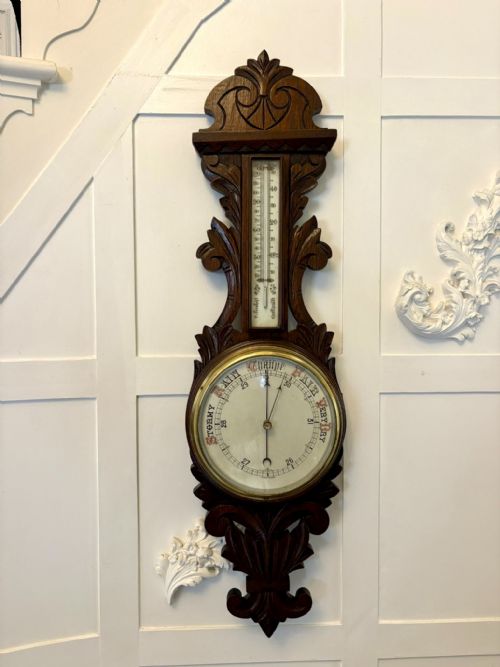


Carved Wood Weather Glass
These carved wood weather glass instruments combine domestic utility with detailed woodworking, offering atmospheric tracking inside a decorative wall hanging.
Carved Wood Weather Glass
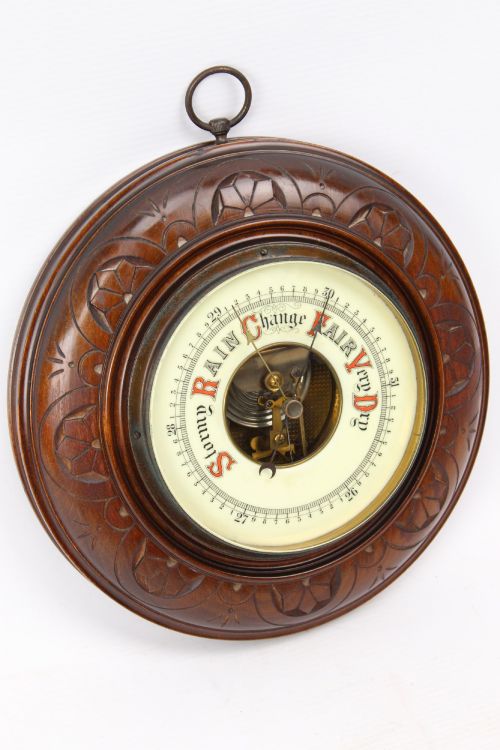
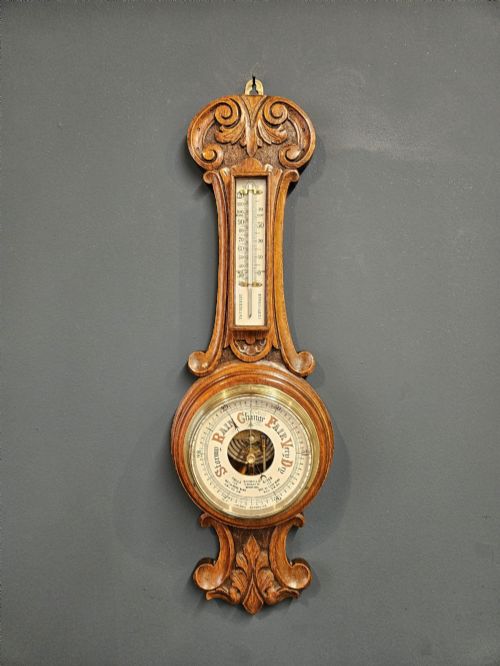
A carved wood weather glass is primarily a wall barometer or stick barometer housed in an intricately shaped wooden frame. The examples found here span the Victorian, Edwardian and nineteenth-century periods, capturing an era when domestic forecasting relied on mechanical and mercurial instruments.
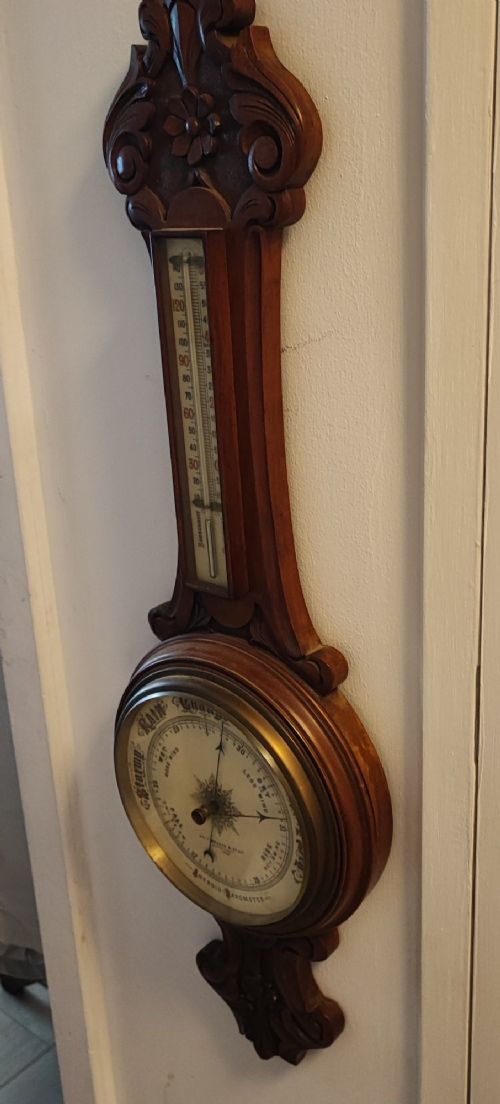
Makers such as Negretti & Zambra, James Pitkin London and W Watson & Sons represent the scientific instrument makers whose dials were set into these wooden housings. These pieces range from simple mercury-filled stick barometers to complex banjo barometers incorporating thermometers and porcelain dials.
Materials and Construction
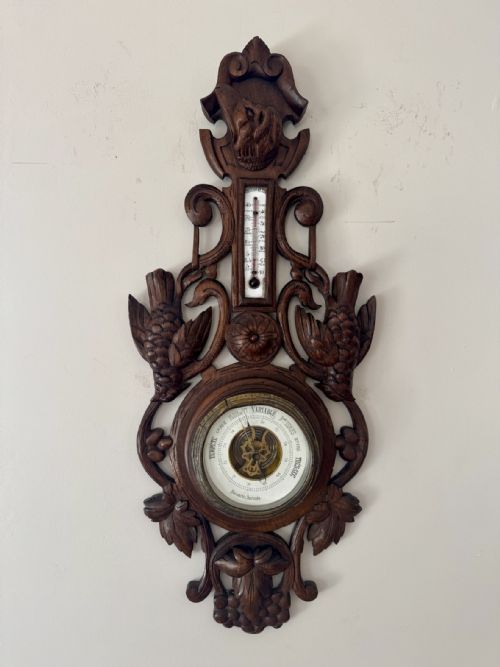
The wooden frames utilise oak, walnut and mahogany, shaped through manual carving and joinery to support the delicate internal mechanics. Black Forest examples display deep relief carving of foliage and animals directly into the timber.
Glass tubes and dials of porcelain, ceramic or brass are fitted directly into the wood alongside mercury or aneroid movements. Metal components such as brass bezels and thermometers complement the wooden housings, while marquetry decorates specific Neo-Classical variants.
Carved Wood Weather Glass Retail Price Guide 2026
Typical asking prices for carved wood weather glass among the pieces listed under this phrase on Sellingantiques today, from the lower quarter to the upper quarter. They describe what is for sale here now, not the wider market.
Listings span the nineteenth century into 1900, incorporating Victorian and Edwardian periods with oak, walnut and mahogany materials.
Assessing Quality and Execution
Quality in a carved wood weather glass rests upon the crispness of the timber carving and the reputation of the instrument maker whose name appears on the dial. Pieces bearing signatures from established London firms demonstrate higher precision in both casework and barometric movement.
The choice of primary wood and secondary veneers dictates visual depth, with burr walnut and figured mahogany elevating the piece above standard oak housings. The integration of auxiliary instruments, such as functioning thermometers or skeletonised movements, further distinguishes the grade of the barometer.
Negretti & Zambra·James Pitkin London·W Watson & Sons
The Carved Wood Weather Glass Glossary
- Aneroid barometer
- A barometer that measures atmospheric pressure through the expansion and contraction of a flexible metal box, omitting liquid mercury.
- Stick barometer
- A tall, vertical barometer utilising a mercury-filled glass tube mounted on a wooden board to indicate pressure changes.
- Banjo barometer
- A domestic barometer shaped like a banjo, typically housing a dial face in the circular head and a thermometer or humidity gauge down the stem.
- Skeletonised movement
- A clock or barometer mechanism with cut-away plates that expose the inner gears and levers to view.
- Marquetry
- The art of applying small pieces of veneer to a structure to form decorative patterns and pictorial designs.
Carved Wood Weather Glass: Frequently Asked Questions
How do I read an antique barometer?
Read the main dial by observing the position of the pointer relative to inscribed weather descriptions like stormy or fair. Tap the glass lightly before reading to settle the mechanism.
Changes in the mercury level or aneroid needle indicate rising or falling atmospheric pressure, pointing toward impending weather shifts.
Where should I hang a wall barometer?
Hang your weather glass on an interior wall away from direct sunlight, radiators and heavy draughts. Stable indoor temperatures ensure the internal mechanism functions accurately.
Ensure the wall anchor securely supports the weight of the dense oak or walnut wooden frame.
How do I tell an aneroid from a mercurial barometer?
Aneroid barometers use a visible circular dial face with a pointer, similar to a clock. They do not contain exposed liquid mercury.
Mercurial barometers, such as stick barometers, feature a long vertical glass tube where the rising and falling column of liquid indicates pressure.
What is Black Forest style woodwork?
Black Forest carving originated in central Europe during the nineteenth century, known for deep, naturalistic depictions of foliage, animals and rustic scenes. This style appears frequently on nineteenth-century barometer frames.
The woodwork often combines three-dimensional animal carvings with functional domestic items like clock faces and barometers.