

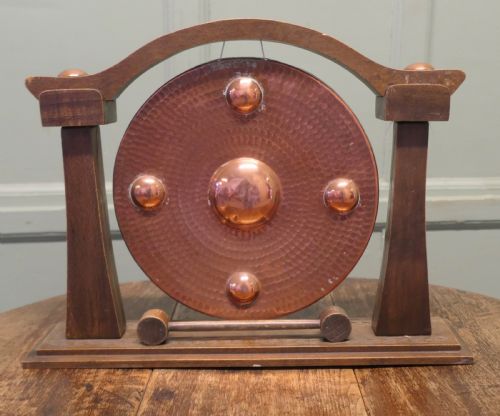


Carved Wood Gong
A carved wood gong brings rich texture and resonant sound into a room, combining substantial timber stands with striking metal bells.
Carved Wood Gong
A carved wood gong consists of a wooden frame or stand holding a suspended metal disc or bell, designed primarily for use in the dining room or hall. These pieces emerge from various stylistic traditions, ranging from European interpretations to Asian export pieces.
The version most commonly met on this page is the nineteenth century Chinese export dining gong, featuring intricate hardwood stands paired with brass or bronze bells. Alongside these, buyers encounter European iterations including Arts and Crafts, Black Forest, and rustic Victorian designs.
Forms vary from compact table gongs intended for smaller spaces to large dinner gongs meant to command attention in a country house hallway. The timber frame often mirrors the decorative vocabulary of its period, utilising dragon motifs, floral carving, or clean geometric lines.
Materials and construction
Construction relies on dense tropical hardwoods and European timbers such as mahogany, rosewood, padouk, oak, and mango wood. These woods are hand-carved to form stable uprights and bases capable of supporting the weight of a suspended metal disc.
Metal components typically comprise cast brass or bronze for the gongs themselves, frequently suspended by sturdy cord. Artisans shape the timber using traditional joinery and chisel work, whilst metal elements are often chased or polished to achieve a resonant tone.
Carved Wood Gong Retail Price Guide 2026
Typical asking prices for carved wood gong among the pieces listed under this phrase on Sellingantiques today, from the lower quarter to the upper quarter. They describe what is for sale here now, not the wider market.
Among the carved figures standing guard over these gongs, a mischievous monkey occasionally holds the line where dragons usually tread.
Assessing quality
Quality rests in the depth and precision of the wood carving, where crisply defined motifs distinguish superior pieces from softer, simpler work. The choice of timber also dictates quality, with dense exotic hardwoods commanding greater respect than basic utility woods.
The proportion between the stand and the suspended bell reveals much about the maker's eye, as does the quality of the metal casting and the clarity of the tone produced when struck. Elaborate detailing, such as inlaid silver or complex figural carving like dragons and monkeys, elevates certain pieces above standard production.
The Carved Wood Gong Glossary
- Dinner Gong
- A large freestanding or table-mounted gong used historically to announce meals in large domestic households. These typically feature a wooden frame supporting a brass or bronze bell.
- Hardwood
- Dense timber derived from broad-leaved trees, including rosewood, padouk, and mahogany. These woods provide the necessary weight and durability for intricate carving on gong stands.
- Chinoiserie
- European artistic style reflecting Chinese motifs and decorative techniques, popular in various periods. This aesthetic often appears on furniture and gong stands produced for Western markets.
- Black Forest
- Regional style of wood carving originating in Germany, known for realistic animal and naturalistic motifs. Gong stands in this manner frequently incorporate carved monkeys or foliage.
- Temple Bell
- A sacred or ritual bronze bell adapted in some instances for domestic display alongside carved wooden mountings. These bells often carry specific patination and casting marks.
Carved Wood Gong: Frequently Asked Questions
How were dinner gongs used?
Dinner gongs were placed in hallways or dining rooms to signal the serving of meals to household residents and guests. A sharp strike on the suspended metal bell produced a resonant tone that carried through large country houses.
Beyond their practical function, they served as decorative furniture pieces that reflected the owner's taste for exotic or artistic home furnishings during the nineteenth and early twentieth centuries.
What woods are used for stands?
Stands are constructed from a variety of dense timbers, with tropical hardwoods like rosewood, padouk, and mahogany frequently utilised for Chinese export pieces. European examples often employ oak, walnut, or mango wood depending on the regional style.
These woods were selected for their structural strength, allowing them to support the weight of heavy metal bells without warping under tension.
How do I date a carved wood gong?
Dating relies on examining the carving style, construction methods, and materials relative to known periods like the Victorian or Edwardian eras. Chinese export pieces often align with nineteenth-century Qing Dynasty production methods.
Hardware, cordage, and the specific type of brass or bronze bell also provide clues to the age and origin of the piece.
Are the bells made of brass or bronze?
The suspended discs or bells are typically cast from brass or bronze, chosen specifically for their acoustic resonance when struck. Different alloy compositions and thicknesses produce distinct tones ranging from bright rings to deep hums.
Many bells feature chased or engraved surface decoration that matches the artistic tradition of the supporting wooden frame.