


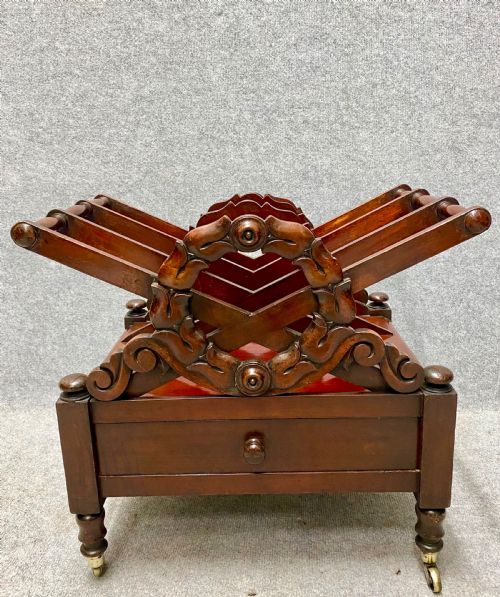


Carved Wood Canterbury
When you select a carved wood canterbury, you choose a compartmentalised stand designed to hold sheet music, newspapers and journals with elegance.
Carved Wood Canterbury
A carved wood canterbury functions primarily as a compartmentalised rack for sheet music, newspapers and periodicals, originating in the late eighteenth century and evolving through the Regency and Victorian eras. These pieces typically feature vertical divisions above a low drawer or plinth, often mounted on castors to facilitate movement across a parlour or drawing room. The form serves as both a practical tidy and a decorative accessory in a traditional interior.
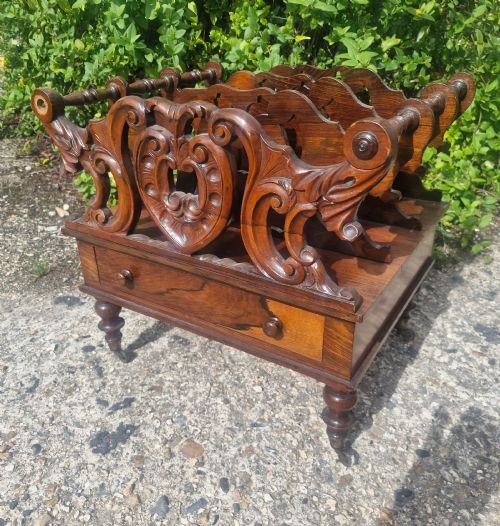
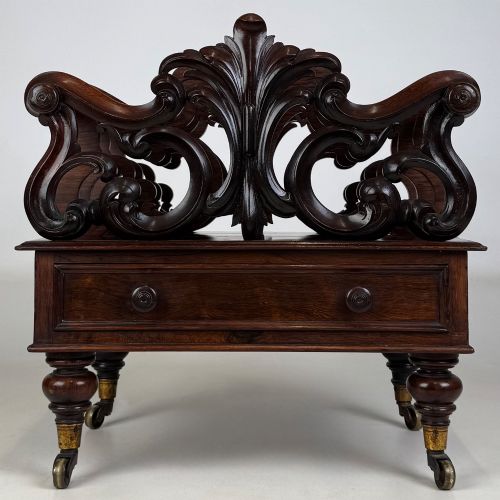
The versions most commonly encountered on this page date from the nineteenth century, spanning Regency, William IV, and Victorian periods. Rosewood and mahogany dominate the selection, frequently enhanced by carved details such as pierced scrolls or foliate motifs. Certain examples combine the standard rack with a work top or function additionally as music stands and cabinets.
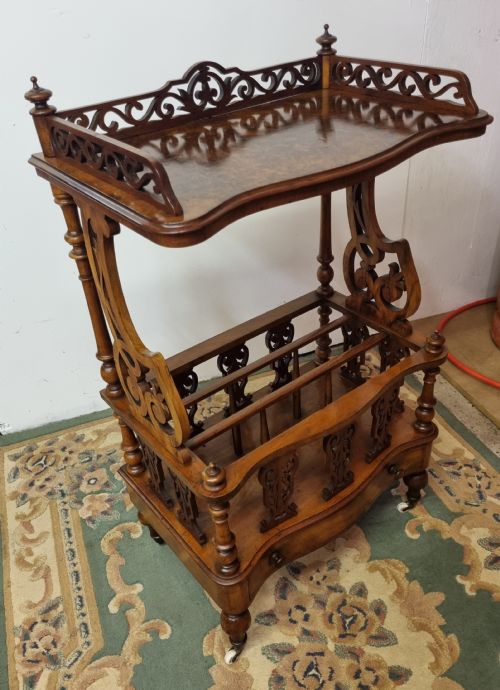
Makers and designers of the period, such as J.C. Loudon, influenced the structural typology of these stands, leading to variations that include serpentine shapes and inlaid fretwork. Later nineteenth-century iterations incorporate burr walnut and satinwood veneers, whilst early twentieth-century examples occasionally utilise oak. Buyers will find that the traditional form adapts readily to contemporary living spaces as a refined storage solution.
Materials and construction
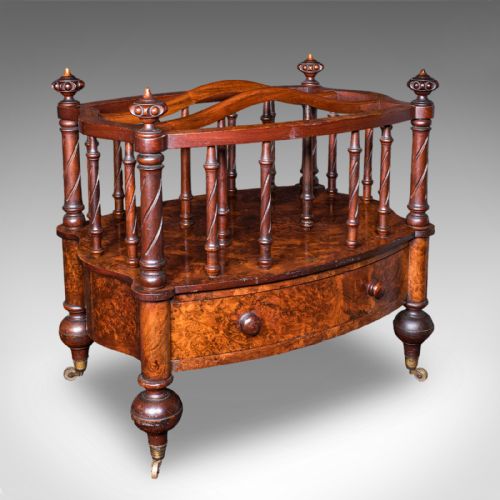
Cabinetmakers constructed these stands predominantly from dense, figured hardwoods including rosewood, mahogany, and walnut, frequently selecting burr veneers for decorative surfaces. These timbers provided the necessary structural stability for the vertical dividers and drawer frames whilst offering a rich natural grain that responded well to polishing. Secondary woods were utilised for internal framing and drawer linings.
Joinery techniques relied on precise mortise and tenon joints to secure the upright partitions to the base platform, ensuring the structure could withstand the weight of stacked paper. Carving was executed by hand, producing intricate details such as Prince of Wales feathers, wreath motifs, and pierced scrollwork along the partitions. Brass castors were routinely fitted to the feet, allowing the stand to be repositioned easily.
Listings feature pieces spanning the Regency, William IV, and Victorian periods, constructed primarily in rosewood, mahogany, and walnut.
Judgments of quality
Quality in these pieces rests upon the crispness of the hand-carved detailing and the selection of timber veneers. Superior examples display deeply defined foliate carving and well-figured rosewood or burr walnut with minimal disruption to the grain. The structural integrity of the vertical divisions and the flush fit of any incorporated drawer further distinguish finer cabinetwork from standard production.
Proportion and the refinement of the turned or carved supports dictate the visual balance of the stand. Pieces exhibiting thoughtful design, such as serpentine shaping or delicate fretwork, demonstrate a higher tier of craftsmanship than plain utility racks. The original inclusion of brass hardware and smooth-running castors contributes significantly to the overall merit of an individual piece.
J C Loudon
The Carved Wood Canterbury Glossary
- Canterbury
- A low stand with vertical divisions used originally for holding music sheets and folios. The name derives from the Archbishop of Canterbury, who is said to have commissioned the first such piece.
- Fretwork
- Ornamental perforated woodwork created by cutting patterns through thin boards. This technique appears on late nineteenth-century panels to lighten the visual weight of the stand.
- Serpentine
- A curved line that bends outward in the centre and inward at the sides. This contour adds fluidity to the base or top surface of cabinet furniture.
- Plinth
- The heavy base slab upon which the vertical framework of the stand rests. It provides stability and grounds the overall composition.
- Castor
- A small swivelling wheel attached to the base of furniture legs. They allowed nineteenth-century stands to be moved across carpets without lifting.
Carved Wood Canterbury: Frequently Asked Questions
What was a canterbury used for originally?
These stands were designed specifically to hold loose sheets of music, musical scores, and daily newspapers within easy reach of a piano or seating area. The vertical partitions kept paper upright and sorted.
Over time, households adopted them for general periodical storage and magazine organisation in drawing rooms and parlours.
How do I date a rosewood canterbury?
Dating relies on stylistic markers, timber choice, and construction methods characteristic of specific periods. Regency examples often display cleaner classical lines, whilst Victorian pieces frequently incorporate heavier carving and burr walnut.
Examination of secondary woods and drawer construction also helps determine whether a piece belongs to the early nineteenth century or later decades.
Can I use a vintage canterbury for modern magazines?
Yes, the partitions accommodate contemporary periodicals, art books, and journals quite comfortably. Their original purpose translates directly to modern living requirements.
Care should be taken not to overload the compartments with excessively heavy volumes to preserve the integrity of the wooden dividers.
Are castors on these stands original?
Many nineteenth-century stands retain their original brass or ceramic castors, which were essential for moving the heavy hardwood furniture across carpeted floors. Replacement castors are common due to wear over generations of use.
Checking the fixings and the wear patterns on the feet helps determine if the castors have been replaced or altered.