


Carved Walnut Caddy
These carved walnut caddy selections bring together timber vessels and related boxes made across the Regency, Victorian, and later periods.
Carved Walnut Caddy
A carved walnut caddy is a wooden vessel designed to store tea, with examples appearing across the Regency, Victorian, and 18th Century periods. These objects take forms such as sarcophagus double tea caddies, standard tea caddies, and related teapoys or decorative boxes.
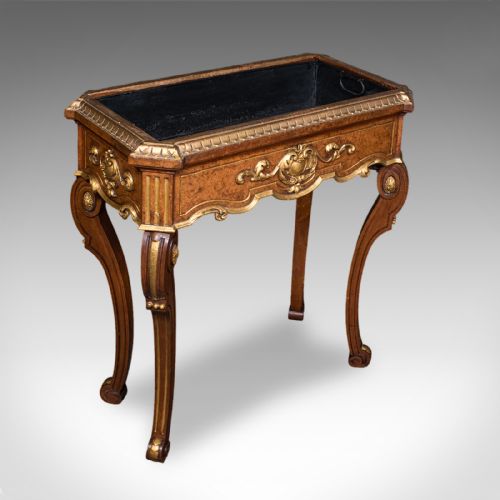
The pieces on this page span several decades, including specific dates like 1860, 1880, and 1930, alongside broader stylistic eras like Georgian and Art Deco. Alongside traditional tea storage, the selection includes related items such as occasional tables, planter stands, and bracket clocks.
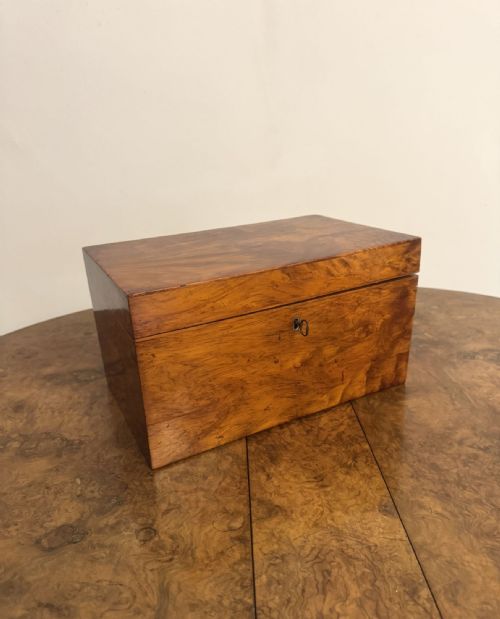
Victorian and Regency examples dominate the visual language here, often utilising rich timber grains to create decorative household objects. Buyers encounter everything from early red walnut formats to later burr walnut veneered boxes.
How they were made
Makers utilised walnut, burr walnut, and red walnut as the primary woods for these boxes, frequently applying marquetry inlay and wood veneers to enhance the surface appearance. The natural figuring of the timber forms the visual foundation of the construction.
Metal elements such as brass and ormolu appear as mounts, hinges, and decorative accents, complementing the dark tones of the walnut body. These metal components provide structural fastening as well as surface contrast.
The listings on this page span the 18th Century, Regency, Victorian, and Art Deco periods, utilising walnut, burr walnut, brass, and ormolu.
What varies in quality
The standard of a carved walnut caddy rests upon the depth and precision of the surface decoration, alongside the choice of timber figure. Plain walnut yields to richly patterned burr walnut and intricate marquetry inlay, altering the visual weight of the piece.
Execution of secondary materials, such as brass or ormolu mounts, distinguishes simpler utilitarian boxes from more elaborate parlour containers. The integration of the timber grain across the lid and sides marks the hand of a more skilled cabinetmaker.
Lenzkirch
The Carved Walnut Caddy Glossary
- Walnut
- A hard, dark timber prized for its rich grain patterns and durability in cabinetmaking. It served as the primary medium for high-status boxes and furniture throughout the eighteenth and nineteenth centuries.
- Burr Walnut
- A specialised wood cut from the growth excrescences of a walnut tree, showing highly swirled and mottled grain patterns. This material was selected for premium veneer work on decorative boxes.
- Teapoy
- A pedestal table or standing box designed specifically for holding tea and its preparation equipment. These pieces often incorporate internal compartments similar to those found in standard caddies.
- Sarcophagus
- A box shape featuring a domed or peaked lid sloping upward from the edges, mimicking ancient stone tombs. This architectural silhouette was particularly popular during the Regency and Victorian eras.
- Ormolu
- Gilded bronze or brass applied as decorative mounts and feet on furniture and boxes. It provided a bright metallic contrast against dark woods like walnut.
Carved Walnut Caddy: Frequently Asked Questions
What is a carved walnut caddy?
A carved walnut caddy is a lidded wooden container originally built to store dry tea leaves securely away from moisture and air.
These vessels range from compact tabletop boxes to larger sarcophagus forms and pedestal teapoys produced during the Georgian, Regency, and Victorian periods.
How were these caddies used originally?
In period households, tea was an expensive commodity kept under lock and key by the head of the house.
Servants or hosts would retrieve the exact amount needed for social gatherings from the internal compartments of the caddy.
What is burr walnut?
Burr walnut is taken from a tree growth knot, yielding intricate, swirling grain patterns that look entirely different from standard straight timber.
Cabinetmakers sliced this wood into thin veneers to wrap the exterior surfaces of luxury boxes and tables.
How do I date a walnut tea caddy?
Dating relies on observing the overall silhouette, such as Regency sarcophagus shapes or Art Deco geometric lines, alongside the specific timber preparations used.
Hardware styles like brass feet and hinges also provide clear indicators of the manufacturing era.
Are these caddies suitable for modern interiors?
These boxes function well as desktop catch-alls, jewellery storage, or decorative display items on occasional tables and shelves.
Their compact scale allows them to integrate easily into contemporary rooms while retaining their historical character.