
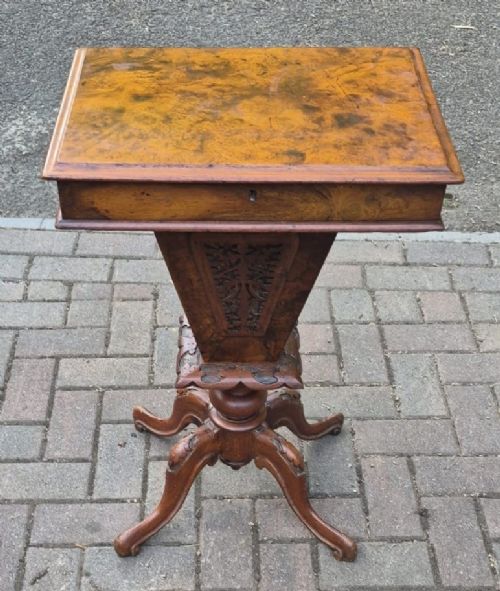


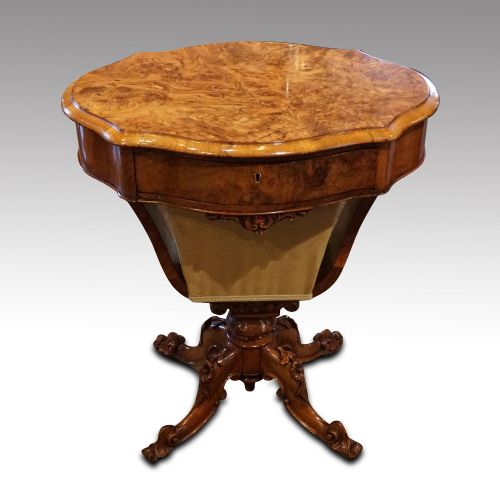


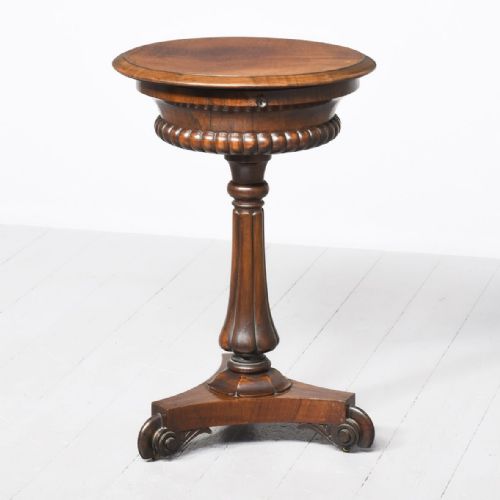

Carved Trumpet Sewing Box
A carved trumpet sewing box brings Victorian needlework furniture into a room with its flared hexagonal body and tripod base.
Carved Trumpet Sewing Box
A carved trumpet sewing box takes the form of a freestanding pedestal table designed for domestic needlework and crafts. These pieces belong predominantly to the Victorian period, appearing across the mid to late nineteenth century with dates spanning from eighteen fifty to eighteen ninety.
The origins seen here include standard Victorian workshop production alongside distinct regional variants such as nineteenth-century Irish yew wood examples. Buyers encounter these primarily in walnut, burr walnut, and rosewood timbers.
How they were made
Cabinet makers constructed the distinctive flared bodies using solid and veneered timbers, selecting rich veneers of burr walnut and rosewood for the primary surfaces. These wood grains were chosen for their decorative patterns and finished with polished surfaces.
Decoration relied on marquetry inlay, boxwood inlay, and carved wooden elements applied to the tripod bases and pillar columns. Interiors incorporated textile linings and fitted compartments of wood to organise sewing implements.
Victorian needleworkers relied on these flared wooden trumpets to keep runaway thimbles from escaping into the upholstery.
What varies in quality
The fineness of the timber veneer sets the baseline for quality, with intricately figured burr walnut and rosewood standing above plainer walnut surfaces. Superior pieces display crisp boxwood inlay and detailed marquetry work across the lid.
Construction standards show in the stability of the tripod base and the precision of the carved details on the pillar. The complexity of the internal fittings and the preservation of the original fabric components also separate standard examples from finer ones.
The Carved Trumpet Sewing Box Glossary
- Burr walnut
- A prized timber harvested from the wart-like growths on walnut trees, yielding highly swirling and decorative grain patterns. Cabinet makers used it as a veneer on high-end Victorian furniture.
- Marquetry
- The art of applying decorative pieces of veneer to a structure to form intricate pictorial or geometric designs. It frequently appears on the lids of nineteenth-century work tables.
- Tripod base
- A three-legged support structure beneath a central pillar, providing stability for the flared body of the sewing box. This configuration is typical of nineteenth-century occasional and work tables.
- Work table
- A multi-functional piece of nineteenth-century furniture designed for sewing, writing, or light domestic tasks, usually incorporating internal storage compartments. These often feature drop-leaf sides or trumpet-shaped bodies.
- Boxwood inlay
- Contrasting pale wood inserted into dark timber surfaces to create linear borders or geometric motifs. It serves as a primary decorative accent on Victorian walnut boxes.
Carved Trumpet Sewing Box: Frequently Asked Questions
What is a trumpet sewing box?
A trumpet sewing box is a nineteenth-century pedestal table with a flared, trumpet-shaped body and a hinged lid enclosing compartments for needlework.
These pieces were kept in sitting rooms for ladies to store threads, pins, and small craft projects close at hand.
How were sewing tables used?
Victorian households utilised these tables for sewing, embroidery, and other needlecrafts while socialising in the drawing room.
The fitted interior kept tools organised, and the hinged lid concealed unfinished projects when guests arrived.
How do I date a Victorian work table?
Dating relies on timber choices, decorative styles, and construction methods recorded across the mid to late nineteenth century. Burr walnut and heavy marquetry often point toward the eighteen fifties and sixties, while later examples show distinct stylistic shifts.
Comparing the turned details on the tripod stem and the complexity of the boxwood inlay helps narrow down the decade of manufacture.
Where should I place one at home?
These compact tables fit well beside armchairs, sofas, or in corners as occasional display surfaces.
The flat top holds a lamp or small objects, while the interior provides discreet storage for modern trinkets or sewing supplies.