






Antique Trumpet Workbox
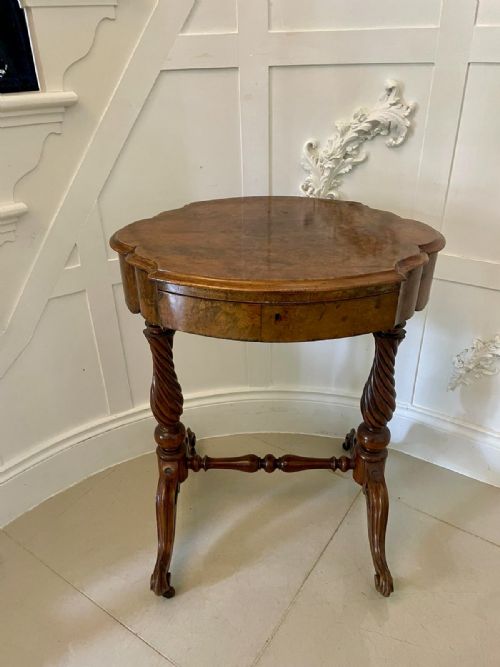
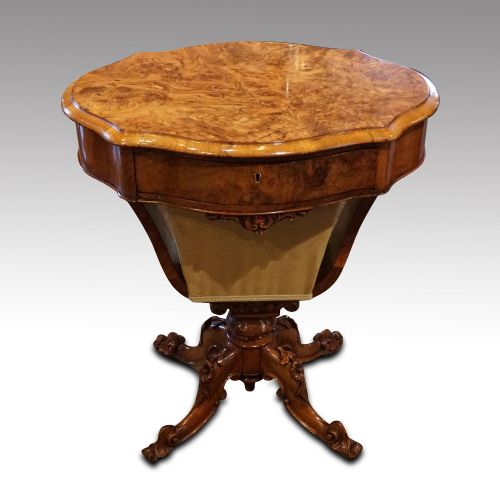
An antique trumpet workbox is a distinct Victorian sewing piece shaped to catch the eye and hold domestic needlework.
Antique Trumpet Workbox
Most examples found on this page date from the mid to late nineteenth century, spanning the eighteen fifties to the eighteen eighties. These tables frequently combine functional storage compartments with occasional table surfaces or integrated games boards.
Makers constructed these pieces primarily in walnut, burr walnut, and mahogany, often incorporating marquetry and wood inlay on the lids. While some function purely as work tables or sewing boxes, others double as lamp tables or tripods.
Materials and construction
Cabinet makers utilised choice timbers such as walnut and burr walnut for the primary visible surfaces, exploiting the rich figuring of the grain. Mahogany also appears regularly in the construction of these sewing tables.
Craftsmen applied intricate marquetry and wood inlay to the lids of the boxes, creating geometric or floral patterns that contrasted with the dark wood background. The flared bodies were constructed from shaped vertical staves joined tightly together to form the signature trumpet profile, supported by tripod bases or pillar columns.
Walnut and burr walnut dominate the listed selection, accompanied by mahogany, brass details, and marquetry inlay.
Quality variations
The sophistication of the timber figure and the precision of the marquetry inlay set superior examples apart from standard production pieces. Finely figured burr walnut commands attention through its depth and grain movement, whereas plain mahogany represents a simpler, more utilitarian standard.
Constructional finesse reveals itself in the joinery of the flared staves and the internal fittings of the sewing box. Elaborate turned tripod bases and intact original fabric interiors indicate a higher grade of manufacture during the Victorian period.
The Antique Trumpet Workbox Glossary
- Trumpet workbox
- A Victorian sewing container featuring a flared, bell-shaped body set on a pillar or tripod base. This specific silhouette defines the form.
- Burr walnut
- A highly prized timber veneer taken from the knotted growths of walnut trees. It yields complex, swirling grain patterns that decorate the best Victorian table lids.
- Marquetry
- The art of applying small pieces of wood veneer to a surface to form decorative patterns. Craftsmen used this technique to adorn the tops of sewing tables.
- Tripod base
- A three-legged support structure commonly found beneath the stem of these tables. It ensures stability for the top-heavy flared body.
Antique Trumpet Workbox: Frequently Asked Questions
What is a trumpet workbox used for?
An antique trumpet workbox served Victorian households as a dedicated repository for threads, needles, and ongoing needlework projects. The flared lower section typically contains a fitted interior with small compartments for sewing tools.
The flat top surface also allowed the piece to function as an occasional table for holding a small lamp or display items beside a chair.
How do I date an antique trumpet workbox?
Dating relies primarily on the prevailing styles, timber choices, and construction methods recorded across the Victorian era. Pieces from the eighteen fifties often show simpler proportions, while those from the eighteen seventies and eighties frequently incorporate elaborate marquetry inlay.
Examining the interior layout and the turning of the tripod base further helps narrow the period of manufacture.
Are these pieces made of solid walnut?
Cabinet makers typically applied choice veneers, such as burr walnut, over secondary structural timbers rather than building the entire piece from solid exotic wood. This technique allowed craftsmen to showcase decorative grain patterns on large surfaces like the lid while maintaining stability.
Mahogany was also utilised in solid form for certain structural components or simpler tables.
How do I care for a Victorian work table?
Maintaining these wooden pieces involves keeping them away from direct sunlight and sources of extreme heat that might dry out the walnut or mahogany. Regular dusting with a soft, dry cloth preserves the polished finish without harming the historic timber.
Care should also be taken when opening internal sewing compartments to avoid straining original hinges and internal fittings.