
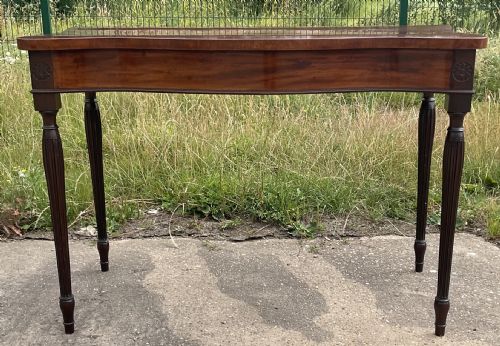

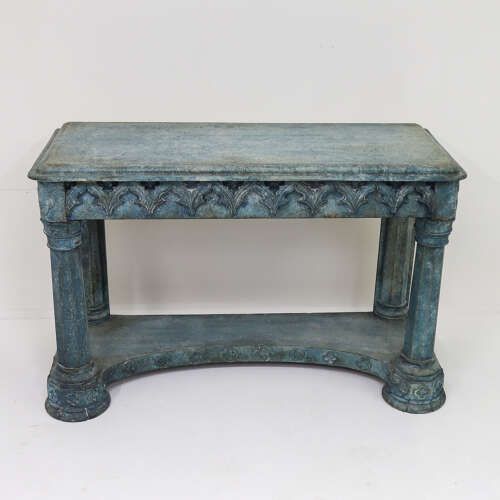


Carved Timber Pier Table
These carved timber pier tables bring formal architectural presence and substantial classical ornament into a grand hallway or reception room.
Carved Timber Pier Table
When you search for a carved timber pier table, you encounter console and pier tables designed to stand flat against a wall, frequently beneath a mirror or between windows. The examples seen here span the eighteenth century, the nineteenth century, and the early twentieth century, taking forms such as serpentine fronts, demi-lune shapes, and breakfront designs.
You are most likely to meet nineteenth-century interpretations and revival pieces on this page, alongside earlier eighteenth-century baroque and console forms. These tables originate from English, Irish, Italian, and Anglo-Indian workshops, reflecting distinct regional tastes in carving and ornamentation.
How they were made
Cabinetmakers utilised dense timbers such as mahogany, rosewood, padouk, and pine as the structural foundation for these heavy tables. Pine and softer woods frequently served as the underlying base for applied gesso and painted decoration.
Carvers shaped elaborate ornamentation directly into the timber or built up relief using gesso before applying paint or gilding. Many tables incorporate heavy marble slabs fitted directly to the timber frame, requiring sturdy construction to bear the heavy stone.
Listings feature mahogany, pine, rosewood, and padouk, alongside applied gesso, paint, and marble.
What varies in quality
The standard of a carved timber pier table rests upon the crispness and depth of the timber carving. Tables featuring hand-chiselled detail executed with precision separate themselves from simpler joinery or softer, less defined moulding.
Materials also dictate the tier of the piece, with dense tropical hardwoods and genuine marble tops marking out more ambitious commissions. The integration of painted surfaces, gesso work, and stylistic cohesion across the frame determines the overall distinction of the table.
Hicks of Dublin
The Carved Timber Pier Table Glossary
- Pier table
- A side table designed specifically to fit against the wall space between two windows. They generally stand beneath a matching pier mirror.
- Console table
- A wall-mounted or heavily bracketed table supported by legs at the front. These pieces are intended for display in hallways and reception rooms.
- Demi-lune
- A half-moon shape used for table tops and frames. This curved outline allows the furniture to sit compactly against a flat wall.
- Gesso
- A plaster-like mixture applied to wood surfaces as a smooth base for paint or gilding. It allows for crisp, moulded relief decoration.
- Serpentine
- A furniture front curving inward centrally and outward at the sides. This flowing contour requires advanced woodworking skill to execute properly.
Carved Timber Pier Table: Frequently Asked Questions
What is a pier table?
A pier table is a formal side table designed to stand flat against the wall, traditionally placed in the architectural pier space between windows. They often supported heavy marble slabs and served as decorative display furniture in grand interiors.
Over time, the terms pier table and console table became largely interchangeable in domestic settings. Both types provide a narrow surface for ornaments while anchoring the wall composition below a mirror or painting.
Where should I place one?
These tables find their natural home in hallways, reception rooms, and grand corridors where floor space is shallow. Because they are designed to be viewed primarily from the front and sides, they fit closely against walls without obstructing pathways.
Pairing a table with a wall-mirror hung directly above recreates the traditional interior arrangement. Their shallow depth also makes them suitable for living spaces requiring a slim surface for lamps or decorative objects.
How do I date these tables?
Dating relies on examining the timber species, construction methods, and stylistic vocabulary used in the carving. Pieces from the eighteenth century display distinct baroque or early revival proportions, whereas nineteenth-century examples often draw on Gothic, classical revival, or Anglo-Indian influences.
Tool marks on the underside and the condition of the underlying pine or mahogany help differentiate original period construction from later revival work. Revival pieces from the Victorian era or the early twentieth century often employ historical styles with distinct mechanical timber preparation.
Are the marble tops original?
Marble tops on antique tables were cut to fit specific frames, though replacements did occur during repairs or updates. Inspecting the underside reveals how the stone rests upon the timber framing and whether the weight distribution matches the age of the base.
Original tops generally show appropriate edge wear and consistent weathering alongside the wooden support structure. The integration between the marble slab and the gesso or timber moulding provides clues to their shared history.