
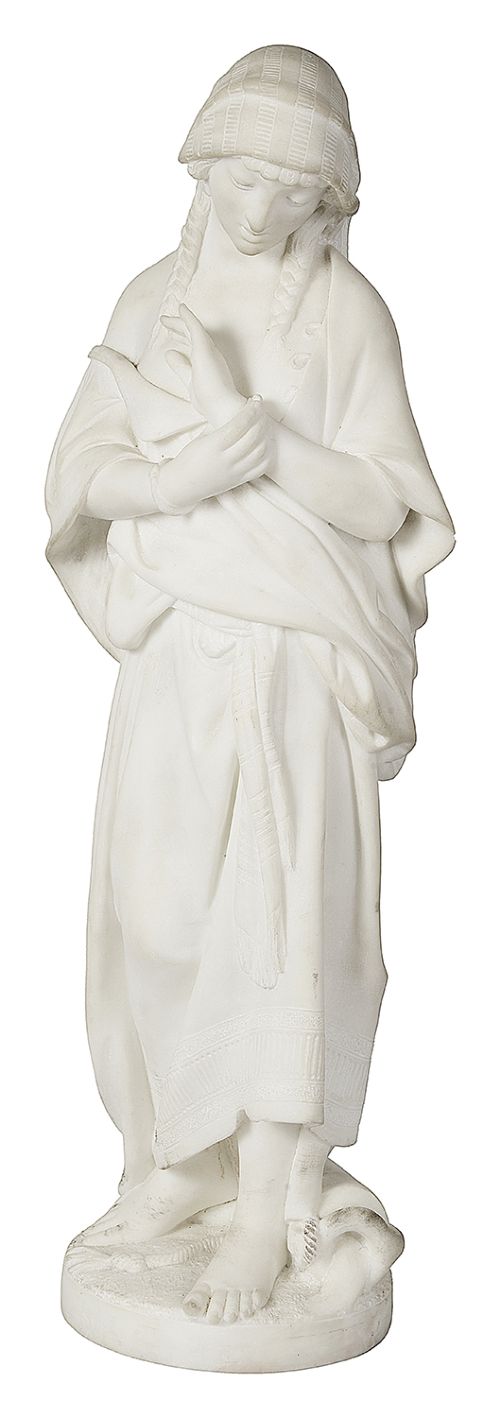
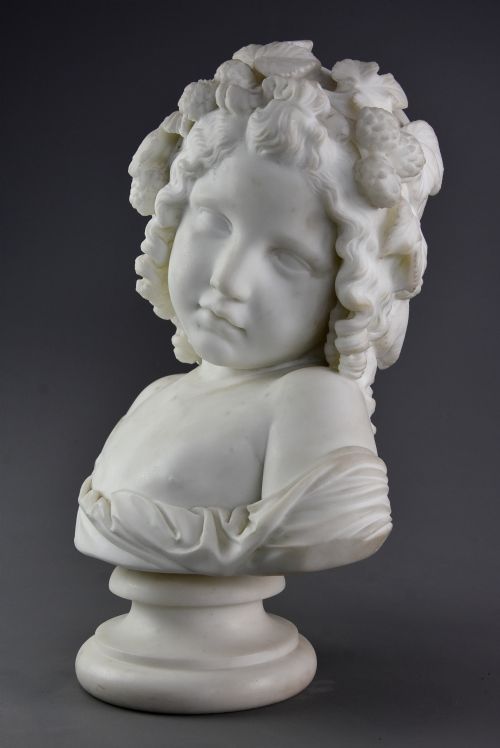


Carved Stone Girl Statue
A carved stone girl statue brings classical elegance and refined nineteenth-century portraiture directly into your interior.
Carved Stone Girl Statue
When you search for a carved stone girl statue, you encounter sculptural depictions of young female figures ranging from the early nineteenth century to the early twentieth century. These pieces primarily manifest as detailed busts and full statues rendered in classical or regional dress, often capturing serene expressions or delicate gestures such as holding flowers and instruments.
You are most likely to meet nineteenth-century Italian and French examples on this page, executed in fine white marbles and softer alabaster. Subjects extend from classical Neoclassical interpretations and Italian school studies to specific character pieces like Dutch girls or musicians with mandolins and harps.
The aesthetic bridges several distinct movements including Victorian, Edwardian, Orientalist, and Art Nouveau tastes. These sculptures serve as striking focal points for mantelpieces, pedestals, or console tables, offering a tangible connection to European academic sculpture traditions.
How they were made
These sculptures rely on the skilled subtraction of material from high-grade stones, predominantly Carrara marble, white marble, dark grey marble, and translucent alabaster. Master carvers utilised specialist chisels, rasps, and abrasive drills to achieve smooth flesh tones and intricate detailing in hair, drapery, and accessories.
Surface treatments occasionally incorporate parcel-gilt and gilt highlights to accentuate decorative borders, floral elements, or garments. Many works bear the signatures of notable European workshops and sculptors, indicating professional studio production and careful hand-finishing.
Listings feature works spanning the nineteenth and early twentieth centuries, including specific periods like 1800, 1880, and 1910.
What varies in quality
Quality rests heavily on the natural purity of the stone and the anatomical precision achieved by the sculptor. Finer marbles display minimal veining in the face and an exceptional smoothness that mimics soft skin, whereas simpler pieces show a more rigid adherence to standard workshop patterns.
The depth of undercut work in the hair and clothing separates standard decorative carvings from exceptional artistic achievements. Master carvers created genuine three-dimensional separation in curls and folds, whereas lesser examples remain flatter and more generalised in execution.
Barranti, Florence·Houdon·Eduardo Giolli·P. Della Vedova
The Carved Stone Girl Statue Glossary
- Carrara marble
- A type of white or blue-grey marble from the city of Carrara in Italy, prized since classical times for its fine, uniform grain. It remains the preferred medium for detailed figurative sculpture.
- Alabaster
- A fine-grained, soft stone often used for ornamental carvings and detailed busts. Its semi-translucent quality allows light to penetrate the surface, creating a warm, luminous effect.
- Bust
- A sculpted representation of a person's head, shoulders, and upper chest. This format concentrates expression and character in the upper portion of the figure.
- Parcel-gilt
- A decorative technique where specific areas of a sculpture are partially gilded with thin gold leaf or paint. This highlights particular details against the natural stone background.
- Neoclassical
- An artistic style inspired by the classical art and culture of ancient Greece and Rome. It emphasises restraint, proportion, and idealized forms in sculpture.
Carved Stone Girl Statue: Frequently Asked Questions
What materials are these statues made from?
These sculptures are carved primarily from Carrara marble, standard white marble, dark grey marble, and alabaster. Some examples incorporate parcel-gilt or gilt accents to emphasise decorative elements.
The choice of stone directly influences the visual weight and translucency of the finished piece, with alabaster offering a softer glow and marble providing crisp definition.
Where were most of these sculptures created?
The pieces originate predominantly from European workshops, with a strong representation of nineteenth-century Italian and French schools. Major cultural centres such as Florence produced many of the signed marble busts.
Craftsmen in these regions drew upon classical Neoclassical traditions as well as contemporary Victorian and Art Nouveau aesthetic movements.
How do I style a marble bust at home?
Marble and alabaster busts suit prominent placement on sturdy surfaces like wooden console tables, marble mantelpieces, or dedicated display pedestals. Their neutral stone tones complement both traditional period interiors and clean modern rooms.
Ensure the supporting furniture can safely bear the substantial weight of solid stone without risk of tipping or structural strain.
What subjects do these statues represent?
The pieces depict young girls and women in various settings, ranging from classical drapery to specific regional costumes such as Dutch attire. Many figures engage with objects like flowers, harps, or mandolins.
These narrative elements transform simple portraits into lively character studies reflecting nineteenth-century artistic tastes.