

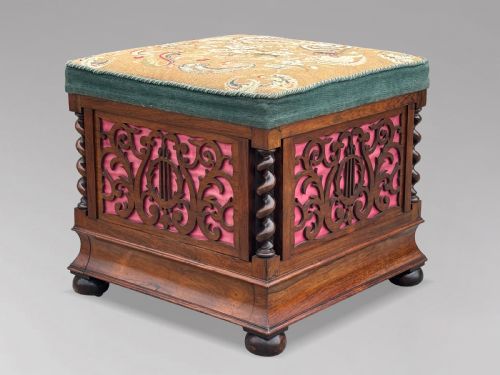


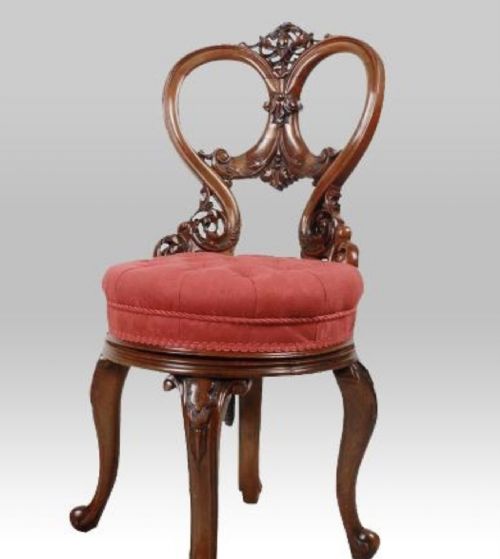
Carved Rosewood Music Stool
A carved rosewood music stool brings solid timber and adjustable height to the instrument bench, offering sturdy support for the player.
Carved Rosewood Music Stool
A carved rosewood music stool provides a dedicated seat for the piano or harp, appearing in various forms across the nineteenth century. These seats serve musicians at the keyboard or strings, blending practical height adjustment with decorative timber framing.
The pieces on this page include piano stools, music chairs, and harpist chairs spanning the Georgian, Regency, William IV, and Victorian periods. Buyers frequently encounter adjustable or revolving mechanisms alongside fixed rising seat designs.
Origins stretch from the early nineteenth century through to the late Victorian era, utilising dense tropical hardwood carved with classical or floral motifs. Every example combines seating utility with the rich grain of rosewood appropriate for a parlour or music room.
How they were made
Cabinet makers constructed these stools primarily from solid rosewood, often pairing the dark timber with brass hardware for the adjustment mechanisms. The frames feature carved ornamentation executed directly into the dense wood, reflecting the prevailing style of the period.
Upholstery forms a vital component, with makers utilising silk, velvet, tapestry, and standard fabric over the padded seats. Metal screws and threading within the central column allow the top to rise and revolve for the seated musician.
Carved Rosewood Music Stool Retail Price Guide 2026
Typical asking prices for carved rosewood music stool among the pieces listed under this phrase on Sellingantiques today, from the lower quarter to the upper quarter. They describe what is for sale here now, not the wider market.
Listings feature rosewood music stools spanning the Georgian, Regency, William IV, and Victorian periods.
What varies in quality
The distinction between standard examples and finer pieces lies in the crispness of the carving and the complexity of the revolving or rising mechanism. Superior specimens exhibit deeply articulated foliage and robust brass turning components that operate smoothly.
Material selection also dictates standing, with solid rosewood frames commanding greater interest than veneered alternatives. The choice of original upholstery fabric, whether fine tapestry or rich velvet, contributes to the overall integrity of the piece.
The Carved Rosewood Music Stool Glossary
- Rosewood
- A dense, dark timber prized for its prominent grain and heavy weight. It takes a high polish and forms the primary structural material for these music seats.
- Revolving piano stool
- A seat featuring a central screw mechanism that allows the top to turn through a full circle. Musicians use this to adjust their position relative to the keyboard.
- Harpist chair
- A specialised seating form designed without arms to accommodate the posture and instrument of a harp player. These often incorporate adjustable heights.
- William IV
- A transitional design period spanning the 1830s characterised by robust classical proportions and bold carved details. Pieces from this era show heavy rosewood turning.
- Tapestry fabric
- A woven textile frequently employed for nineteenth-century seat pads. It displays pictorial or geometric patterns in coloured threads.
Carved Rosewood Music Stool: Frequently Asked Questions
What is a music stool?
A music stool is a dedicated seat designed for musicians playing keyboards or harps in nineteenth-century parlours. They provide stable seating tailored to the height required for playing.
Many examples incorporate mechanical screws to alter the seat height while seated. The timber frames match the domestic furniture of the period.
How do adjustable stools work?
Adjustable music stools use a threaded central column or screw mechanism hidden beneath the padded top. Turning the seat clockwise or anti-clockwise raises or lowers the level.
Brass collars and threaded rods commonly secure the moving parts. This allows players to find a comfortable position before playing.
How do I date a rosewood stool?
Dating relies on the stylistic clues present in the carved woodwork and the form of the legs and base. Regency and William IV pieces display heavier classical turns, while later Victorian versions shift in proportion.
Turned pillars and claw feet help place pieces into specific decades of the nineteenth century. Examining the construction of the turning offers further chronological evidence.
Where were music stools used?
These stools belonged in the principal rooms of nineteenth-century homes where pianos and harps stood. They served as functional seating for daily practice and musical evenings.
Their decorative rosewood frames ensured they complemented other parlour furniture when not in use. The portable nature allowed them to be shifted near instruments easily.