
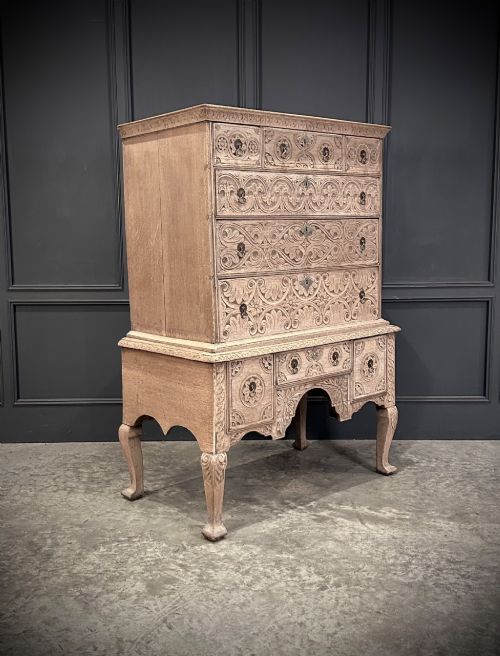
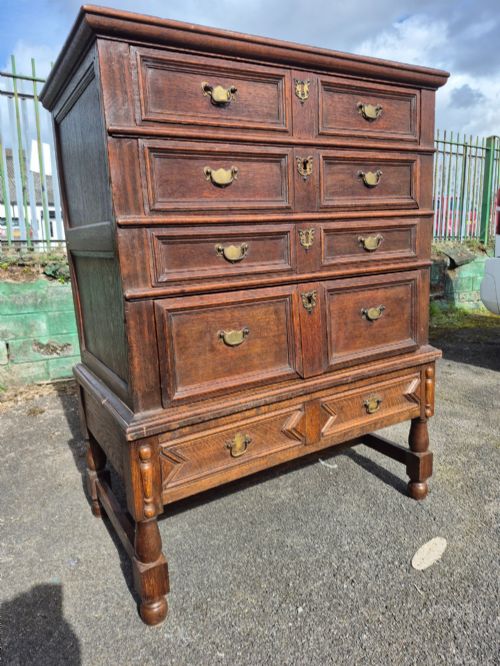
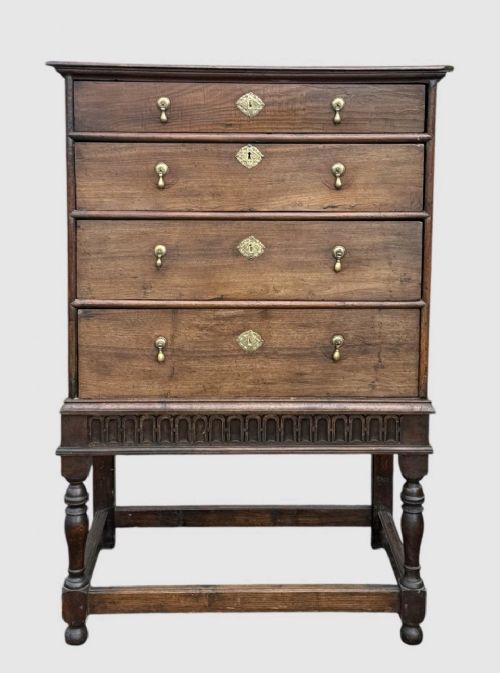


Carved Oak Highboy
A carved oak highboy is a commanding stacked storage piece built to hold linen and papers with gravity.
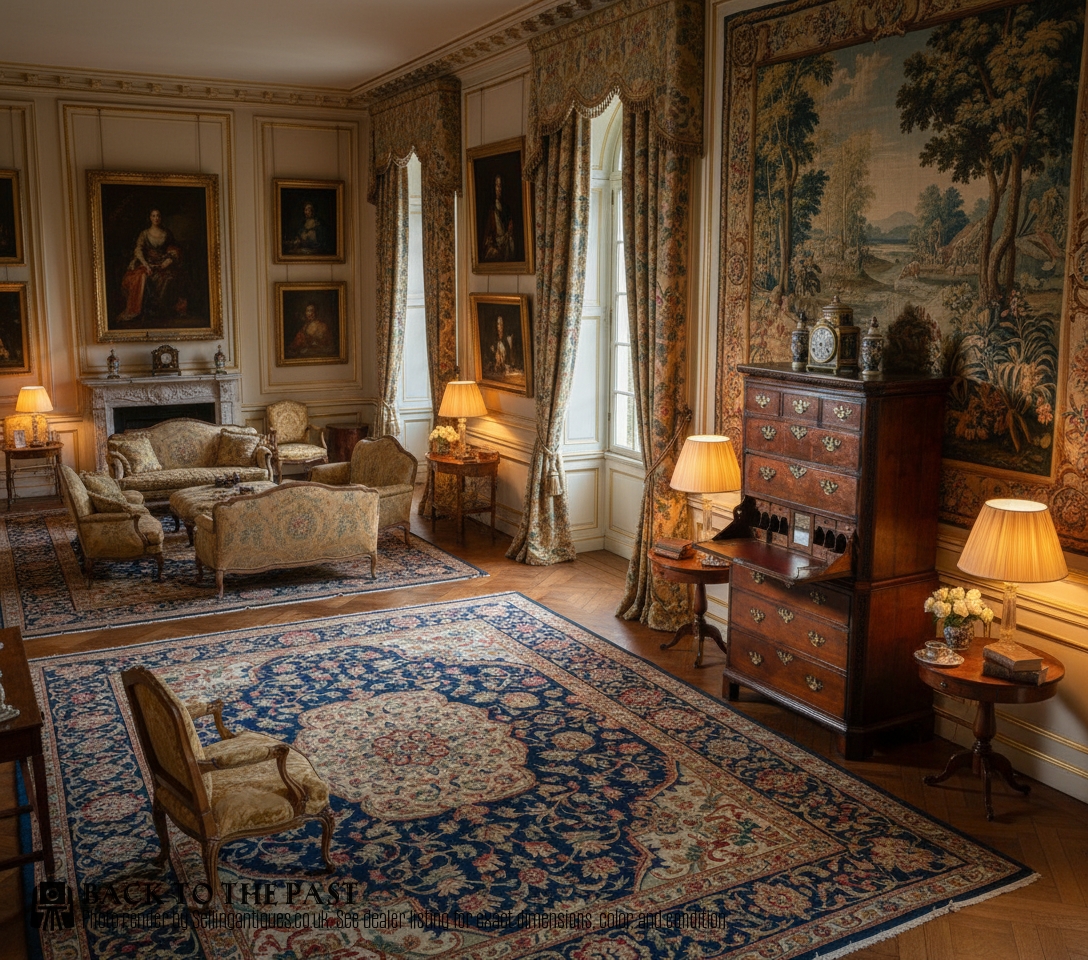
Carved Oak Highboy
A carved oak highboy brings together multiple tiers of drawers in a chest on stand or chest on chest format, standing tall off the floor. You will most frequently meet pieces from the seventeenth and eighteenth centuries, shaped by Georgian, Charles II, and Jacobean hands.
The form splits visually between the upper chest and the lower stand or secondary chest, creating height without overwhelming a room. These tall pieces served as principal storage in domestic chambers long before modern wardrobes arrived.
Makers built these items using robust proportions, combining drawer storage with elevated bases that often feature turned legs or compact stands. Irish Georgian variants also appear, demonstrating regional adaptations of the form.
How they were made
Makers constructed these pieces primarily from solid oak, framing panels and drawer carcases with heavy timber that resists warping. The natural grain of the wood provides the main decorative surface, often enhanced by carved details.
Brass handles and hardware punctuate the timber fronts, some surviving as original elements from the period. Leather finds occasional use in internal components or associated secretary fittings.
Materials recorded across the inventory include solid oak, brass handles, and occasional leather elements.
What varies in quality
The refinement of the carving dictates the visual success of the piece, moving from simple geometric moulding to elaborate period motifs. Crisp execution in the woodwork separates standard utilitarian furniture from finer regional examples.
The survival of original brass handles and untruncated stands alters the historical integrity of a highboy. Proportions that balance the upper chest cleanly over its stand demonstrate greater skill in the original design.
The Carved Oak Highboy Glossary
- Chest on stand
- A cabinet form featuring a smaller drawer section raised on an open frame with legs. This format lightens the visual weight of tall storage.
- Chest on chest
- A tall case furniture type where a larger chest sits directly upon a slightly narrower base chest. It maximises vertical capacity within a room.
- Jacobean
- A seventeenth-century design style marked by sturdy construction, geometric paneling, and formal carved ornamentation. It precedes the lighter Georgian aesthetic.
- Bleached oak
- Timber that has undergone a lightening process, often historical, reducing the dark tone of aged heartwood. This treatment highlights the grain structure.
Carved Oak Highboy: Frequently Asked Questions
Where did people place a highboy?
These tall chests stood primarily in principal bedchambers to hold linens, garments, and personal documents. Their elevated design kept contents away from damp floor levels.
Today, they function well in dining rooms, large hallways, or studies where vertical storage creates a strong focal point without occupying excessive floor space.
How do I distinguish seventeenth and eighteenth-century pieces?
Seventeenth-century examples often display heavier mouldings, bold geometric paneling, and robust stands characteristic of the Jacobean or Charles II eras. They rely heavily on structural joinery and stark profiles.
Eighteenth-century pieces, including Georgian variants, tend towards softer proportions, refined brass hardware, and cleaner lines that reflect changing domestic tastes.
Are these pieces heavy to move?
Solid oak construction and stacked drawer configurations make these items exceptionally heavy and dense. Most forms are built in two separate sections, the upper chest lifting off the lower stand or base.
This two-part construction eases transportation and placement, though careful handling remains essential to protect original timber edges and joined feet.
What is the difference between a highboy and a tallboy?
A highboy traditionally refers to a chest on a separate lowboy stand with legs, while a tallboy typically describes a chest on chest configuration. Both terms denote tall stacked storage.
Historical listings often interchange these names depending on regional terminology, though the underlying architectural form remains focused on vertical drawer space.