

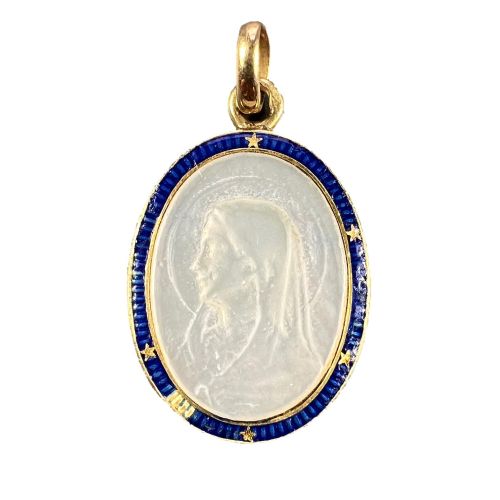
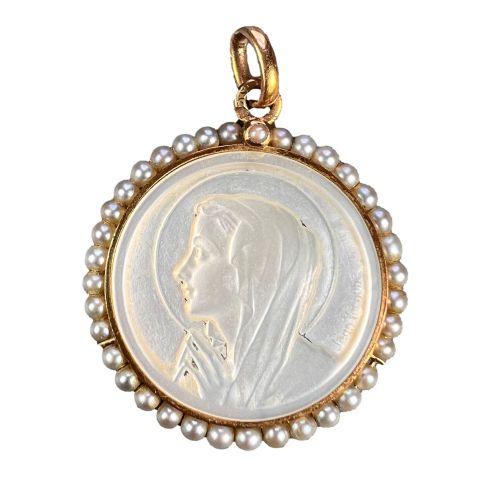


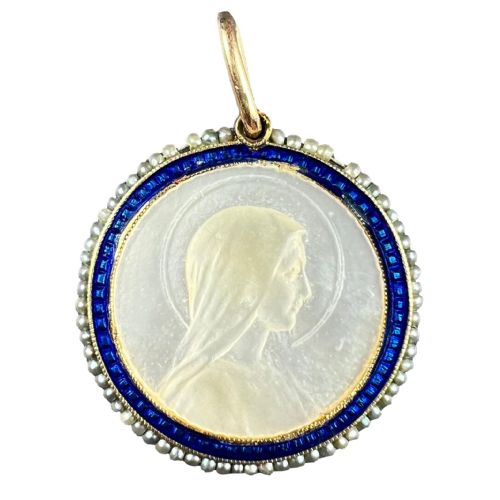
Carved Gold Religious Pendant
These carved gold religious pendant items are devotional jewels uniting precious metal with miniature carved work, prized for their quiet spiritual charm.
Carved Gold Religious Pendant
A carved gold religious pendant brings together sacred imagery and precious metalwork, originating primarily from French and Spanish traditions spanning the nineteenth and early twentieth centuries. When you search for carved gold religious pendant pieces, you encounter devotional charms and medals designed to be worn close to the heart.
The selections on this page feature sacred figures rendered in miniature, most notably the Virgin Mary, the Madonna and Child, and various saints. These small devotional objects reflect the pious artistic output of French religious workshops and Spanish colonial periods, fashioned into wearable charms and medals.
Most examples hail from the late nineteenth century and the decades leading up to the nineteen-thirties. Buyers find both simple yellow gold medals and more ornate pieces embellished with seed pearls or enamel borders.
Materials and construction
Makers shaped these pendants using eighteen-carat yellow, white, and rose gold to house intricately carved mother-of-pearl plaques and cameos. The central carvings depict sacred subjects with fine detail, often framed by delicate seed pearls or colourful enamel work.
Goldsmiths employed traditional techniques to bezel-set the mother-of-pearl or shell elements securely within gold frames. Enamel details were fused onto the metal surface to add borders and inscriptions, whilst seed pearls were individually strung or pegged into place.
Carved Gold Religious Pendant Retail Price Guide 2026
Typical asking prices for carved gold religious pendant among the pieces listed under this phrase on Sellingantiques today, from the lower quarter to the upper quarter. They describe what is for sale here now, not the wider market.
Listings feature mother-of-pearl, eighteen-carat gold, enamel, and seed pearls across Victorian, Art Nouveau, and Art Deco periods.
Quality and craftsmanship
The weight and purity of the gold mountings, alongside the intact preservation of enamel and seed pearls, determine the overall calibre of a pendant. Higher quality items maintain secure bezels and undamaged carved surfaces without chips or hairline fractures.
Becker·Perriat
The Carved Gold Religious Pendant Glossary
- Charm pendant
- A small decorative ornament designed to hang from a bracelet or necklace chain. These pieces often feature a hinged loop or solid bale for suspension.
- Mother-of-pearl
- The iridescent inner layer of mollusc shells, carved into low-relief miniature portraits of religious figures. It provides a luminous ground for sacred iconography.
- Seed pearl
- A tiny, naturally small pearl used in jewellery design to create decorative borders around central plaques. They are traditionally drilled and mounted on thin pins or threads.
- Devotional object
- An item created to aid in prayer, meditation, or personal expression of faith. In jewellery, this manifests as medals and pendants bearing holy imagery.
- Cameo
- A method of carving where a figure is raised in relief against a contrasting background colour. This technique highlights the subject through natural variations in shell or stone.
Carved Gold Religious Pendant: Frequently Asked Questions
What periods do these pendants date from?
The pieces span from the late nineteenth century through the Art Deco era of the nineteen-thirties. Many originate from French religious workshops operating around nineteen-ten.
Collectors also encounter items from eighteen-ninety and the wider nineteenth century, reflecting enduring devotional traditions.
What materials are used in the carvings?
Carvings are predominantly executed in mother-of-pearl, utilising its natural iridescent quality to depict sacred figures. Some selections incorporate carved shell cameos.
Surrounding metalwork consists of eighteen-carat yellow, white, or rose gold, frequently accented with enamel and seed pearls.
How were these devotional items worn?
These pieces function as charms and medals intended for daily personal devotion. They were typically suspended from gold chains to be worn around the neck.
Some smaller forms were also attached to charm bracelets as part of a collection of personal mementos.
Which religious figures appear most often?
The Virgin Mary is the most frequent subject, appearing in various forms such as the Madonna and Child and Ave Maria depictions. Other representations include Saint Therese and Rafael's cherub.
Spanish devotional pieces and French medals occasionally feature specific local Marian titles and regional saints.