
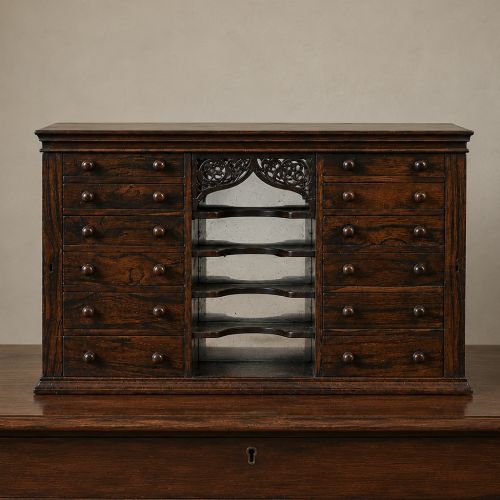


Carved Desktop Organiser
These carved desktop organiser pieces bring order to papers and volumes, offering both utility and character for a study.
Carved Desktop Organiser
A carved desktop organiser covers a variety of desk accessories designed to hold stationery, letters, books, and ink. The pieces seen here span from the Regency period through to the Edwardian era, encompassing styles such as Victorian Gothic Revival, Black Forest, and Art Nouveau.
Stationery boxes, book slides, and inkstands form the core of what turns up on the desk. One is most likely to meet oak and mahogany table-top cabinets alongside rosewood book carriers and elaborately carved animal inkstands.
The materials and construction reflect the tastes of the nineteenth and early twentieth centuries. Workshops utilised dense timbers like walnut and rosewood, often pairing them with brass mounts or mirror glass to create functional furniture for the writing table.
How they were made
Cabinet makers constructed these organisers from hardwoods such as oak, mahogany, walnut, and rosewood. These timbers were selected for their stability and grain, then joined using traditional box and dovetail techniques suitable for heavy desktop use.
Carving defines the more ornate examples, particularly in the Black Forest and Arts and Crafts traditions where artisans rendered foliage and animals directly into the solid wood. Brass fittings, hinges, and glass inserts were incorporated to add structural support and visual contrast.
Several pieces feature carved bears holding logs to serve as inkwells.
What varies in quality
The depth and conviction of the hand carving separate simpler items from superior examples. Crisp detailing in figures and foliage shows the hand of a more proficient workshop rather than routine production.
Choice of timber and internal complexity dictate the standing of a piece. Solid rosewood or figured mahogany with fitted compartments and original brass hardware represent a higher order of desk accessory than plain softwood carcases.
The Carved Desktop Organiser Glossary
- Book slide
- An extendable desk accessory designed to hold a row of volumes upright between two ends. These often feature carved wooden or brass ends.
- Stationery box
- A tabletop cabinet with a sloping or hinged lid to store writing paper and envelopes. They frequently contain internal dividers.
- Inkstand
- A tray or stand holding one or more inkwells alongside pen troughs. They range from simple wooden bases to elaborate carved animal figures.
- Black Forest
- A style of wood carving originating in Switzerland and Germany during the nineteenth century. It is distinguished by realistic depictions of animals and natural foliage.
- Arts and Crafts
- A design movement valuing hand-craftsmanship and simple construction. Pieces in this style emphasise the natural qualities of oak and wrought metal.
Carved Desktop Organiser: Frequently Asked Questions
What is a carved desktop organiser?
A carved desktop organiser is a collective term for nineteenth and early twentieth-century desk accessories designed to hold writing materials, books, and letters. These include stationery boxes, inkstands, and expanding book slides.
Such pieces were standard fixtures in period libraries and studies, combining practical storage with decorative wood carving.
How were stationery boxes used?
Stationery boxes sat upon writing desks to keep loose paper, cards, and envelopes clean and ordered. Their hinged lids and tiered interiors kept correspondence separate from daily working clutter.
Many examples feature built-in compartments for stamps and nibs, reflecting the writing habits of the Victorian and Edwardian periods.
What woods were used for these organisers?
Cabinet makers predominantly utilised durable hardwoods like oak, mahogany, walnut, and rosewood. These timbers resisted the wear of daily desk use and took fine details from hand-carving.
Some regional variants, such as Kashmiri pieces or Black Forest work, utilised local timbers suited to specific relief carving techniques.
How do I date a desktop organiser?
Dating relies on identifying the prevailing style, such as the heavy geometric forms of Victorian Gothic Revival, the organic lines of Art Nouveau, or the plain construction of the Arts and Crafts movement. Materials like rosewood point towards earlier Regency and Victorian dates.
Hardware styles, construction methods, and the presence of specific decorative motifs also provide clear chronological markers.