



Carved Chess Set
A carved chess set brings tactile history to the board, pairing traditional wood or bone with centuries of quiet craftsmanship.
Carved Chess Set
A carved chess set represents a miniature study in period design, spanning the Victorian and Edwardian eras. Buyers search for these pieces to own functional antiques that double as decorative centrepieces for the library or study.
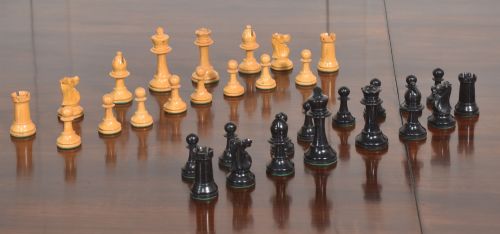
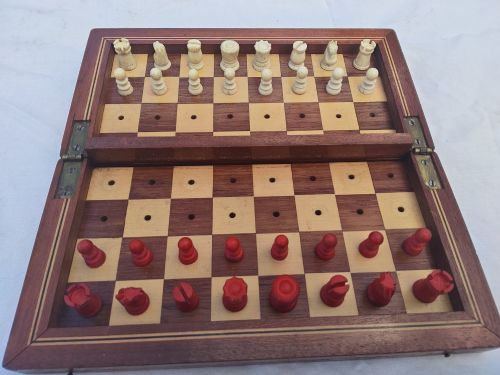
Most examples found here follow the classic Staunton pattern, though earlier and alternative styles such as St George, Whittington, Calvert, and Whitty appear regularly. These sets often arrive complete with folding boards or housed within dedicated games boxes and compendiums.
Originating predominantly from English makers in the nineteenth and early twentieth centuries, these sets reflect the domestic leisure habits of the period. The range includes full-sized library sets alongside portable travelling companions.
How they were made
Turned woods form the backbone of these collections, with natural boxwood paired against dark ebony or ebonised wood to create the contrasting sides. Selected pieces also utilise rosewood and mahogany for boards and storage boxes, while bone provides a paler, intricately carved alternative.
Makers utilised precision lathe work to shape the shafts and finials of the pieces before hand-carving the intricate details such as knight heads and bishop mitres. Bases were frequently weighted with lead to improve balance during play and finished with felt linings to protect the board.
Carved Chess Set Retail Price Guide 2026
Typical asking prices for carved chess set among the pieces listed under this phrase on Sellingantiques today, from the lower quarter to the upper quarter. They describe what is for sale here now, not the wider market.
What varies in quality
Quality in a carved chess set rests primarily on the depth and precision of the hand-carving, particularly visible in the expression of the knights and the openwork of the rooks. Finer sets display crisp, symmetrical detailing that remains sharp across the entire roster of pieces.
The selection of materials dictates the upper tier of the market, where dense, genuine ebony and finely grained boxwood command attention over ebonised alternatives. Original boxes, weighted bases, and well-preserved felt underlays further elevate the standing of a set.
Jaques·British Chess Company·F. H. Ayres
The Carved Chess Set Glossary
- Staunton pattern
- The standard design for tournament chess pieces introduced in the mid-nineteenth century, featuring distinct architectural forms and a crowned rook.
- Ebonised wood
- Fruitwood or boxwood treated with a dark stain to imitate genuine ebony, offering a uniform dark finish for chess pieces.
- Games compendium
- A fitted box containing multiple traditional tabletop games, often including chess, checkers, and backgammon alongside boards and dice.
- Whittington pattern
- An earlier nineteenth-century regional design of chess pieces characterised by distinctive turning and simpler proportions compared to the Staunton standard.
Carved Chess Set: Frequently Asked Questions
How do I identify a Staunton chess set?
The Staunton pattern is defined by standardised, highly recognizable shapes where the king resembles a coronet and the rook a castle tower. This style became the tournament standard during the Victorian era and dominates nineteenth-century sets.
Earlier designs often featured simpler or more abstracted turning, whereas Staunton pieces prioritize immediate visual clarity during play. Look for proportional heights and distinct crowning on the major pieces to confirm the style.
Are bone and wood sets cleaned differently?
Bone chess pieces require careful handling with dry cloths to preserve the surface grain and prevent moisture damage. Natural oils should be used sparingly if the material shows signs of dryness.
Wooden pieces in boxwood and ebony benefit from occasional gentle polishing with appropriate furniture waxes. Avoiding direct sunlight and damp environments protects both mediums from splitting or warping over time.
Why are some pieces weighted?
Weighting improves the tactile experience of play by adding stability and preventing the pieces from tipping easily during movement. Lead weights were typically inserted into the base during manufacture.
Unweighted sets tend to feel lighter in the hand and were often produced for travel or economy. Weighted sets sit more heavily on the board and indicate a higher grade of production.
What is a games compendium?
A games compendium is a multi-purpose box designed to house several traditional pastimes in one organised enclosure. These sets commonly combine chess with draughts, cribbage, and dominoes.
They reflect Victorian and Edwardian domestic entertainment, providing compact storage for families who enjoyed a variety of tabletop games. The folding lids frequently double as game boards.