



Card Game Compendium
A card game compendium brings together the counters, boards and cards needed for historic parlour pastimes inside a fitted box or upon a dedicated table.
Card Game Compendium
A card game compendium encompasses fitted boxes, caskets and tables designed specifically to house the equipment for nineteenth and twentieth-century indoor pastimes. When you search for a card game compendium, you meet pieces ranging from modest wooden cribbage boxes to elaborate walnut games compendiums and grand Regency card tables.
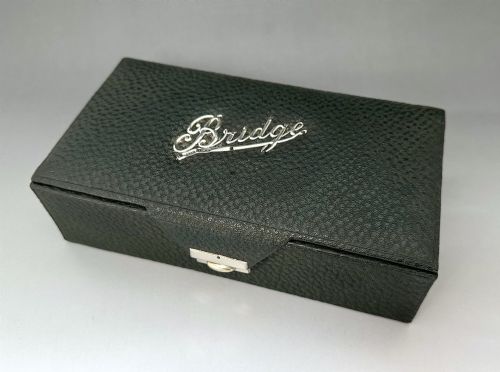
The objects span multiple periods, including eighteenth-century George II designs, Regency gilt-decorated Pope Joan layouts, Victorian walnut and rosewood boxes, Edwardian silver-mounted bridge and patience boxes, and mid-century Italian enamel items. Materials vary widely across the selection, featuring mahogany, oak, rosewood, walnut, kingwood, brass, leather, silver and black lacquer.
Many examples incorporate specific provisions for traditional pastimes such as cribbage, patience, bridge and poker. Whether taking the form of a carved Black Forest set or a brass-bound figured walnut box, these items preserve the social entertainment furniture of past eras.
Evaluating Quality
Quality rests upon the selection of timbers, such as figured walnut or dense mahogany, and the precision of the joinery forming the box carcass or table structure. Finer examples display meticulous carving, such as detailed Black Forest work, or integration of precious metals like sterling silver mounts.
The sophistication of the internal fitting dictates distinction, separating simple storage containers from comprehensive compendiums with dedicated slots for cards, cribbage boards, and counters. Harmony between decorative elements like brass bindings and the underlying wood marks the work of skilled makers.
Card Game Compendium Retail Price Guide 2026
Typical asking prices for card game compendium among the pieces listed under this phrase on Sellingantiques today, from the lower quarter to the upper quarter. They describe what is for sale here now, not the wider market.
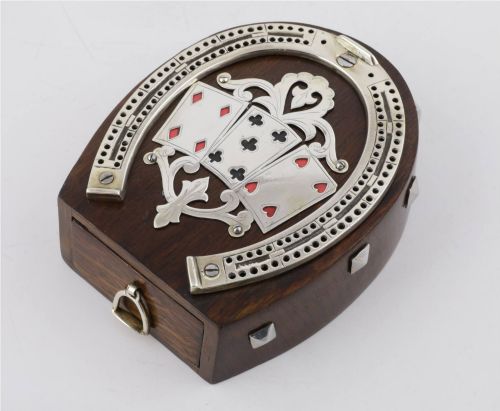
Horseshoe-shaped cribbage boards paired with card boxes ensured that nineteenth-century players brought good fortune straight to the card table.
George Betjemann
The Card Game Compendium Glossary
- Cribbage board
- A board featuring tracks of holes used to score points in the card game cribbage. These boards often form an integral part of nineteenth-century games boxes.
- Pope Joan
- A traditional parlour card game played with a specialised board and counters. Regency examples often feature gilt decoration.
- Bridge box
- A container specifically sized and fitted to hold the playing cards and scoring paraphernalia required for the game of bridge. Edwardian versions frequently incorporate silver mounts.
- Black Forest
- A style of wood carving originating from the European mountain region, known for naturalistic motifs. Game boxes in this style feature detailed carved ornamentation.
- Compendium
- A collection of different games or items housed within a single fitted container. In this context, it refers to boxes equipped for multiple pastimes.
Card Game Compendium: Frequently Asked Questions
What is inside a card game compendium?
A card game compendium typically contains fitted compartments designed to hold playing cards, counters, cribbage boards, and occasionally markers for various parlour pastimes. The internal layout matches the specific requirements of nineteenth and twentieth-century indoor games.
Different boxes cater to distinct pastimes, ranging from dedicated bridge and patience containers to elaborate multi-game sets housed in walnut or rosewood cases.
How do I identify the period of a box?
Dating relies upon observing the combination of timber choices, decorative styles, and mounting metals. For instance, Regency pieces often display gilt decoration for games like Pope Joan, while Edwardian examples frequently feature silver mounts on leather boxes.
Structural details and stylistic cues specific to periods such as the eighteenth century, Victorian era, or 1940s Italian design provide further chronological markers.
Were these boxes used for travel?
Many compendiums and games boxes were constructed with sturdy timbers like oak, walnut and mahogany to withstand domestic use and occasional transport between country houses. Their fitted interiors kept loose pieces secure during movement.
Smaller patience and cribbage boxes offered greater portability, allowing players to carry their card games easily.
What is the difference between a box and a table?
Games boxes are portable containers designed to sit on a tabletop, housing the loose components required for card games and pastimes. Card tables are freestanding items of furniture featuring folding or stationary tops configured for play.
Both forms utilise fine materials such as mahogany, walnut and brass, but serve different roles within a period interior.