

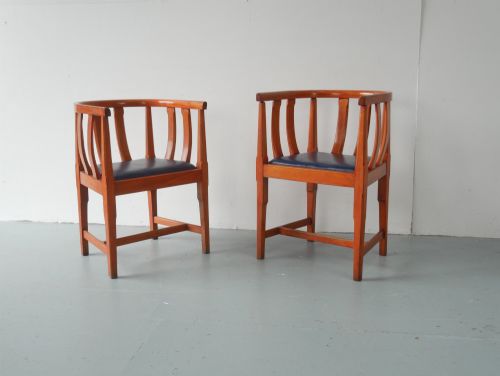
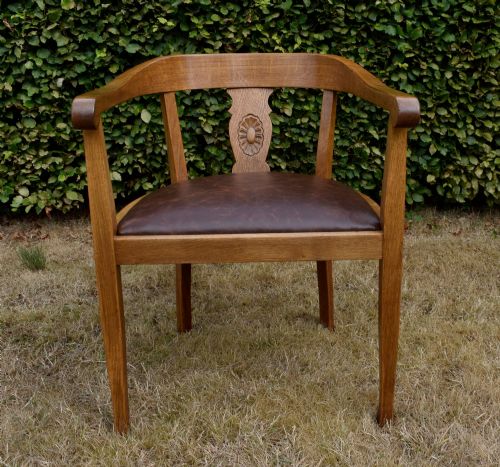


Captain Barrel Chair
These captain barrel chairs and associated tub forms offer deep-seated comfort and architectural presence, built for studies, libraries and drawing rooms.
Captain Barrel Chair
When you search for captain barrel chair, you meet a distinct lineage of circular, enclosing seating designed around a supportive curved backrest. These pieces function primarily as desk chairs, club armchairs and library seats, providing an enveloping posture suited to long hours of reading or writing.
The examples gathered here span the nineteenth century and the early twentieth century, showing a clear preference for robust timber frames and upholstered seating. You encounter styles ranging from plain Edwardian oak desk chairs to elaborate French Empire Revival mahogany and ormolu mounted armchairs.
Forms often overlap with tub chairs, horseshoe desk chairs and Chesterfield club armchairs, all sharing the characteristic curved enclosing back. Solid golden oak, mahogany and bentwood provide the primary structures, frequently paired with hand-dyed leather or velvet upholstery.
How they were made
The construction of these chairs relies on traditional cabinetmaking techniques, utilising dense timbers such as mahogany, oak and bentwood to form the continuous curved backrests. Wood framing is shaped to support the barrel or tub geometry, often reinforced with brass and ormolu mounts.
Upholstery methods combine coil springing and traditional stuffing with surface coverings in leather, velvet and cane. Leather is frequently hand-dyed, while cane work provides lighter side or back panels on specific Edwardian and Arts and Crafts examples.
Captain Barrel Chair Retail Price Guide 2026
Typical asking prices for captain barrel chair among the pieces listed under this phrase on Sellingantiques today, from the lower quarter to the upper quarter. They describe what is for sale here now, not the wider market.
Listings feature pieces spanning the nineteenth century, the Edwardian era and the early twentieth century, utilising mahogany, oak, leather, velvet and cane.
What varies in quality
The distinction between standard examples and superior pieces rests on the choice of timber and the sophistication of the joinery shaping the curved back. Dense mahogany and solid golden oak command higher regard than softer woods, especially when the grain is chosen with care.
Refinement in metalwork, such as crisp ormolu mounts and heavy brass detailing, separates ordinary utilitarian seating from grander revival pieces. The execution of hand-dyed leather and the integrity of the underlying frame construction further define the upper tier.
The Captain Barrel Chair Glossary
- Barrel chair
- A seating form featuring a continuous, semi-circular backrest that wraps around the user to form arms. This design originates from vernacular seating and evolved into formal library and desk chairs.
- Tub chair
- An upholstered armchair with a rounded, enclosing back resembling the shape of a halved wooden tub. These chairs typically sit low and prioritize cushioned support.
- Ormolu
- Gilded bronze ornamentation applied to furniture, popular in French Empire Revival pieces. This decorative metalwork adds metallic contrast to dark mahogany surfaces.
- Bentwood
- Wood softened by steam and bent into curved structural components. This technique allows for continuous rounded chair backs without traditional mortise and tenon joints.
- Horseshoe desk chair
- A desk chair featuring a low, curved backrest shaped like a horseshoe to provide side support while turning at a workspace.
Captain Barrel Chair: Frequently Asked Questions
What is a captain barrel chair?
A captain barrel chair is a sturdy, enveloping seat with a continuous curved backrest designed for desks and libraries.
These pieces provide firm support around the torso, making them practical for prolonged seated work.
How do I style a tub chair at home?
Tub chairs fit well beside fireplaces, in corners or paired with partner desks due to their compact footprint.
Their curved profiles soften straight architectural lines in a room.
Are these chairs comfortable for daily use?
Many examples use sprung seats and deep padding combined with ergonomic curved backs intended for long hours of sitting.
Leather and velvet upholstery surfaces wear differently depending on maintenance and original construction.
How do I distinguish Edwardian from Victorian chairs?
Victorian examples tend to employ heavier dark mahogany or solid oak with dense ornamentation and formal upholstery.
Edwardian pieces often present lighter woods, simpler joinery, cane panels or restrained Arts and Crafts influences.