






Caned Seating Bench
A caned seating bench brings woven texture and light frames to a room, spanning French window seats and English mahogany forms.
Caned Seating Bench
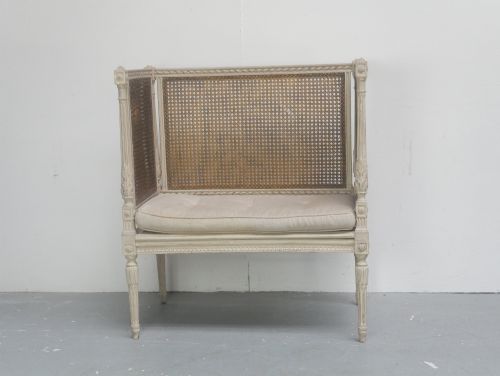
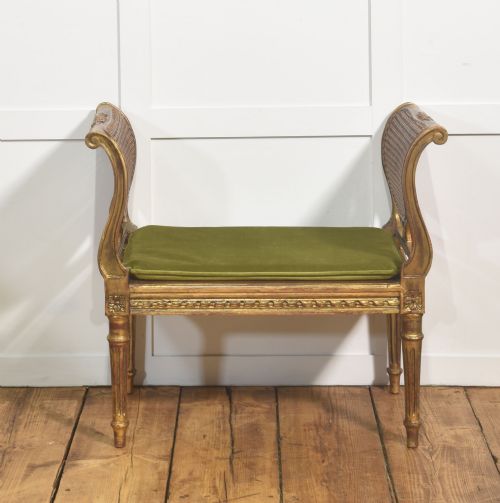
A caned seating bench encompasses various low forms designed for rest, from compact window seats and stools to larger settees and sofas. You are most likely to encounter 19th-century French painted examples alongside Edwardian and Regency variations on this page.
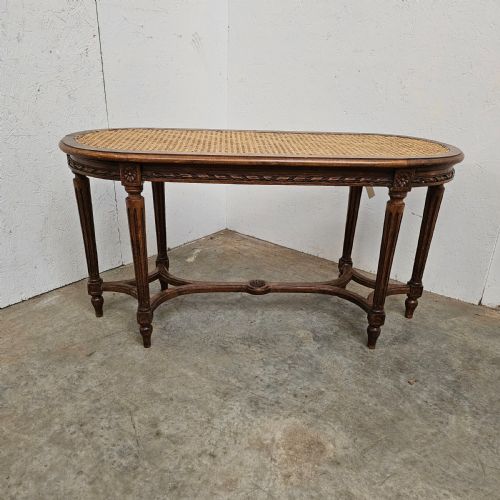
Makers shaped these pieces across the eighteenth, nineteenth, and early twentieth centuries, drawing heavily upon Louis XVI, Regency, and neoclassical styles. The forms include oval window seats, X-frame stools, and long settees suitable for halls and salons.
Origins stretch across European workshops, taking in Swedish Gustavian pieces, Italian twin seats, and Anglo-Indian rosewood designs. Each regional interpretation utilises local timbers and traditional carving patterns to frame the woven cane insert.
Construction and Materials
Frames rely on sturdy timbers including beech, mahogany, walnut, and satinwood, frequently shaped with hand-carved details or finished with paint and giltwood. Workshops selected these hardwoods for strength, allowing slender legs and scroll backs to support sitting weight without heavy bulk.
The characteristic seating panels employ split rattan cane woven through drilled holes in the wooden rail. This technique creates a flexible, breathable mesh surface that contrasts with solid wood and upholstered cushions.
Caned Seating Bench Retail Price Guide 2026
Typical asking prices for caned seating bench among the pieces listed under this phrase on Sellingantiques today, from the lower quarter to the upper quarter. They describe what is for sale here now, not the wider market.
Several listings double as coffee tables, proving that antique benches enjoy remarkably flexible second careers.
Assessing Quality
Quality rests in the precision of the frame's joinery and the crispness of any carved decoration, such as floral motifs or reed moulding. Superior pieces maintain tight joints and balanced proportions without relying on thick layers of later overpaint.
The integrity of the woven cane work dictates the standard of the seat, with uniform tension and neat drilling showing higher workshop skill. Original surface treatments, whether aged gilding or worn painted finishes, carry more integrity than poorly matched modern restorations.
The Caned Seating Bench Glossary
- Canework
- Woven rattan material used to form light, breathable panels for seats and backs. It requires careful hand labour to thread through the frame.
- Window seat
- A long, narrow bench specifically proportioned to sit beneath a low window. These forms often feature scroll arms or open ends.
- Giltwood
- Timber coated with a thin layer of gold leaf over a prepared gesso ground. This finish appears frequently on formal French decorative seating.
- X-frame
- A structural base formed by intersecting diagonal timbers that support the seat. This ancient geometric design provides notable stability.
- Bergere
- An enclosed upholstered or caned armchair or small settee with solid sides. The style originated in France during the eighteenth century.
Caned Seating Bench: Frequently Asked Questions
Where should I put a caned seating bench?
These pieces fit naturally beneath windows, along hallways, or at the foot of a bed where their low profiles maintain open sightlines. Their woven panels keep rooms feeling light compared to solid upholstered furniture.
They also serve as occasional seating in living rooms or studies, offering a compact spot to sit without dominating the floor plan.
How do I care for cane seating?
Keep caned panels slightly hydrated by wiping them with a damp cloth occasionally, as overly dry air can cause the rattan to brittle and snap. Avoid placing the bench near direct heat sources or strong sunlight.
Support the woven surface with custom squab cushions if heavy daily use is expected, reducing direct strain on the natural fibres.
What is the difference between a settee and a window seat?
A settee functions as a small sofa with a defined backrest and often arms, built to seat two or more people comfortably in a living space. It stands independently as a primary room feature.
A window seat is typically narrower and longer, designed explicitly for placement in architectural window recesses, sometimes lacking a high back to preserve the view.
How do I identify a 19th-century French piece?
French nineteenth-century examples often display neoclassical or Louis XVI revival motifs such as fluted legs, carved ribbon twists, and painted or gilded surfaces. Beech is the most common framing timber used in these regional workshops.
Proportions tend to be decorative and refined, incorporating caned backs or seats intended to complement formal salon furniture.