
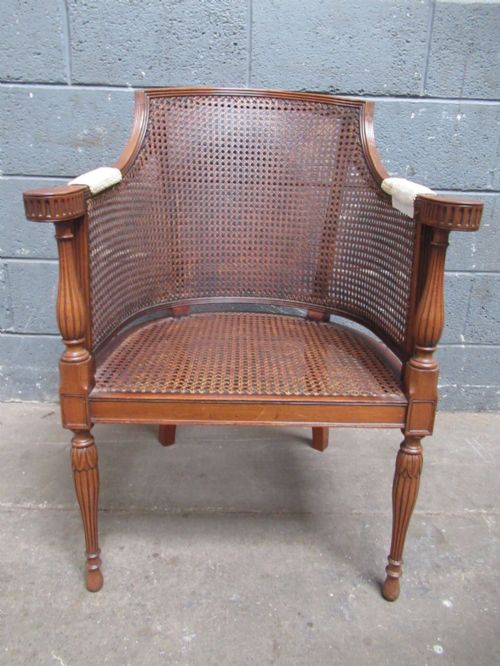
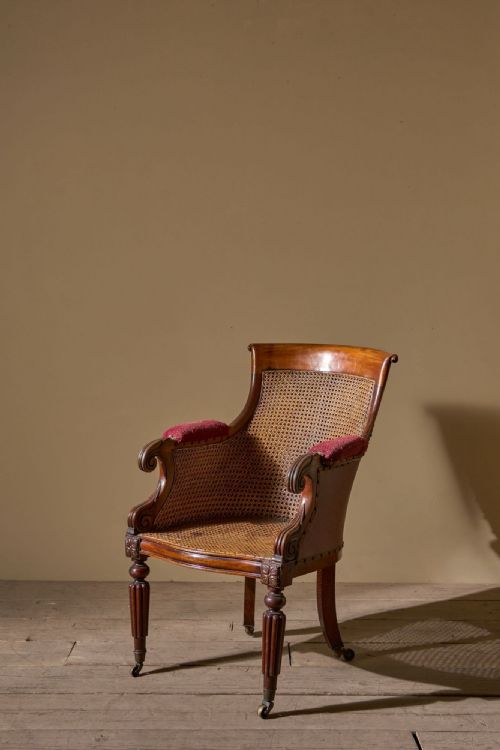
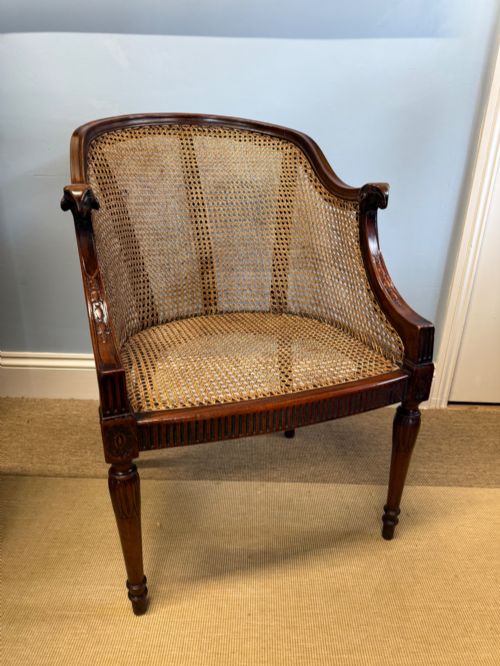
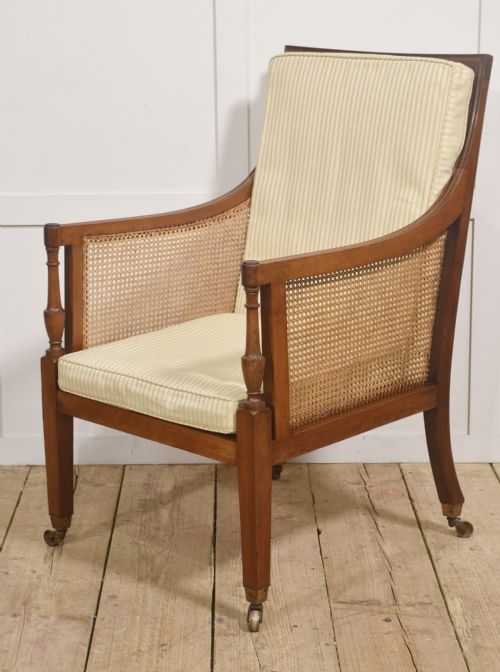


Caned Mahogany Arm Chair
These caned mahogany arm chairs are sturdy seating pieces combining timber frames with woven panels, offering classic comfort and rich grain.
Caned Mahogany Arm Chair
A caned mahogany arm chair brings together a dense tropical timber frame and a woven seating or back panel. The selection spans Regency, Victorian, Edwardian, William IV, and 1930s examples, showing how form evolved from library seating to occasional chairs.
Most entries here take the form of bergère armchairs, alongside tub shapes, library steps combinations, and country house library chairs. The framing relies on mahogany, while the seating surfaces utilise cane, rattan cane, and textile elements.
Makers such as Gillows appear in the record, representing high workshop standards of the Regency period. Buyers encounter everything from simple occasional pieces to metamorphic library steps designed for dual utility.
How they were made
Craftsmen built the structural frames using solid mahogany, sometimes incorporating brass, leather, fabric, or textile details for added comfort and contrast. Inlaid patterns and carved elements appear on Edwardian and 19th Century iterations.
The characteristic caning involves weaving cane or rattan cane tightly through drilled frame holes to form supportive seat and back panels. Some historical examples also integrate original cushions and chinoiserie decoration upon the timber framework.
One remarkably clever armchair hides a full set of library steps inside its mahogany frame.
What varies in quality
The refinement of the mahogany frame sets the baseline for quality, distinguishing plain commercial output from pieces bearing crisp carved details, fine inlays, or documented workshop provenance such as Gillows. Timber selection matters greatly, with deeply figured grain commanding stronger attention.
The execution and survival of the woven cane panels also define the standard. Uniform tension, careful drilling, and the retention of original upholstery or cushions elevate a piece far above one with clumsy modern webbing or replacement cane.
Gillows
The Caned Mahogany Arm Chair Glossary
- Cane
- Strips of material derived from the rattan palm, used to create woven panels for seats and backs. It provides flexible support while keeping the chair light.
- Metamorphic furniture
- Pieces designed to transform into another object, such as a library armchair that unfolds into a set of steps. This ingenuity was particularly popular during the Regency period.
- Tub chair
- An armchair with a continuous curved back and arms forming a rounded enclosure. This form appears frequently in mahogany with cane panels.
- Chinoiserie
- European decorative style reflecting Chinese artistic motifs, occasionally found painted on the wooden frames of early twentieth-century pieces.
Caned Mahogany Arm Chair: Frequently Asked Questions
What is a bergere armchair?
A bergère is an enclosed upholstered or caned armchair featuring solid sides and a low profile. These chairs prioritise comfort through upholstered cushions and woven cane panels.
Cabinet makers utilised mahogany to build sturdy frames that supported intricate caning work across the back and seat sections.
How do I identify a Regency piece?
Regency items date from the early nineteenth century and often display clean architectural lines, classical proportions, and fine mahogany grain. Maker attribution, such as Gillows, sometimes aids identification.
These chairs frequently take the form of library armchairs or metamorphic steps designed for domestic utility.
Where were these chairs used?
Country house libraries, studies, and drawing rooms served as the primary locations for these comfortable seating options. Owners placed them near bookshelves for reading.
Library chairs often included leather padding or original cushions to ensure comfort during long periods of study.
What materials are used?
Mahogany forms the primary structural wood across the selection, paired with woven cane, rattan cane, and textile panels. Brass details and leather upholstery also appear.
Some Edwardian and Victorian variants incorporate carved woodwork or decorative inlays into the mahogany frames.