



Cane Back Reading Chair
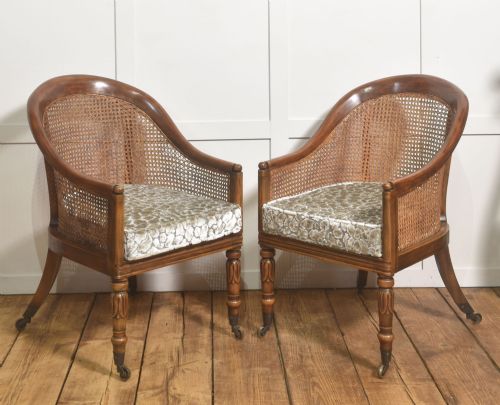
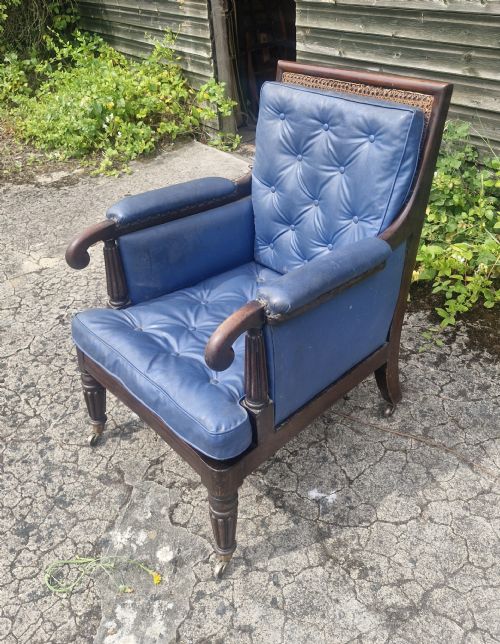
These cane back reading chair examples offer deep comfort and sturdy library frames, combining woven panels with mahogany or oak for daily sitting.
Cane Back Reading Chair
When you search for a cane back reading chair, you find sturdy library armchairs and bergere forms designed for long hours of sitting with a book. The selection here spans the Regency, Victorian, Edwardian, and William IV periods, alongside later twentieth-century pieces.
Mahogany forms the core of the offering, accompanied by oak, hardwood, and faux rosewood frames. Most examples integrate woven cane into the back and sometimes the seat, often paired with leather, fabric, or tapestry cushions.
The styles range from Regency elegance and William IV substance to Victorian country house comfort, Jacobean Revival oak, and Arts and Crafts simplicity. Armchairs dominate the types, built as solitary seats or occasionally as matching pairs.
How they were made
Cabinetmakers constructed these frames using solid mahogany, oak, and hardwood, shaping arms and legs to suit the prevailing taste of the period. Brass fittings and castors often support the heavier library chairs, allowing easy movement across a room.
Cane panels are hand-woven into the wooden frames of the backrests, creating a resilient, breathable support for the sitter. Drop-in or loose cushions upholstered in leather, fabric, or tapestry add padding to the wooden or caned seats.
Cane Back Reading Chair Retail Price Guide 2026
Typical asking prices for cane back reading chair among the pieces listed under this phrase on Sellingantiques today, from the lower quarter to the upper quarter. They describe what is for sale here now, not the wider market.
The listings span the Regency, Victorian, Edwardian, and William IV periods, constructed primarily from mahogany, oak, and hardwood.
What varies in quality
The refinement of the timber turning and the crispness of the frame joinery distinguish the finer library chairs from simpler vernacular pieces. Cabinetmaking execution shows in the fluidity of curved armrests and the neatness of the cane weaving.
Original materials carry more weight than later replacements, particularly where secondary woods, castors, and leather upholstery are concerned. Proportion and presence matter greatly, as the grander Regency and William IV pieces command attention through sheer scale.
Gillows Regency Mahogany·Dryad of Leicester
The Cane Back Reading Chair Glossary
- Bergere
- A French-style upholstered armchair with enclosed sides, where the upholstered or caned back and sides form a single continuous frame. This form became particularly popular in British Regency and nineteenth-century libraries.
- Cane
- Strips of rattan woven in an open mesh pattern to form light, flexible panels for chair backs and seats. It provides both structural support and ventilation.
- Regency
- A British design period spanning the early nineteenth century, characterised by classical restraint, inspired by ancient Greece and Rome. Mahogany and faux rosewood were frequently utilised during this era.
- William IV
- A transitional British design period bridging the Regency and Victorian eras, noted for heavy, substantial proportions and robust mahogany construction. Chairs from this time often feature bold scrolling arms and turned supports.
- Tub chair
- An armchair featuring a rounded, enclosed back that curves continuously to form low armrests, resembling the shape of a deep basin. This form offers a snug, enclosed seat suited to reading.
Cane Back Reading Chair: Frequently Asked Questions
What is a bergere chair?
A bergere is an enclosed armchair featuring caned or upholstered sides and back. It provides a deep, comfortable seat designed for relaxed reading.
These chairs often feature mahogany frames and loose cushions upholstered in leather or fabric. The style was widely adopted in British libraries during the Regency and Victorian periods.
How do I care for cane?
Caned panels require gentle cleaning with a damp cloth to remove dust from the woven mesh. Keeping the material slightly hydrated prevents it from drying out and snapping.
Avoid placing these chairs directly next to intense heat sources or in overly dry rooms. Proper humidity helps preserve the natural flexibility of the rattan.
Are these chairs comfortable?
These reading chairs were built for prolonged sitting in libraries and drawing rooms. The supportive cane back combines with upholstered cushions to offer firm backing.
Many examples include padded armrests and deep seats designed for relaxation. The addition of leather or tapestry cushions further enhances the comfort of the wooden frames.
How do I date a reading chair?
Dating relies on observing the timber choice, turning style, and structural proportions of the frame. Regency pieces often display classical restraint and mahogany, while William IV models are heavier and more robust.
Later nineteenth-century and Edwardian pieces introduce revival styles and alternative timbers like oak. Comparing the joinery and hardware to established period traits clarifies the age.