



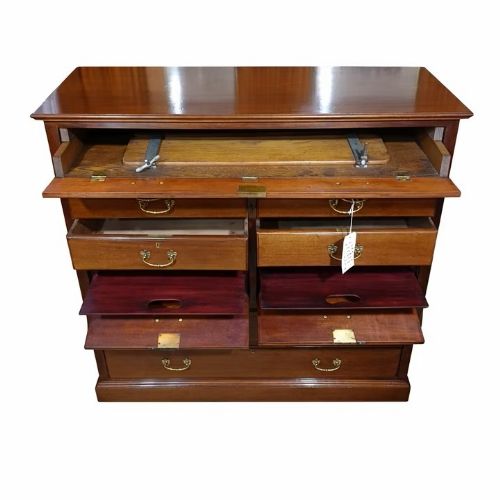


Campaign Dresser Drawers
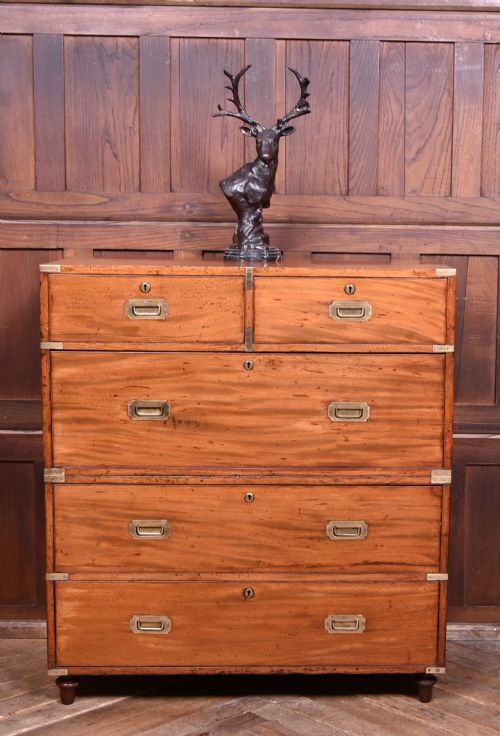
Campaign dresser drawers are portable chests designed for travel, offering officers sturdy storage that dismantles cleanly into two separate sections.
Campaign Dresser Drawers
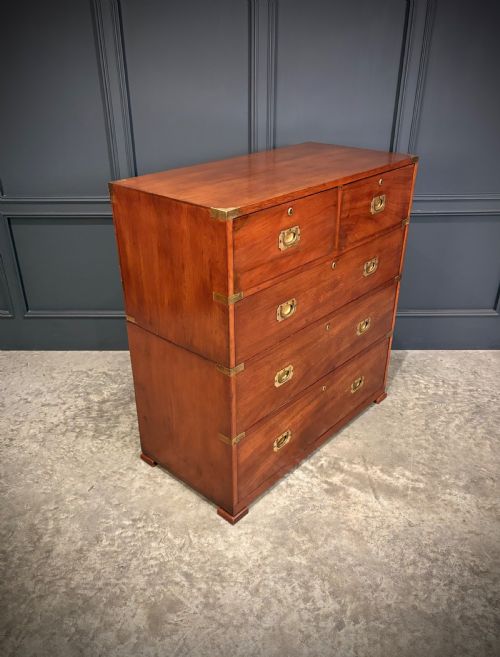
Campaign dresser drawers are portable chests constructed for transport during military deployment and travel. These sturdy items arrive in two separate sections to ease movement on campaigns.
The versions met most frequently on this page span the Regency, Victorian, and Edwardian periods. Common forms include chests of drawers, tallboys, and secretaire variants.
Makers utilised resilient timbers such as mahogany, teak, walnut, and cedar to withstand arduous journeys. Brass mounts and carrying handles protect the edges and facilitate lifting.
How they were made
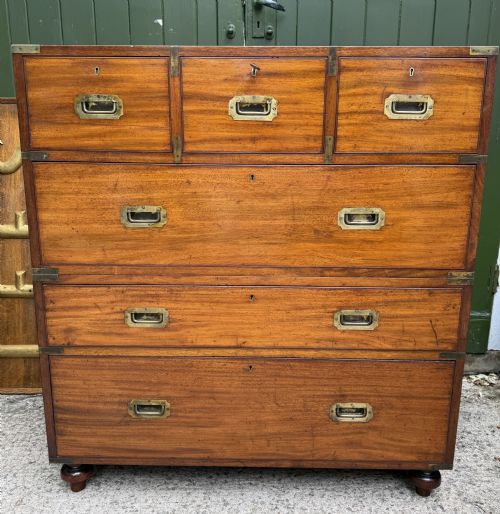
Craftsmen built these pieces from dense hardwoods like mahogany, teak, and walnut, frequently housing them in two modular parts. Recessed brass handles and corner brackets protected the timber from knocks during transit.
Drawers were fitted securely to prevent contents spilling during movement. Secondary timbers such as pine and cedar appear internally, while cast iron hardware occasionally reinforces the structure.
One Victorian gentleman's sporran chest specifically accommodates Scottish accessories alongside everyday socks.
What varies in quality
Quality rests upon the choice of primary timber and the precision of the brass hardware integration. Superior examples display flush-fitting recessed pulls and tightly dovetailed joints that withstand repeated dismantling.
The cleverness of internal writing drawers or secretaire compartments further distinguishes finer commissions. Maker attribution, such as work by Ross and Co., elevates the standing of a piece.
Ross & Co.
The Campaign Dresser Drawers Glossary
- Two-part design
- Construction method where a chest splits horizontally into upper and lower sections for easier transport. This modular format defines standard military campaign furniture.
- Secretaire
- A chest featuring a dedicated pull-out writing drawer fitted with internal pigeonholes and small drawers. It combines desk functionality with standard clothes storage.
- Brass-bound
- Furniture edged and reinforced with brass straps and corner pieces. This metalwork absorbs heavy impacts encountered during travel.
- Padauk
- A dense, richly coloured exotic hardwood utilised in Anglo-Indian colonial pieces. It offers exceptional durability and resistance to warping in humid climates.
Campaign Dresser Drawers: Frequently Asked Questions
Why do campaign chests split in two?
They separate into two modular sections to allow officers to transport their belongings easily on horseback or wagon during military campaigns.
This clever division also made loading onto ships and navigating tight quarters much simpler for travelling personnel.
How do I identify a true campaign chest?
Look for recessed brass handles, corner brackets, and a two-part modular construction designed for easy dismantling.
These functional attributes protected the timber and facilitated movement during military deployments.
What timbers were used for campaign furniture?
Makers selected durable hardwoods such as mahogany, teak, walnut, padauk, and cedar to endure harsh travel conditions.
Secondary woods like pine were occasionally utilised for internal drawer linings and hidden framework.
Are campaign chests suitable for modern bedrooms?
Their compact proportions and flat tops make them practical storage surfaces for contemporary living spaces.
The sturdy construction and generous drawer depth offer robust utility alongside distinctive period character.