

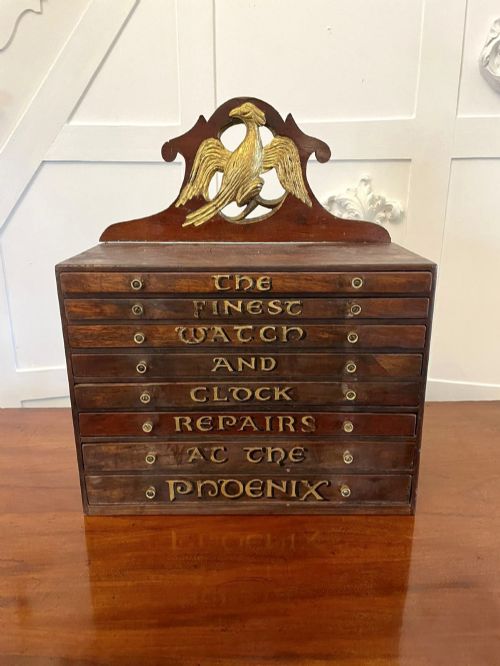


Cabinet Clock
When you search for cabinet clock, you are hunting for precision timepieces housed within fine timber or brass enclosures that anchor a room.
Cabinet Clock
A cabinet clock brings together horology and fine cabinet-making, uniting precision timekeeping with architectural or decorative housing. When you search for cabinet clock, you will encounter diverse forms ranging from French brass four glass mantel clocks to English library clocks and Swiss Atmos models in bell-jar cases.
The materials span mahogany, rosewood, oak, ebonised wood and brass, often complemented by glass panels, enamel dials and velvet linings. These timepieces served both practical and decorative functions in Victorian, Edwardian and mid-century interiors, functioning as centrepieces on desks, mantels and tables.
How they were made
Clockmakers and cabinet-makers constructed these pieces using seasoned timbers such as mahogany, oak and rosewood, frequently applying ebonising or intricate inlays. Brass frames and gilt mountings were meticulously cast and finished to house delicate movements and enamel dials safely.
Protection and display relied on heavy glass panels, four glass configurations and blown glass domes or cloches. Precision mechanics, such as Swiss Atmos movements or French gorge cases, required expert calibration to ensure accurate timekeeping within their decorative enclosures.
Cabinet Clock Retail Price Guide 2026
Typical asking prices for cabinet clock among the pieces listed under this phrase on Sellingantiques today, from the lower quarter to the upper quarter. They describe what is for sale here now, not the wider market.
Some nineteenth-century horologists clearly enjoyed a puzzle, hiding intricate gear trains inside unassuming wooden chests and writing desks.
What varies in quality
The calibre of the movement largely determines the standing of a cabinet clock, separating standard timepieces from exceptional examples by renowned makers like Samuel Marti or Jaeger Le Coultre. Finer clocks display superior finishing on internal gears, escapements and complex striking or barometer mechanisms.
The integrity and craftsmanship of the outer housing equally influence worth, distinguishing robust timber joinery and fire-gilt brass mounts from simpler constructions. Original components, undamaged enamel dials and well-preserved glass panels or domes elevate an individual piece.
Samuel Marti·Jaeger Le Coultre·J.C Vickery
The Cabinet Clock Glossary
- Gorge case
- A distinct style of brass clock case featuring stepped mouldings and a flat top handle, commonly found on French carriage and mantel clocks from the nineteenth century. This heavy brass framework securely houses bevelled glass panels.
- Atmos clock
- A mechanical clock driven by thermal expansion and contraction of gas within a hermetically sealed capsule, requiring no manual winding. Developed in Switzerland, models often sit beneath protective glass bell jars.
- Four glass clock
- A mantel clock encased in glass on all four sides, permitting a clear view of the complex gear train and pendulum from multiple angles. These brass-framed pieces gained popularity during the Victorian period.
- Enamel dial
- A clock face formed by fusing powdered glass to a metal substrate at high temperatures, creating a smooth, durable white surface. Numerals are typically hand-painted in black with fine minute markers.
- Library clock
- A compact, portable timepiece designed for desk or shelf use in private studies, frequently housed in rosewood or mahogany. They often feature five glass panels to showcase the movement.
Cabinet Clock: Frequently Asked Questions
How do I wind a cabinet clock?
Winding mechanisms vary depending on the specific movement, with many traditional spring-driven clocks requiring a dedicated key inserted into the dial.
Care must be taken not to over-wind the mainspring, ensuring the longevity of the internal gears and escapement.
Where should I place a cabinet clock?
These clocks are best positioned on stable, level surfaces such as mantelpieces, heavy sideboards or dedicated display tables away from direct sunlight and drafts.
Placing them securely prevents vibrations that might interfere with the pendulum or delicate balance wheel.
How do I identify a Victorian cabinet clock?
Victorian examples frequently exhibit rich timber selections like walnut and mahogany, alongside heavy brass gorge cases or intricate enamel work.
Examining the construction methods, dial typography and style of the brass framing usually reveals the nineteenth-century origins.
Why do some clocks feature glass domes?
Glass domes and cloches protected delicate mechanisms and sensitive dials from dust, moisture and accidental knocks in busy household environments.
They also provided an unobstructed visual display of intricate clockwork and decorative stands.