


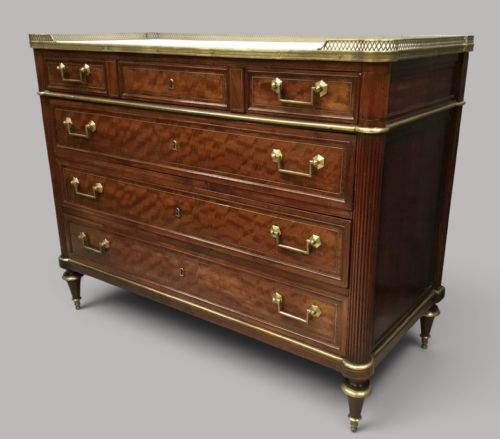


C18th Dresser
These c18th dresser pieces are substantial case furniture designed to anchor a room while offering deep storage in walnut, mahogany, and oak.
C18th Dresser
When you search for a c18th dresser, you encounter large storage forms designed during the Georgian and eighteenth-century periods. These examples span regional British and continental styles, including George II, Louis XV, German Baroque, and Italian Rococo expressions.
The objects listed on this page comprise chests of drawers, chest-on-chest tall-boys, commodes, and low cabinets. Walnut, red walnut, and mahogany dominate the core forms, supplemented by specialised fruitwood, olive-wood, and kingwood veneers.
Continental pieces often display distinct serpentine outlines and bow fronts originating from German, Spanish, and Italian workshops. British iterations rely on Georgian proportions and architectural detailing across chest-of-drawers configurations.
How they were made
Cabinetmakers constructed these carcases using solid timber frames overlaid with figured veneers such as mahogany, kingwood, and walnut. Drawer linings and secondary woods frequently utilise native timbers to support the primary decorative faces.
Brass hardware, handles, and escutcheons punctuate the facades of both British and continental forms. Specialised shaping, such as serpentine and bow-front contours, required meticulous hand-sawing and timber-bending techniques.
C18th Dresser Retail Price Guide 2026
Typical asking prices for c18th dresser among the pieces listed under this phrase on Sellingantiques today, from the lower quarter to the upper quarter. They describe what is for sale here now, not the wider market.
Listings feature eighteenth-century pieces utilising brass hardware, marble tops, and detailed wood veneers including kingwood and red walnut.
What varies in quality
The sophistication of the timber figure defines the visual weight of each piece, particularly where matched grains meet across drawer fronts and commode tops. Figured mahogany and red walnut display complex grain patterns that elevate the surface interest.
The fluidity of the carved or shaped outline distinguishes regional styles, especially on serpentine German, Italian, and Spanish commodes. Joinery precision in the drawer construction and carcase framing separates standard utilitarian output from high-style cabinet work.
The C18th Dresser Glossary
- Commode
- A low French-style chest of drawers or cabinet popular in eighteenth-century continental design. These items frequently feature curved serpentine outlines and decorative veneering.
- Chest-on-chest
- A tall storage piece comprising one chest of drawers stacked directly upon a larger lower section, often called a tall-boy. This form maximises vertical capacity.
- Serpentine
- A front outline curving inward centrally and convexly outward at the sides. This contour demands advanced woodworking skill to execute cleanly.
- Kingwood
- A dense, heavy tropical timber utilised for contrasting veneers on continental case pieces. It provides deep colour variation alongside mahogany and walnut.
- Red walnut
- A distinct American or European timber variety prized by mid-eighteenth-century cabinetmakers for its rich reddish tone. It appears frequently in George II furniture.
C18th Dresser: Frequently Asked Questions
What is a c18th dresser?
A c18th dresser refers to large storage furniture from the eighteenth century, encompassing chests of drawers, tall-boys, and commodes.
These pieces served functional storage roles in domestic interiors across Britain and continental Europe.
Where were these pieces made?
The pieces originate from British workshops under Georgian influence alongside continental centres including Germany, France, Italy, and Spain.
Each region applied distinct regional styles like Louis XV, German Baroque, or Italian Rococo.
How do I identify eighteenth-century woods?
Eighteenth-century carcases rely heavily on solid oak, walnut, and mahogany, with decorative surfaces finished in red walnut, kingwood, fruitwood, and olive-wood.
Figured grain patterns and natural ageing indicate period timber usage rather than modern composite materials.
How do I place a commode in a room?
Commodes provide low-profile surface space combined with deep drawer storage, making them suitable for living spaces, hallways, and bedrooms.
Their finished backs and serpentine contours allow them to stand against walls as focal points.