

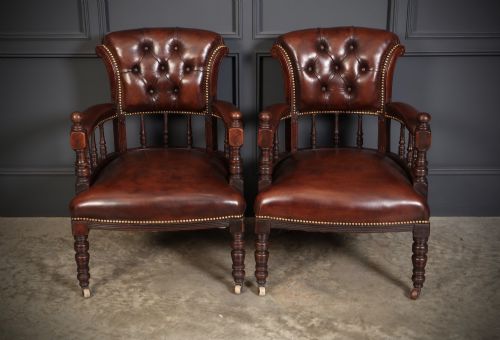
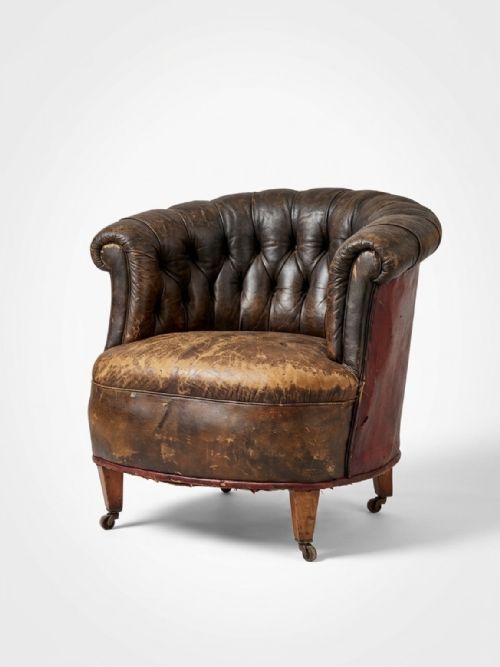


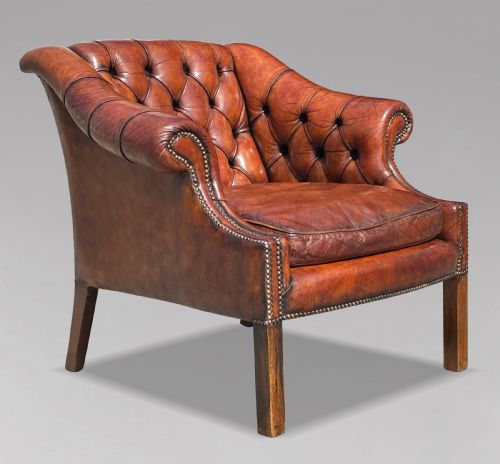

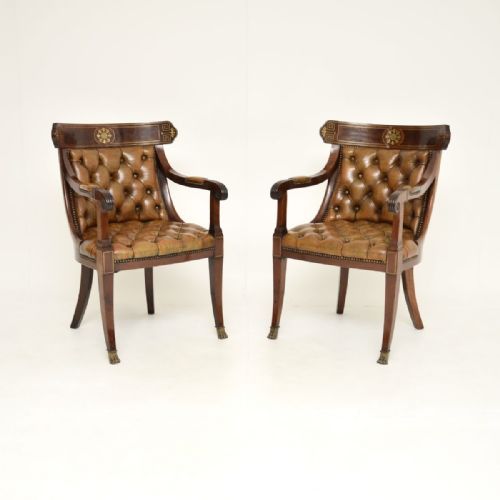


Buttoned Leather Tub Chair
These buttoned leather tub chair examples combine deep-buttoned upholstery with curved wooden frames, offering supportive seating for studies and libraries.
Buttoned Leather Tub Chair
A buttoned leather tub chair brings together curved wooden frames and deep-buttoned upholstery designed for studies, offices, and libraries. Buyers searching for a buttoned leather tub chair encounter pieces originating from the nineteenth and early twentieth centuries, spanning Victorian, Regency, Edwardian, and William IV styles.
The selection on this page centres primarily on armchairs, desk chairs, and library seating made from materials such as mahogany, oak, and leather. Examples range from revolving desk chairs and captain chairs to club armchairs and library chairs.
Victorian and nineteenth-century variants dominate the listings alongside Regency and Edwardian pieces. Buyers frequently find designs featuring brass details, caned panels, and mahogany or oak timber frames.
What Varies in Quality
The selection of timber grade and the execution of the wood carving dictate the standard of the frame. Solid mahogany and oak structures with detailed carving sit at the higher end compared to simpler supporting woodwork.
The condition and tanning quality of the leather covering, alongside the precision of the deep buttoning work, define the visual and tactile standard of the upholstery. Original leather coverings and careful joinery distinguish finer examples.
Buttoned Leather Tub Chair Retail Price Guide 2026
Typical asking prices for buttoned leather tub chair among the pieces listed under this phrase on Sellingantiques today, from the lower quarter to the upper quarter. They describe what is for sale here now, not the wider market.
Periods represented on this page span the Regency era, the nineteenth century, Victorian decades, and early twentieth-century Edwardian production.
The Buttoned Leather Tub Chair Glossary
- Tub chair
- An armchair featuring a continuous curved back and arms that form a single rounded enclosure. This form provides enclosed seating comfort.
- Deep buttoned
- An upholstery technique where buttons are pulled deep into the padding to create a padded diamond pattern. This method secures the internal stuffing.
- Bergere
- A type of enclosed upholstered armchair with wooden frames and cane side panels. These chairs often feature loose seat cushions.
- Captain chair
- A wooden swivel or fixed desk chair with a rounded low back and armrests. They served primarily in offices and studies during the nineteenth century.
- Library chair
- A heavy armchair designed for reading rooms and studies, frequently upholstered in leather. These pieces often incorporate mahogany or oak frames.
Buttoned Leather Tub Chair: Frequently Asked Questions
What is a buttoned leather tub chair?
A buttoned leather tub chair is an upholstered seating form featuring a rounded, enclosing backrest and leather covering secured with deep buttoning. These pieces typically combine wooden frames with padded armrests.
They appear across nineteenth and early twentieth-century styles including Victorian and Edwardian designs, functioning as library or occasional chairs.
Where were these chairs used?
These chairs served primarily in studies, home offices, libraries, and drawing rooms as working or reading seats. Desk versions accommodated writing tasks while club and lounge variants provided relaxed seating.
Their sturdy timber frames and leather surfaces suited heavy daily use in professional and domestic interiors.
How do I date a leather tub chair?
Dating relies on examining the timber species, construction methods, and stylistic markers such as Regency brass inlay or Victorian carving. The listed pieces span the nineteenth century up to the early twentieth century.
Secondary indicators include the type of leather finishing, framing woods like oak or mahogany, and associated design details recorded in the period styles.
What woods were used for the frames?
Cabinet makers utilised hardwoods such as mahogany, oak, walnut, and birch for the structural frames. These timbers provided the strength needed for curved tub backs and desk chair mechanisms.
Some examples also incorporated supplementary materials like cane panels, brass mounts, and iron support components.
Are these chairs suitable for daily desk work?
Many variants, including revolving desk chairs and captain chairs, were specifically designed for office and writing desk use. Their supportive backrests and arm structures accommodate seated tasks.
Checking the height, swivel function, and leg clearance helps match a specific chair to modern desk dimensions.