

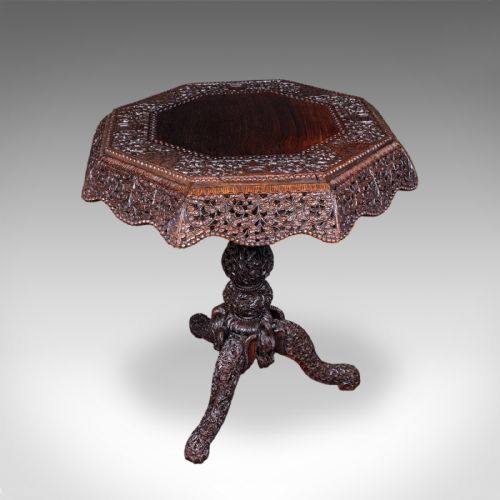
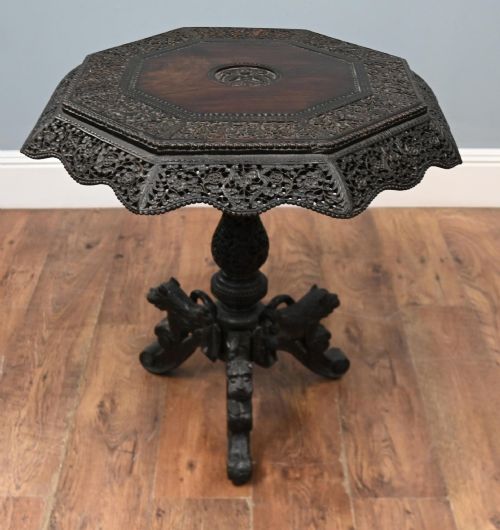

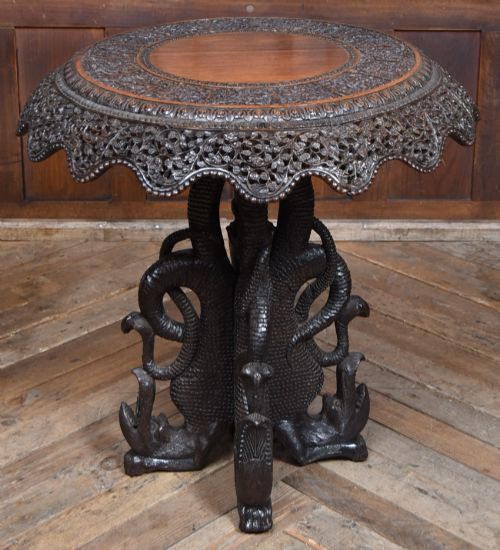
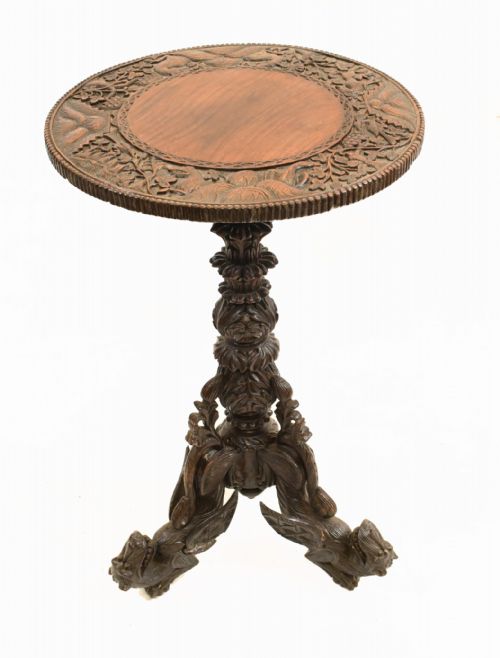




Burmese Occasional Table
A burmese occasional table brings dense colonial carving and rich tropical hardwoods into a room with distinct historical character.
Burmese Occasional Table
A burmese occasional table is typically encountered as a side table, lamp table, or tilt-top table originating from the nineteenth and early twentieth centuries. These pieces display distinct colonial styles such as Anglo-Burmese and Burmese Colonial, spanning the 1840s through to the 1930s.
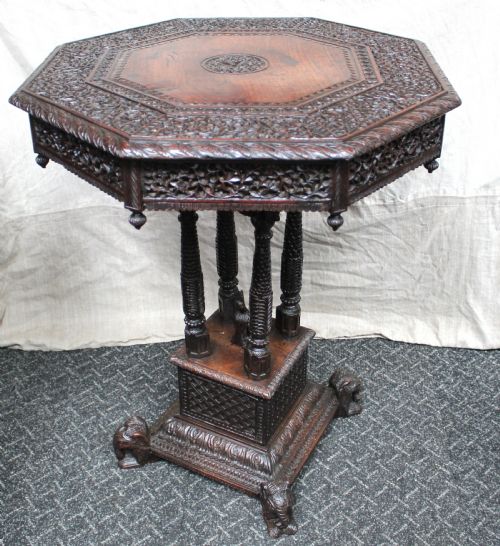
The form frequently manifests as round or two-tier tables, alongside occasional pieces featuring specific structural elements like elephant legs. Most examples found on this page reflect the traditional craftsmanship of Burma and Myanmar during the Victorian and Edwardian eras.
Materials and construction
Makers utilised dense tropical timbers including teak, padouk, hardwood, and occasional instances of lacquered wood or rosewood. These heavy woods provided the stable foundation necessary for deep, intricate relief carving.
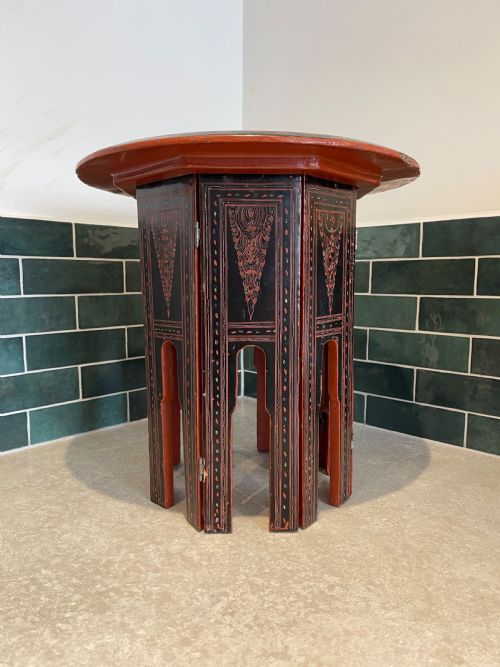
Surface decoration frequently combined hand carving with pigment and lacquer finishes. Artisans shaped the wood into flexible forms, including tip-top mechanisms and multi-tier structures.
Burmese Occasional Table Retail Price Guide 2026
Typical asking prices for burmese occasional table among the pieces listed under this phrase on Sellingantiques today, from the lower quarter to the upper quarter. They describe what is for sale here now, not the wider market.
Keep an eye out for tables supported by carved elephant legs, adding a whimsical touch to traditional colonial joinery.
Assessing quality and depth of work
The standard of a burmese occasional table rests upon the crispness and depth of its hand carving. Superior examples exhibit intricate, sharply defined figures and foliage that retain their architectural integrity across heavy timber.
Material selection also dictates the standing of a piece, with dense padouk and figured teak outperforming simpler softwood substitutes. The sophistication of structural mechanisms, such as tilt-top hinges, separates standard production from finer work.
The Burmese Occasional Table Glossary
- Padouk
- A dense, heavy tropical hardwood prized for its reddish-brown colour and durability. It served as a primary material for carved colonial furniture.
- Tip top
- A table mechanism featuring a hinged top that folds vertically for storage. This functional design appears on several occasional tables.
- Anglo-Burmese
- A design style produced during British administration that combined traditional Burmese carving with European furniture forms. These pieces often feature extensive figurative relief.
- Two tier
- A furniture construction incorporating a main surface alongside a secondary lower shelf supported by turned or carved legs. This layout adds display space.
- Lacquer
- A durable resin finish applied to wooden surfaces, sometimes combined with pigments. It provided both protection and a decorative sheen.
Burmese Occasional Table: Frequently Asked Questions
What is a burmese occasional table?
A burmese occasional table is a small decorative stand or side table featuring traditional hand-carved woodwork originating from nineteenth and early twentieth-century Burma.
These pieces typically serve as lamp tables or display surfaces in reception rooms.
How do I date these tables?
Dating relies on recorded construction periods, timber types, and stylistic shifts between mid-nineteenth-century colonial work and later 1930s examples.
Examining the depth of the carving and the presence of lacquer finishes helps place the piece within its historical era.
Where should I place it?
These tables suit hallways, sitting rooms, or studies where their carved details can be appreciated alongside traditional or eclectic interiors.
They function well as lamp stands or small display surfaces for decorative objects.
Are they sturdy enough for daily use?
Most examples are constructed from heavy hardwoods like teak and padouk, providing solid structural stability for everyday placement.
Care should be taken with delicate carved edges and tilt-top mechanisms during relocation.