

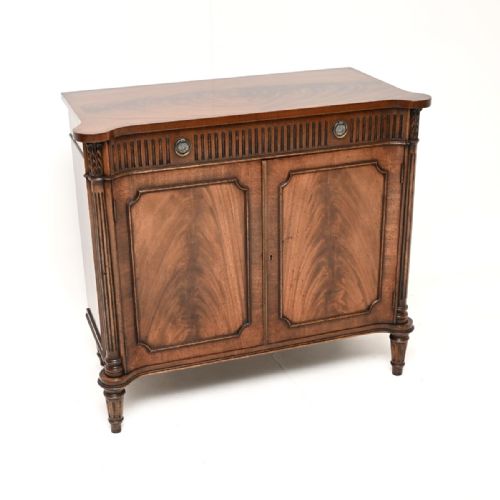
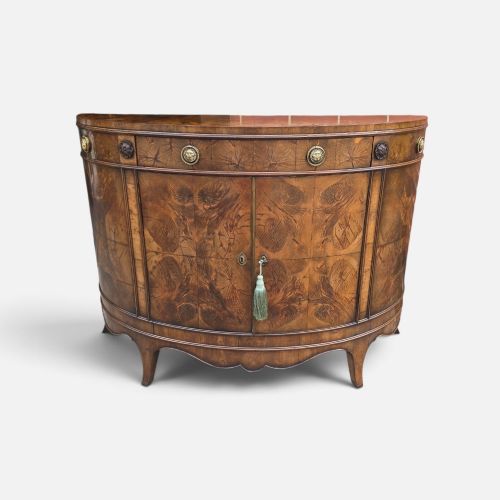


Brown Veneer Sideboard
These brown veneer sideboard examples span centuries of cabinetmaking, offering rich timbers and practical storage that anchor any dining room or hall.
Brown Veneer Sideboard
A brown veneer sideboard brings together rich timber surfaces and functional storage, serving as both a dining room centrepiece and a hall display surface. When you search for brown veneer sideboard, you encounter forms ranging from Georgian pedestal pieces to 1930s Art Deco cabinets.
The selection here encompasses various timber surfaces, including flame mahogany, burr walnut, and yew wood, alongside forms such as chiffoniers and low linen presses. These pieces originate from multiple periods, notably the Regency era and the twentieth century, reflecting shifting domestic needs.
You are most likely to meet mahogany and walnut iterations dating from the nineteenth and twentieth centuries, often featuring cupboards, drawers, or marble tops. Each iteration demonstrates how cabinetmakers utilised figured veneers to create striking visual patterns on utilitarian furniture.
How they were made
Cabinetmakers applied thin sheets of figured timber, such as flame mahogany, burr walnut, and burr yew, over a secondary wood carcass to create symmetrical grain patterns. This technique allowed workshops to display expensive and highly figured timber across large flat surfaces without using solid boards.
Brass hardware, including handles and key escutcheons, was fitted to drawers and cupboard doors alongside marble tops on specific French and Art Deco examples. Joinery methods relied on traditional cabinet construction, ensuring stability for heavy timber frames and veneered panels.
Brown Veneer Sideboard Retail Price Guide 2026
Typical asking prices for brown veneer sideboard among the pieces listed under this phrase on Sellingantiques today, from the lower quarter to the upper quarter. They describe what is for sale here now, not the wider market.
Some nineteenth-century French commodes feature faux marble tops, offering the grand look of stone without the weight.
What varies in quality
The distinction between tiers rests upon the choice of timber and the precision of the veneer matching across doors and drawer fronts. Superior examples display continuous grain patterns that flow seamlessly from one panel to the next, demonstrating careful planning by the maker.
Secondary wood selection and the crispness of applied brass mounts or carved details also separate standard production items from workshop pieces. Construction depth, drawer linings in solid hardwoods, and the integrity of the underlying veneer ground determine the longevity of each cabinet.
Bowman Brothers
The Brown Veneer Sideboard Glossary
- Flame mahogany
- A specific cut of mahogany timber displaying a distinctive, flickering flame-like grain pattern. It was frequently utilised on prominent furniture surfaces during the nineteenth century.
- Burr walnut
- Wood taken from a growth on a walnut tree, yielding a swirling, knotted grain full of intricate eye formations. Cabinetmakers prized this material for high-status cabinet doors and drawer fronts.
- Commode
- A low French chest of drawers or cabinet designed for domestic storage, often topped with marble. The form developed in the eighteenth century and persisted through the nineteenth.
- Chiffonier
- A compact sideboard or cabinet featuring a raised shelf or back, popular during the Victorian period. It provided enclosed storage for glassware and dining accessories in smaller rooms.
Brown Veneer Sideboard: Frequently Asked Questions
What is the difference between a sideboard and a chiffonier?
A sideboard is typically a larger dining room piece designed for serving food and storing heavy tableware, cutlery, and linens. It often incorporates pedestal ends or multiple cupboards and drawers.
By contrast, a chiffonier is generally smaller and includes a raised shelf or gallery at the back, originating as a multi-purpose cabinet for parlours and sitting rooms. Both utilise decorative wood veneers, but their scale and internal configurations suit different domestic spaces.
How do I date a brown veneer cabinet?
Examine the secondary woods inside the drawers, such as oak or pine, alongside the construction joints like dovetails. Hand-cut dovetails generally indicate nineteenth-century or earlier manufacture, while machine-cut joints point towards the twentieth century.
Consider the overall style, such as Regency scrollwork or 1930s geometric Art Deco lines, as well as the specific veneer types utilised. Hardware styles and backboards also provide physical evidence that aligns with known historical production periods.
Can I use a marble top sideboard in a hall?
Marble-topped pieces provide a durable, hard-wearing surface that withstands daily use in entrance halls for keys and post. Their decorative stone surfaces introduce contrasting textures against panelled walls.
Ensure the piece fits comfortably within the walkway dimensions of your hallway without obstructing doors. The enclosed cupboards and drawers underneath offer practical storage for shoes, gloves, and household items.