





Brown Musical Box
These brown musical box pieces are mechanical instruments housed in timber cases that play pinned cylinder or disc tunes, offering authentic historic sound.
Brown Musical Box
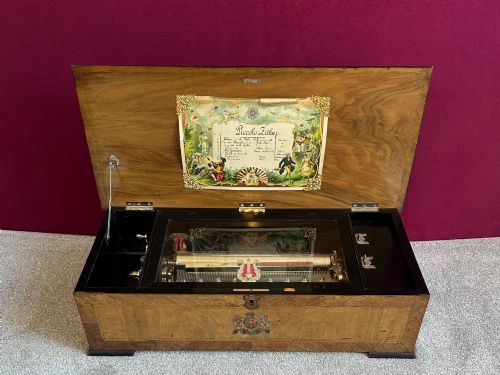
A brown musical box is a mechanical instrument housed in timber cases that play pinned cylinder or disc tunes, offering authentic historic sound. When searching for a brown musical box, buyers encounter Victorian and Edwardian examples dating from the nineteenth and early twentieth centuries alongside individual related items like a conductor baton.
The domestic forms include Swiss cylinder boxes playing multiple airs, sometimes featuring bells or mandolin effects, and larger disc playing automata. Walnut, rosewood, and ebonised wood dominate the exterior construction of these items, showing the prevalent cabinet woods of their respective periods.
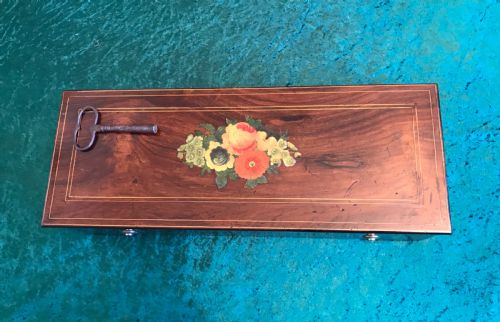
Originating largely from Swiss workshops and nineteenth century British retail contexts, these objects range from simple key wound mechanism housings to large cabinet instruments. Walnut cased Swiss cylinder boxes and rosewood inlaid pieces with multiple airs represent the typical forms found within this selection.
Materials and construction
Cabinet makers utilised timber veneers such as walnut, burr walnut, and rosewood over solid foundations, frequently incorporating inlaid fruitwood detailing to ornament the exterior cases. These timber enclosures protect the internal acoustic chambers and mechanical assemblies.
Internal components combine precision brass combs with steel pins set onto rotating brass cylinders or metal discs, driven by spring wound clockwork movements. Additional elements like glass covers and mounted bells augment certain mechanisms to create specific musical tones.
Brown Musical Box Retail Price Guide 2026
Typical asking prices for brown musical box among the pieces listed under this phrase on Sellingantiques today, from the lower quarter to the upper quarter. They describe what is for sale here now, not the wider market.
Listings span the eighteenth to the twentieth centuries, featuring walnut, rosewood, and brass construction.
Factors of quality
Quality resides in the precision of the pinned cylinder and the tuning of the brass comb teeth, which dictate the clarity and complexity of the musical performance. Elaborate arrangements featuring multiple airs, bells, or mandolin attachments indicate higher grade production.
Cabinet execution distinguishes individual pieces, with figured timbers like burr walnut, intricate fruitwood inlay, and substantial case proportions marking superior workshop output compared to simpler plain timber boxes.
Lochmanns·B A Bremond·Nicole Freres
The Brown Musical Box Glossary
- Cylinder
- A pinned brass barrel that rotates against a tuned comb to play specific musical airs. Each pin strikes a specific tooth to produce the desired note.
- Air
- A distinct tune or musical piece recorded onto the cylinder or disc mechanism. Boxes are often designated by the total number of airs they can play.
- Comb
- A flat piece of steel cut into individual teeth of graduated length and pitch. The comb vibrates when struck by the rotating pins to create sound.
- Inlay
- Decorative wood or metal set into the surface of the timber case. Fruitwood is commonly utilised for this contrasting ornamentation.
Brown Musical Box: Frequently Asked Questions
How do cylinder and disc boxes differ?
Cylinder boxes utilise a pinned brass barrel to play a fixed sequence of tunes, while disc boxes employ flat metal plates that can be swapped to change the music.
Cylinder mechanisms are typically housed inside rectangular wooden cases, whereas disc machines often take the form of larger cabinet instruments.
What woods were used for the cases?
Cabinet makers predominantly utilised walnut, burr walnut, and rosewood for the exterior construction of these musical instruments. Ebonised wood and inlaid fruitwood also appear frequently across the period.
These timbers were selected both for their structural stability and their rich decorative appearance in domestic interiors.
How many tunes do they play?
The musical capacity varies from single tune mechanisms to elaborate Swiss cylinder boxes capable of playing eight or more distinct airs.
Complex models may incorporate additional instrumentation such as bells or mandolin effects to enrich the performance.
How do I operate a key wound box?
Operation involves winding the spring mechanism using the dedicated key and releasing the lever stop to allow the cylinder and comb to play. Care must be taken not to overwind the spring assembly.
Once started, the mechanism will cycle through the pinned airs before coming to a natural halt against the governor.