




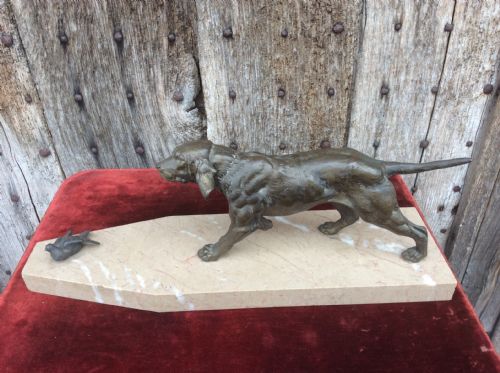
Bronze Setter Sculpture
A bronze setter sculpture captures the alert stance and steady poise of the Gundog, crafted to last through generations of admirers.
Bronze Setter Sculpture
A bronze setter sculpture brings the focused energy of the hunting dog into the home, capturing the breed's characteristic pose on point or at rest. These figures most frequently appear in nineteenth-century French Animalier styles or early twentieth-century interpretations, showing the dog alone or in pursuit of game such as pheasants and rabbits.
The objects take the form of distinct tabletop sculptures and figure groups, often mounted upon heavy bases of marble or onyx. Pieces range from detailed nineteenth-century castings by renowned founders to later decorative interpretations executed in spelter or patinated metal during the Art Deco period.
Materials and construction
Foundries produced these figures using traditional metal casting techniques, employing bronze or alternative alloys like spelter to capture muscular definition and fine coat textures. Many examples utilise cold-painted finishes or patinated bronze surfaces to render naturalistic colouring on the animal.
Finished metal figures were secured firmly to substantial stone plinths, most commonly utilising contrasting materials such as marble, onyx or alabaster to provide weight and an architectural base.
Bronze Setter Sculpture Retail Price Guide 2026
Typical asking prices for bronze setter sculpture among the pieces listed under this phrase on Sellingantiques today, from the lower quarter to the upper quarter. They describe what is for sale here now, not the wider market.
Listings feature works spanning the nineteenth century through the Art Deco era, utilising bronze, spelter, marble, and onyx.
Judging quality
Quality rests upon the crispness of the cast and the fidelity of the anatomical modelling, distinguishing spirited portrayals of working dogs from stiff or generalised commercial productions. The depth of hand-chasing and the nuance of the patination reveal the care invested in the metalwork after it left the foundry mould.
The selection and finish of the supporting stone plinth also separate tiers of production, with dense veined marble bases indicating higher-grade presentation than lighter or simpler mounting materials.
Jules Moigniez·Delabrierre·C Masson·P J Mene
The Bronze Setter Sculpture Glossary
- Animalier
- A nineteenth-century artistic movement focused on the realistic depiction of animals, particularly in sculpture. Practitioners of this style studied living subjects closely to render movement and anatomy with precision.
- Spelter
- A zinc-based alloy commonly utilised as a less costly alternative to bronze for sculptural castings. It takes patination and paint well, frequently appearing in decorative figures from the early twentieth century.
- Patinated bronze
- Bronze treated with chemical solutions to produce a specific surface colour or aged finish. This process protects the metal while accentuating the sculptural details of the casting.
- Cold-painted bronze
- Metal sculpture decorated with oil or enamel paints applied without heat after the casting process. The technique allows for bright, lifelike coloration on animal and bird figures.
- Gundog
- A type of hunting dog bred to find and retrieve game for sportsmen. Sculptures frequently depict these dogs in active working poses alongside birds or rabbits.
Bronze Setter Sculpture: Frequently Asked Questions
What is an Animalier sculpture?
An Animalier sculpture focuses primarily on realistic depictions of animals, capturing natural movement, musculature, and behaviour rather than idealised human forms. This sculptural tradition gained immense popularity across nineteenth-century Europe.
Artists observed living animals in menageries and the field, translating their studies into detailed bronze and metal castings that often portrayed predators and hunting dogs in action.
How do I care for bronze?
Bronze requires minimal intervention to maintain its stable surface over decades and centuries. Light dusting with a soft, dry cloth prevents particulate accumulation without disturbing the underlying patina.
Avoid using harsh chemical polishes, abrasive cloths, or modern cleaning sprays, as these substances strip away the historic patination and damage the metal.
What is spelter?
Spelter is a zinc-based alloy that sculptors and founders utilised as an affordable alternative to bronze, particularly during the Art Deco period. It provides a workable medium for detailed decorative castings.
While softer and lighter than bronze, spelter accepts patination and cold-painted finishes effectively, resulting in accessible decorative figures.
Why are some figures on marble?
Mounting metal sculptures on heavy stone plinths provided structural stability and added visual contrast to the piece. Marble, onyx, and alabaster were favoured for their density and polished appearance.
These stone bases elevate the subject physically and aesthetically, anchoring the dynamic bronze composition within an architectural frame.