





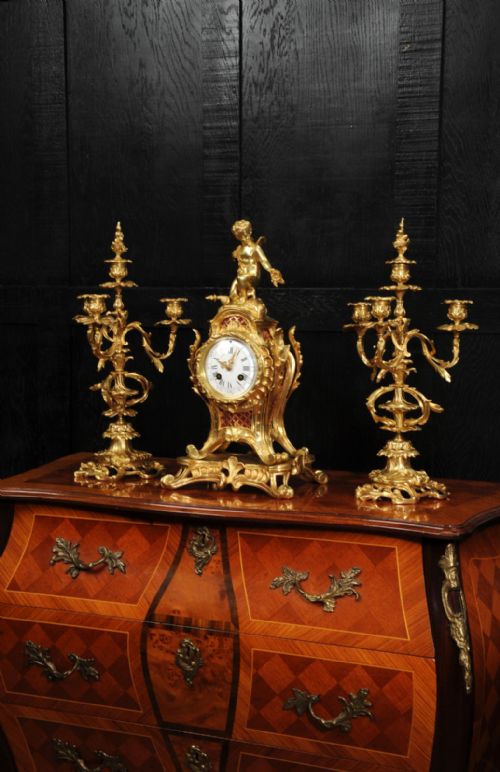


Bronze Putti Mantel Clock
A bronze putti mantel clock brings classical French and English figural foundry work into a room.
Bronze Putti Mantel Clock
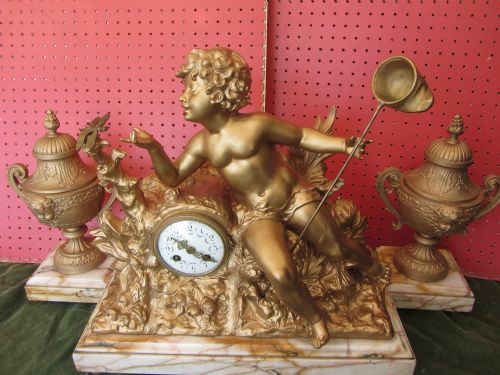
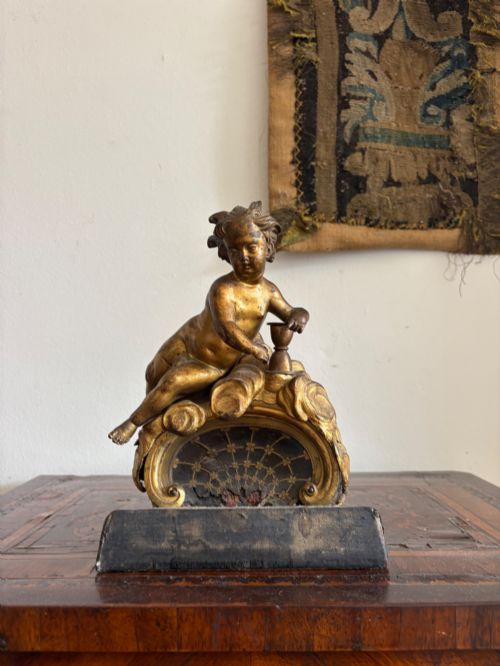
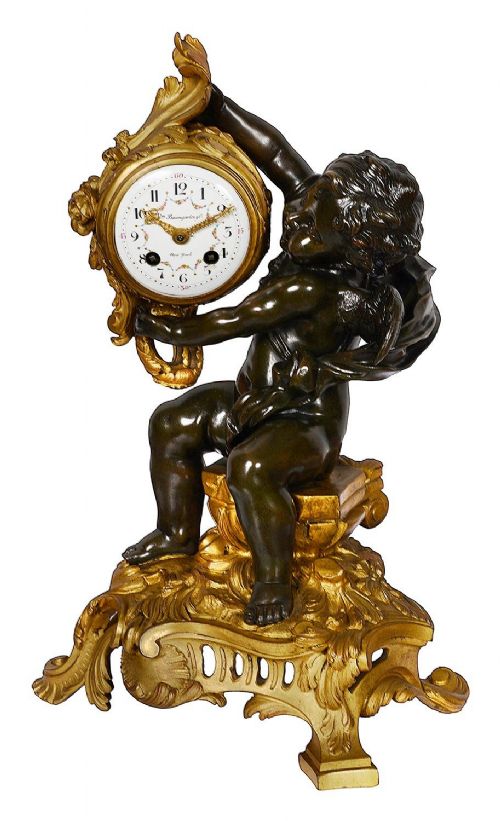
A bronze putti mantel clock combines timekeeping with sculptural figures of winged cherubs, infants or cupids cast in metal. Buyers searching for a bronze putti mantel clock find domestic timepieces from the nineteenth century, largely originating from French workshops and occasionally English makers.
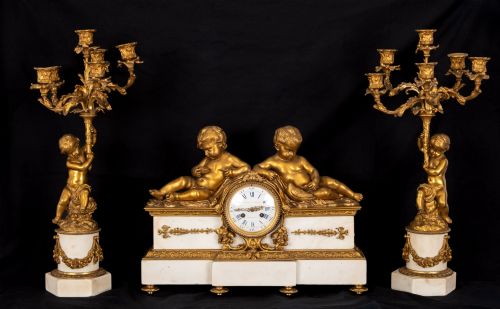
Most examples appearing here belong to the Victorian era or late nineteenth century, manifesting in French Rococo Revival, Louis XVI, and classical styles. These objects frequently take the form of mantel clocks, clock garnitures with matching candelabras, or smaller table clocks.
The sculptural putti appear either as finials perched atop the case, flanking the dial as supporting figures, or interacting with architectural elements like globes and marble plinths. Their presence transforms a functional instrument into an ornate decorative centerpiece.
Materials and technique
Foundries produced these pieces using bronze, gilt bronze, and ormolu, often mounting the metalwork upon white or red marble bases. Enamel dials, sometimes hand-painted, display the numerals behind glass bezels.
The manufacturing process united metal casting, mercury or electro-gilding, and stone masonry. Skilled artisans chased the bronze surfaces by hand after casting to sharpen the feather details on wings and the folds of drapery.
Bronze Putti Mantel Clock Retail Price Guide 2026
Typical asking prices for bronze putti mantel clock among the pieces listed under this phrase on Sellingantiques today, from the lower quarter to the upper quarter. They describe what is for sale here now, not the wider market.
Cupid occasionally trades his bow for a clock gear, quietly keeping time while appearing to supervise the mantelpiece.
Quality variations
Quality reveals itself in the crispness of the bronze chasing and the depth of the gilding. Superior examples exhibit finely articulated facial expressions and hair on the putti, whereas lesser pieces display softened contours from worn casting moulds.
The integration of materials also dictates standing; clocks marrying heavy, unblemished marble bases with substantial fire-gilded bronze figures represent the higher tier of production. Movement complexity, such as single fusee mechanisms, further elevates the stature of an individual piece.
Le Roy Paris·Leon Message·Jollet et Cie·Phillipe H Mourey·Bellenot Paris·John Bennett Cheapside London·Henry Berkeley Square London·F Marti
The Bronze Putti Mantel Clock Glossary
- Ormolu
- Gilded bronze produced by applying a mixture of mercury and gold to a bronze base and heating it. This technique creates a durable, luminous surface finish characteristic of fine nineteenth-century French clock cases.
- Putto
- A plump, naked male infant, frequently winged, depicted in classical art and sculpture. In these horological pieces, putti serve as decorative figures lounging upon or flanking the clock body.
- Garniture
- A set of decorative objects designed to be displayed together on a mantelpiece. These listings frequently pair a central clock with matching candelabras or side ornaments.
- Fusee
- A conical pulley used within a clock movement to equalize the declining power of the mainspring as it unwinds. This mechanism improves timekeeping accuracy across the duration of the wind.
- Chasing
- The manual tooling of a metal surface using hammers and punches after casting. Artisans employ this technique to refine textures, sharpen details, and add depth to cast bronze figures.
Bronze Putti Mantel Clock: Frequently Asked Questions
Where do these clocks originate?
The vast majority of these pieces hail from nineteenth-century France, produced in Parisian workshops and commercial foundries. A smaller proportion originates from English makers working in London during the Victorian period.
French pieces lean heavily into Rococo Revival and Louis XVI styles, whilst English examples frequently employ classical architectural cases with fusee movements.
What is a clock garniture?
A clock garniture is a matched set consisting of a central mantel clock accompanied by side pieces such as candelabras or urns. They were designed as a cohesive decorative arrangement for a drawing room mantelpiece.
These sets share identical casting motifs, materials like ormolu and marble, and stylistic vocabularies.
How do I wind the clock?
Winding requires a matching key inserted into the winding holes on the enamel dial. Turning the key tensions the mainspring housed within the mechanical movement behind the face.
Care must be taken not to overwind the movement, as this can strain the internal spring mechanism.
What is white marble used for?
White marble forms the architectural plinths and bases that support the bronze clock cases and figural putti. The pale stone provides a stable, neoclassical foundation that contrasts with the golden ormolu metalwork.
Marble components often feature decorative gilt bronze mounts applied directly to the stone.