



Bronze Figure Mother Child
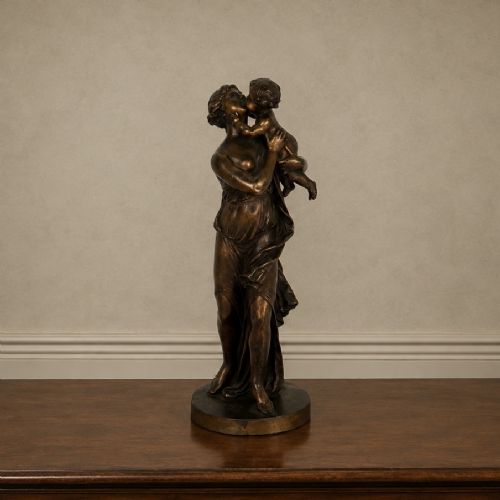
A bronze figure mother child brings tactile warmth and domestic narrative into a room, spanning 19th-century classical grace to Art Deco modernism.
Bronze Figure Mother Child
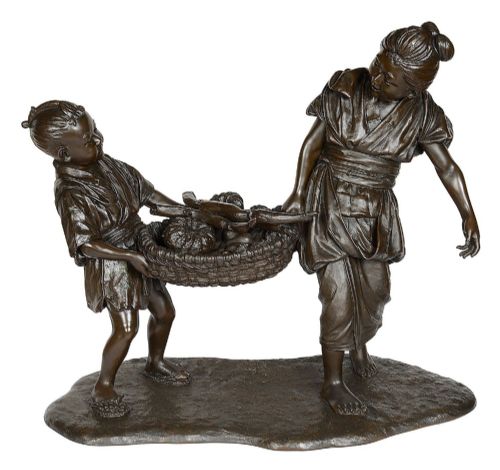
These pieces capture the maternal bond through sculptural forms across distinct eras, most frequently appearing as nineteenth-century classical works, French salon bronzes, and Art Deco interpretations. Collectors seek a bronze figure mother child for its expressive portrayal of affection, rendered in diverse global traditions from Victorian Grand Tour souvenirs to Japanese Meiji bronzes and African tribal art.
The selections on this page range from intimate wall plaques to large-scale groups, utilising subjects like classical Grecian figures, mythological groupings, and outsider art. A bronze figure mother child frequently employs patination to accentuate the tender interaction between figures, whether cast in traditional bronze or alternative media like spelter.
Materials and methods
Foundries employed traditional casting techniques to render these sculptures, utilising bronze alloys finished with dark or silvered patinas to define surface texture and shadow. Artisans frequently mounted these metal figures on bases of contrasting stone such as marble or onyx to provide stability and visual weight.
Alternative compositions include cast metal and spelter, particularly notable in French Art Deco pieces from the nineteen-thirties, while other works incorporate detailed hand-chiselling to refine drapery, hair, and facial expressions.
Bronze Figure Mother Child Retail Price Guide 2026
Typical asking prices for bronze figure mother child among the pieces listed under this phrase on Sellingantiques today, from the lower quarter to the upper quarter. They describe what is for sale here now, not the wider market.
Listings incorporate nineteenth-century classical subjects alongside Art Deco forms, Japanese metalwork, and African tribal maternity figures.
Distinctions in quality
The refinement of the casting and the crispness of the chaser's final surface work distinguish superior examples from standard production pieces. Superior works demonstrate meticulous attention to anatomical proportion, the subtlety of the subject's emotional engagement, and the integrity of the original patination.
The quality of the secondary materials, such as the veining of an integral marble plinth or the execution of an artist's signature, further separates master foundry output from commercial decorative castings.
P. Sega·Auguste Moreau·Coalbrookdale·Carrier
The Bronze Figure Mother Child Glossary
- Patina
- The chemical coloration or natural oxidation applied to the surface of the metal. This finish protects the bronze while enriching its visual depth.
- Spelter
- A zinc-based alloy commonly utilised as a less expensive substitute for bronze during the nineteenth and twentieth centuries. It often received a bronze-like coating to imitate genuine metalwork.
- Grand Tour
- A cultural journey undertaken by wealthy young Europeans in the eighteenth and nineteenth centuries. Travellers collected small-scale classical sculptures as mementoes of their travels.
- Lost-wax casting
- A traditional method where a molten metal is poured into a mould that has been created by means of a wax model. This technique allows for intricate detail and complex undercut forms.
Bronze Figure Mother Child: Frequently Asked Questions
How do I identify the period of a piece?
Stylistic indicators help date the work, ranging from nineteenth-century classical realism and Victorian ornamentation to nineteen-thirties Art Deco geometries. Foundry marks, signatures, and base materials provide further clues to the era of production.
Patination types and casting techniques also shift across decades, offering clear markers for Victorian, Meiji, and mid-century aesthetics.
Where should I display a bronze figure?
These sculptures suit prominent placement on mantelpieces, sturdy sideboards, or dedicated display tables where their dimensional forms can be appreciated from multiple angles. Wall plaques require secure fixings suited to the weight of metal and stone.
Placement should avoid direct, harsh sunlight to protect sensitive patinas and stone plinths over time.
Are these works signed by the artist?
Certain pieces bear incised signatures or foundry stamps corresponding to renowned sculptors or historic foundries like Coalbrookdale. Other examples remain unsigned, reflecting decorative workshop production or tribal traditions.
Signatures add historical context but should be evaluated alongside the overall quality of the casting and finish.