
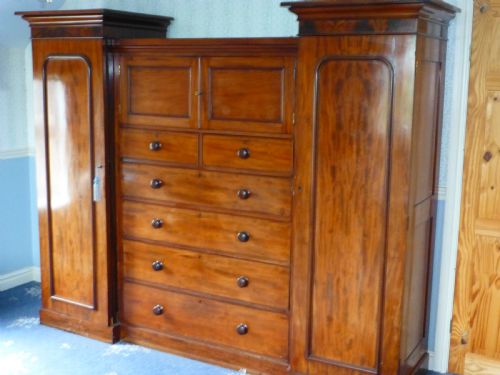
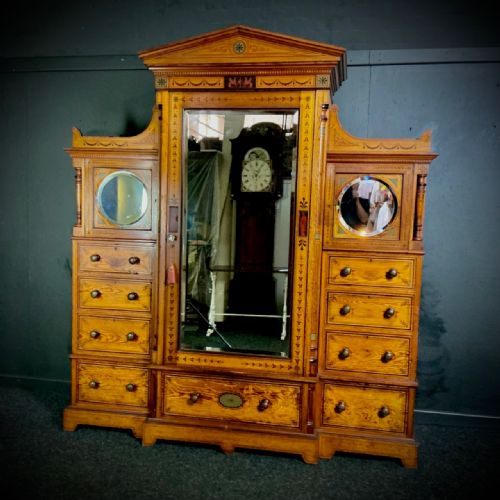


Breakfront Combination Wardrobe
These breakfront combination wardrobe pieces offer imposing storage for a bedroom, combining hanging space and drawers in a distinguished tripartite design.
Breakfront Combination Wardrobe
When you search for a breakfront combination wardrobe, you are looking at substantial bedroom furniture featuring a central section flanked by projecting or recessed wings. These pieces span the Georgian, William IV, and Victorian eras, carrying significant presence through their grand architectural proportions.
How they were made
Cabinet makers utilised solid timbers alongside finely figured veneers, laying flame mahogany and burr walnut across the principal doors to create striking natural patterns. Secondary woods such as pine appear in the internal construction of drawers and carcases.
Joinery techniques relied on robust carcase construction to support the heavy proportions, incorporating brass hardware for locking mechanisms and handles. Many examples were built to dismantle into sections to facilitate transport into grand Victorian and Georgian bedrooms.
Listings feature mahogany, walnut, pine, and brass across Georgian and Victorian periods.
What varies in quality
The distinction between standard production and the finest work lies in the selection of timber veneers and the subtlety of architectural mouldings. Pieces originating from notable workshops demonstrate superior cabinet-making through precise jointing and well-figured grain matching across the breakfront façade.
Proportion and internal configuration also define the upper tier, where sophisticated internal drawer layouts and original brass fittings remain intact. Secondary woods and simpler pine constructions represent more utilitarian domestic furniture from the period.
Gillows
The Breakfront Combination Wardrobe Glossary
- Breakfront
- An architectural cabinet design where the central section projects forward from the side wings. This creates depth and shadow across the front elevation of large wardrobe pieces.
- Compactum
- A multi-functional wardrobe combining hanging space, linen slides, and internal drawers within a single unit. It represents a highly organised approach to bedroom storage.
- Flame mahogany
- A veneer cut from the fork of the mahogany tree where the branches join the trunk, producing a distinctive flame-like ripple pattern. Cabinet makers used this timber for decorative impact on primary surfaces.
- Burr walnut
- A wood harvested from walnut tree growths, featuring swirling, knotted grain patterns that command high decorative value. It appears on polished panels of later Victorian pieces.
- Sentry box
- A colloquial term for a narrow, tall wardrobe configuration reminiscent in shape to a sentry box. These pieces accommodate hanging garments in compact floor footprints.
Breakfront Combination Wardrobe: Frequently Asked Questions
What is a breakfront combination wardrobe?
A breakfront combination wardrobe is a large piece of antique bedroom furniture featuring a projecting central section flanked by wings. It integrates hanging space with drawers and shelving.
These units were designed to provide comprehensive clothing storage in grand bedrooms during the Georgian and Victorian periods.
How do I move a large wardrobe?
Many period wardrobes were constructed to dismantle into major sections, including a cornice, base, and flanking wings, to ease transportation.
Careful removal of internal components and sliding shelves helps secure the carcase before moving the dismantled parts into a new room.
What timber was used most often?
Mahogany served as the primary timber for fine Georgian and early Victorian examples, often enhanced by flame mahogany veneer across the doors. Later Victorian pieces occasionally utilised walnut and burr walnut.
Pine and secondary softwoods appear frequently in the internal carcases, drawer linings, and backing boards.
How do I date a Victorian wardrobe?
Stylistic clues such as architectural pediments, turned feet, and timber selection help distinguish early Victorian and William IV pieces from late Victorian designs. Cabinet-making construction methods inside the drawers also indicate the manufacturing era.
Documentation or maker stamps from firms like Gillows provide precise attribution when present on the timber.