

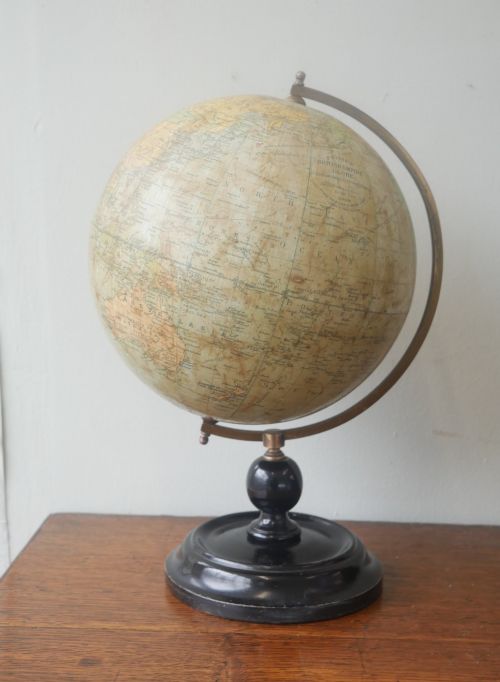
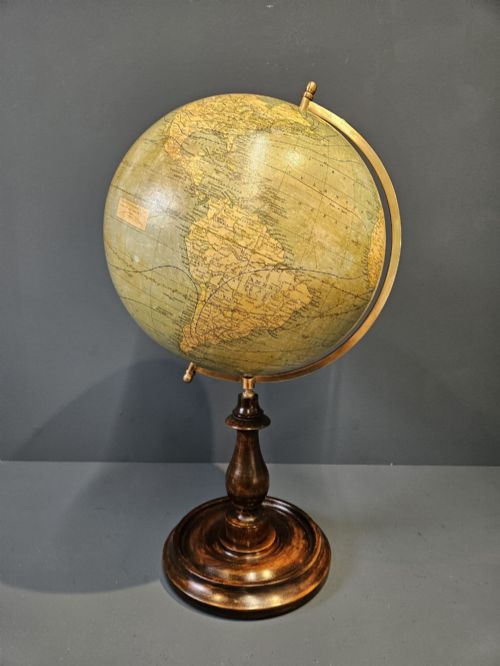
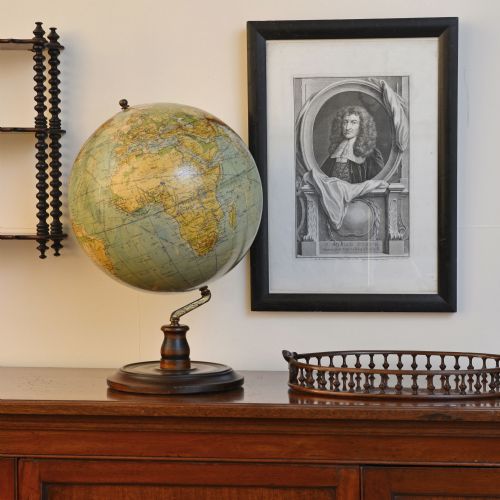


Brass World Globe
A brass world globe brings the geography of earlier centuries into a room, combining polished metal mountings with printed cartography.
Brass World Globe
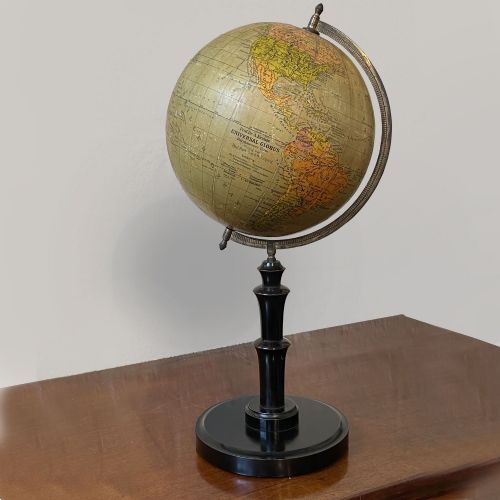
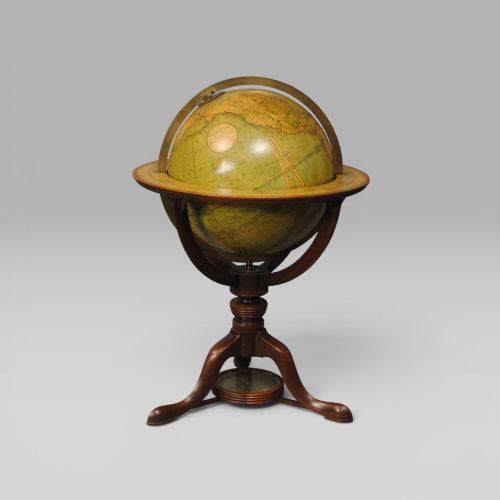
A brass world globe is a cartographic instrument mounted on a metallic support, spanning periods from the eighteenth century through the mid-twentieth century. These pieces take forms such as desk globes, library globes, and table globes, alongside occasional variations like floor standing globes and oil lamps with terrestrial globe shades.
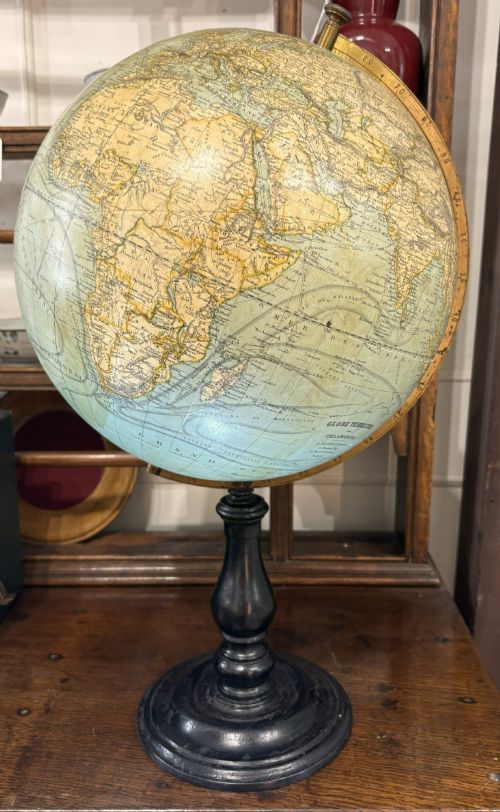
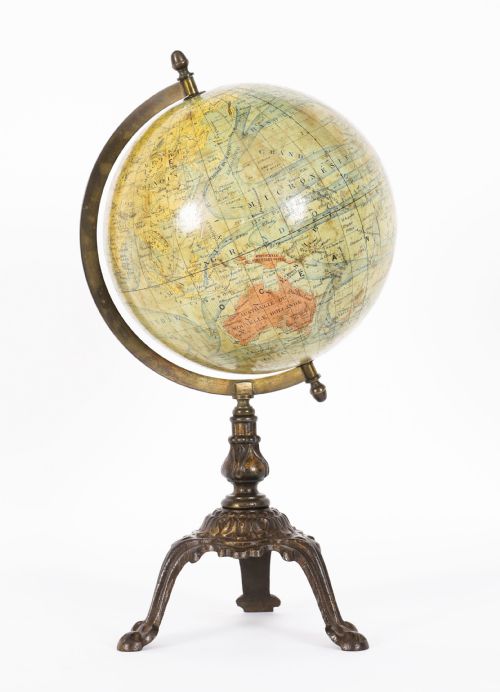
The version most likely to meet you on this page is a nineteenth century table globe or a twentieth century educational model, frequently mounted on a turned wooden foot or supported by a full brass meridian ring. Makers from London, Paris, and Calcutta produced these instruments, utilising paper gores applied over plaster spheres.
Beyond standard desk iterations, the selection includes miniature globes and substantial library pairs that show historical geographical boundaries. Each piece reflects the cartographical knowledge of its specific decade, from the Victorian era to the interwar period.
How they were made
The construction of these globes relies on a plaster or paper mache sphere that forms the core of the object. Artisans applied printed paper gores - segmented map sections - by hand over the sphere to align the cartography accurately across the curved surface.
Brass formed the structural meridians, horizon rings, and stands that cradled the sphere, often paired with mahogany, walnut, ebonised wood, or simple wood bases. Glass appeared in specialised instances, such as terrestrial globe shades utilised on nineteenth century oil lamps.
Brass World Globe Retail Price Guide 2026
Typical asking prices for brass world globe among the pieces listed under this phrase on Sellingantiques today, from the lower quarter to the upper quarter. They describe what is for sale here now, not the wider market.
Listings feature brass world globes produced across the nineteenth and twentieth centuries, incorporating materials such as paper, plaster, mahogany, and ebonised wood.
What varies in quality
Quality in these globes rests upon the precision of the cartography, the crispness of the printing on the paper gores, and the casting quality of the brass fittings. Finer examples exhibit meticulous hand-coloured details on the paper map and heavy, well-turned wooden or metal stands.
The integrity of the surface layer dictates the standing of the piece, as paper maps prone to toning or wear retain more value when the geographical text remains legible. Maker attribution also elevates a piece, with globes bearing signatures from established cartographers commanding distinct regard.
Cary·George Philips and Son Ltd·Lebegue and Cie·J Forest·Malby's·Chandy Charan and Co·Carl Adami·Crunchley·Geographia·Bacon's·M. Vivien
The Brass World Globe Glossary
- Gores
- Printed paper segments shaped like narrow triangles that are applied to the sphere to form the complete map of the world. They require careful alignment by the maker so that lines of latitude and longitude meet correctly.
- Meridian
- The brass ring that encircles the globe from pole to pole, allowing the sphere to spin on its axis. This ring is often graduated with degrees to measure latitude.
- Terrestrial globe
- A scale model of the Earth displaying landmasses, oceans, countries, and major cities as known at the time of manufacture. It contrasts with a celestial globe, which maps the stars.
- Library globe
- A large-scale terrestrial or celestial globe, traditionally produced in a pair and mounted on a sturdy floor or table stand. These were intended for scholarly reference in domestic libraries.
Brass World Globe: Frequently Asked Questions
How do I clean a brass world globe?
Dust the paper sphere gently with a dry, soft cloth, avoiding any moisture that might damage the historical gores. Polish the brass mountings carefully with a suitable metal cleaner while ensuring no polish touches the map surface.
Keep the globe away from direct sunlight to prevent the printed paper from fading or becoming brittle over time. Stable indoor humidity protects both the plaster core and the wooden base from warping.
What is the difference between a table and library globe?
Table globes are compact instruments designed to sit on desks, tables, or cabinets for quick reference. They usually feature smaller diameters and simpler stands suited to domestic spaces.
Library globes are substantially larger, often forming part of a matching pair with a celestial counterpart. They rest on elaborate floor stands and were built for detailed study in institutional or grand residential libraries.
How can I date an antique globe?
Examine the political boundaries, country names, and capital cities depicted on the map surface, as these reflect the geopolitical reality of the manufacturing year. Railways, shipping routes, and colonial territories offer further clues to the specific era.
Cartographer signatures, publication dates printed in the cartouche, and patent marks on the brass hardware help narrow the timeframe. Comparing the style of the wooden stand and typography also supports accurate dating.
Where were these globes manufactured?
Production centres for these instruments spanned major European capitals and global trade hubs, with prominent makers operating in London, Paris, and Germany. Specific workshops also emerged in regions such as Calcutta to serve local educational and administrative needs.
Each manufacturing region imparted distinct stylistic traits to the brasswork and cartography, reflecting local mapmaking traditions and available materials.