

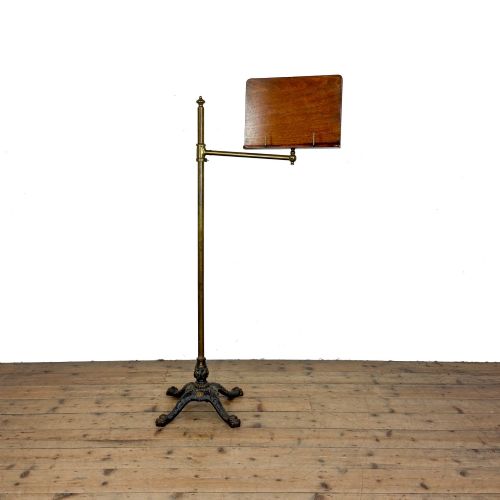
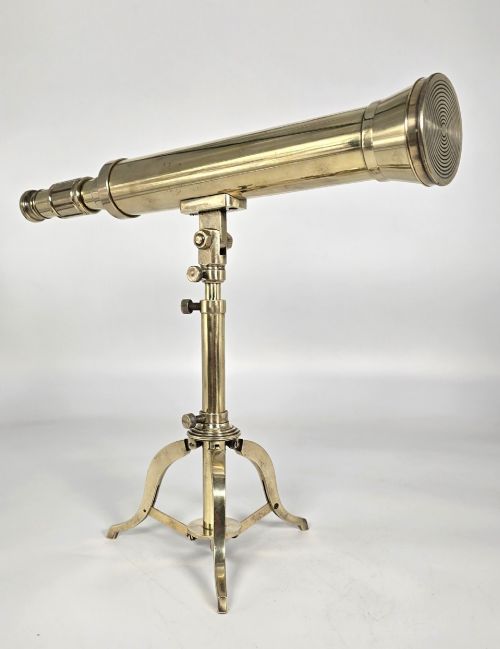


Brass Telescope Stand
A brass telescope stand anchors precision optics securely, offering sturdy support and historic character for display in a study or library.
Brass Telescope Stand
Buyers seeking a brass telescope stand encounter robust supports designed to hold heavy optical instruments steady during observation. These pieces appear frequently alongside complete telescopes from the nineteenth and twentieth centuries, fashioned to elevate tabletop or library instruments to a comfortable viewing height.
The selections on this page span periods from the eighteenth century through the Edwardian era, incorporating styles such as Georgian, Victorian, and Victorian Maritime. Alongside dedicated stands, listings include instruments with integrated folding tripods and related scientific items like reading stands and theodolites.
Origins trace primarily to established English makers who supplied precision brass hardware for domestic and navigational use. The forms range from compact tabletop versions to tall floor-standing variants, reflecting the diverse requirements of historical astronomers and mariners.
Materials and construction methods
Makers utilised heavy brass for its durability and resistance to corrosion, casting and turning components to create rigid supports. Many examples incorporate polished brass finishes that highlight the precision machining of joints and adjustable collars.
Supporting elements frequently combine brass with timber components, utilising mahogany and other dense woods for stability bases or mounting blocks. Additional materials such as leather and glass appear on associated components, while nickel and steel provide alternative metallic textures in later pieces.
Brass Telescope Stand Retail Price Guide 2026
Typical asking prices for brass telescope stand among the pieces listed under this phrase on Sellingantiques today, from the lower quarter to the upper quarter. They describe what is for sale here now, not the wider market.
Nineteenth-century astronomers spent hours polishing brass until it shone like gold, ensuring their telescope stands looked as impressive as the stars.
Markers of superior craftsmanship
Quality reveals itself in the mechanical precision of moving joints and the smoothness of adjustment mechanisms. Superior examples exhibit tightly fitted threads, stable locking screws, and robust castings that prevent any wobble in the mounted instrument.
The reputation of the maker also dictates distinction, with signed pieces bearing the stamp of recognised London or provincial opticians commanding particular interest. Furthermore, the retention of original surface patination and matching hardware indicates an uncompromised historical state.
Ross of London·W and T Gilbert London·Clarkson London·Steward of London·Negretti and Zambra·Chadburn Brothers of Sheffield·Matthew Berge London·G Adams of London
The Brass Telescope Stand Glossary
- Tripod
- A three-legged folding stand designed to provide stable support on uneven surfaces. This form is commonly found paired with portable nineteenth-century telescopes.
- Single Draw
- An optical tube design consisting of a single moving section that slides within a main barrel to adjust focus. This mechanism characterises many period marine telescopes.
- Theodolite
- A precision optical instrument used for measuring angles in horizontal and vertical planes. These devices share similar brass mounting techniques with telescope stands.
- Library telescope
- A large terrestrial or astronomical instrument intended for stationary indoor use rather than field travel. These heavier pieces require substantial desk or floor stands.
Brass Telescope Stand: Frequently Asked Questions
How do I secure the telescope?
Most stands utilise threaded screws or clamping collars that engage with mounting brackets on the optical tube. Tightening these fittings prevents rotation or slippage during viewing.
Care should be taken not to over-tighten brass threads, as excessive force can strip the metal or crack historical mountings.
Are these stands adjustable?
Many examples feature movable joints, sliding sections, or rotating heads that allow the user to alter the viewing angle. Floor and tabletop models often include height adjustment screws.
Historical mechanisms rely on manual friction rather than modern gas struts, requiring careful handling to maintain position.
Where should I place a stand?
These pieces suit placement on sturdy wooden desks, dedicated reading tables, or directly on the floor depending on the scale of the stand. A stable surface ensures the mounted instrument remains vibration-free.
Keeping the stand away from direct heat sources prevents timber shrinkage and protects any historic leather components.
How do I date an antique stand?
Dating relies on stylistic clues, manufacturing techniques, and maker signatures stamped into the metal components. Georgian and Victorian pieces exhibit distinct casting weights and fastener designs.
Comparing the construction style with known instruments from makers active in London or Sheffield helps narrow the period of manufacture.