
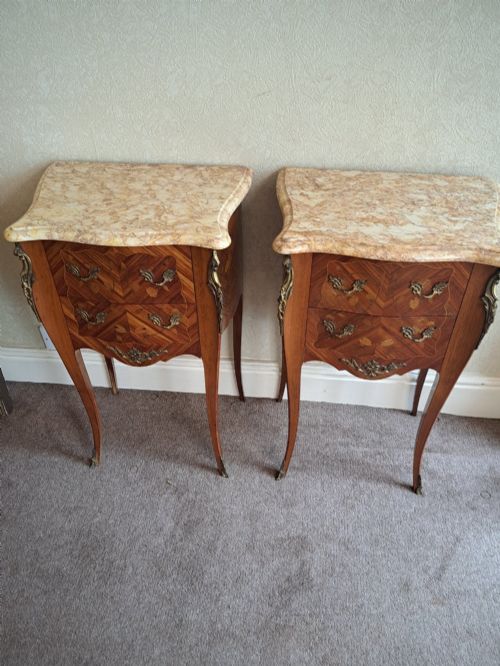


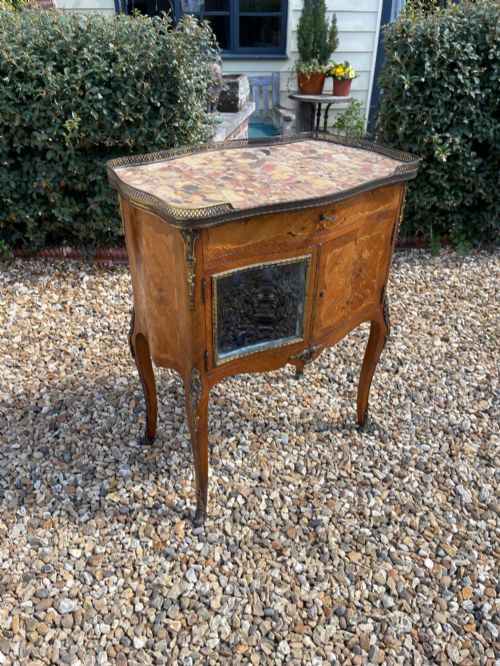


Brass Mounted Bedside Cabinets
Brass mounted bedside cabinets combine practical bedside storage with decorative metalwork across French and Victorian styles.

Brass Mounted Bedside Cabinets
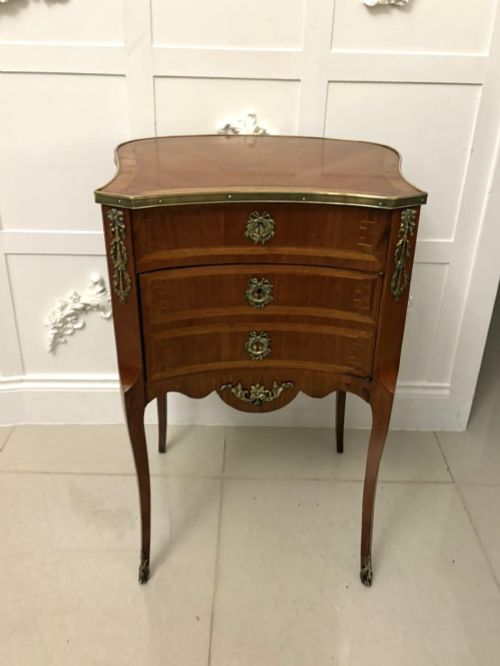
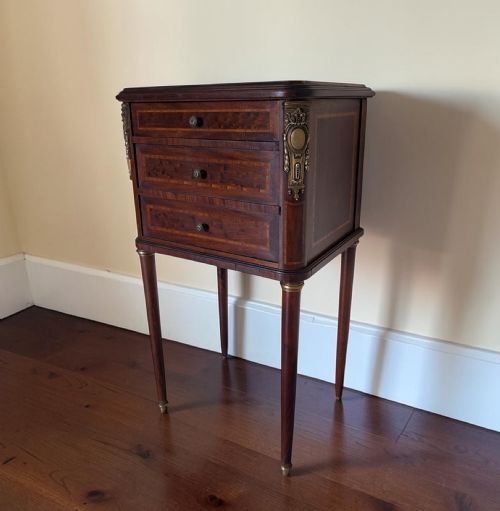
Brass mounted bedside cabinets serve as compact storage pieces beside a bed, taking the form of bedside tables, cabinets, nightstands, and small chests of drawers. These items emerge primarily from nineteenth-century production up through the nineteen-thirties, reflecting diverse continental and domestic tastes.
The pieces appearing on this page span Victorian periods and early twentieth-century decades, notably nineteen-hundred to nineteen-thirty. Buyers frequently encounter French revival styles, including Louis XV and Louis XVI interpretations, alongside mahogany and walnut constructions.
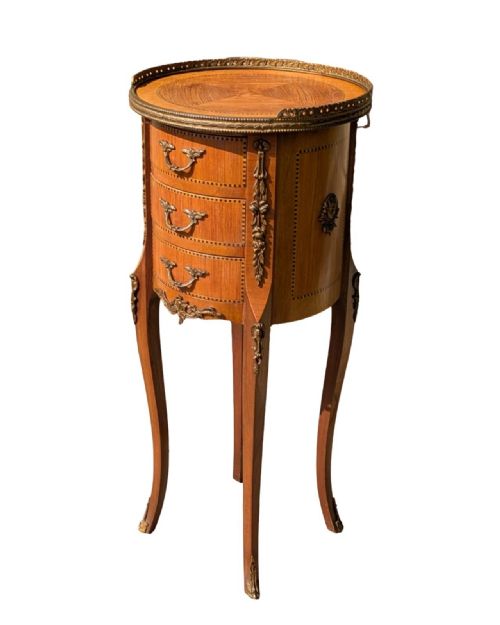
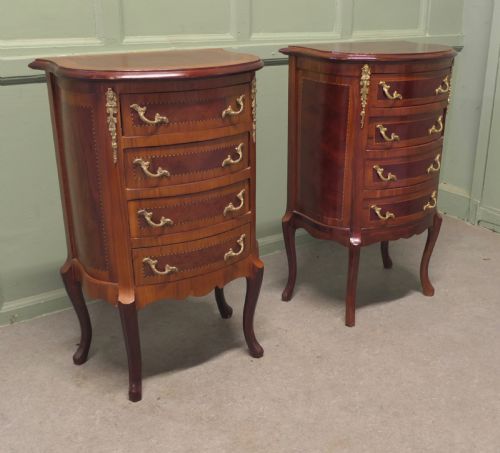
Forms range from circular and kidney bean shapes to bow front chests and pedestal cabinets. Many examples survive as matched pairs, offering symmetry for twin bedside placements.
Materials and Construction
Cabinetmakers constructed these pieces using a foundation of solid woods and veneers, selecting mahogany, walnut, kingwood, rosewood, and satinwood. Marquetry inlays frequently decorate the surfaces, creating intricate geometric or floral patterns.
Mounts, handles, and galleries cast in brass or ormolu provide structural accents and decorative borders. Marble tops, including breche d'alep varieties, appear fitted to numerous cabinet surfaces for durability and finish.
Kidney bean shapes squeeze past tight bedframes.
Distinctions in Quality
Integration of fitted marble slabs and the structural integrity of small drawers and door hinges reveal the underlying standard of cabinetmaking. Matched pairs demonstrating consistent wood grain and identical hardware command greater recognition than assembled pairs.
The Brass Mounted Bedside Cabinets Glossary
- Ormolu
- Gilt bronze mounts applied to furniture for decoration. This technique gained widespread use in French cabinetmaking during the eighteenth and nineteenth centuries.
- Marquetry
- The art of applying pieces of veneer to a structure to form decorative designs. Craftsmen utilised various coloured woods to create intricate pictorial or abstract patterns.
- Kingwood
- A dense, richly figured wood imported from South America. Furniture makers valued this material for high-end veneering during the eighteenth and nineteenth centuries.
- Chevet
- A French term for a small bedside table or cabinet. These diminutive pieces typically feature small drawers or cupboards for night-time storage.
- Commode
- A low chest of drawers, often fitted with a marble top. French examples from the nineteenth century frequently incorporate curved serpentine fronts and brass mounts.
Brass Mounted Bedside Cabinets: Frequently Asked Questions
What are brass mounted bedside cabinets?
Brass mounted bedside cabinets are small storage items for the bedroom decorated with metal mounts, handles, or galleries. They appear in various woods like mahogany, walnut, and kingwood.
Most surviving examples date from the Victorian era through the early twentieth century, heavily influenced by French design styles.
Are pairs common for these cabinets?
Matched pairs of bedside cabinets do appear frequently in the listings, designed to flank a bed symmetrically. Finding genuine pairs requires checking that the wood grain, dimensions, and brass mounts correspond closely.
Assembled pairs, where two similar pieces are brought together later, also occur on the market.
What periods do these cabinets represent?
The pieces span the nineteenth century and the early decades of the twentieth century, including Victorian and Edwardian periods. Many items adopt earlier aesthetic models, such as Louis XV and Louis XVI revivals.
Dates range from the eighteen-eighties through the nineteen-thirties.
How do marble tops affect the cabinets?
Marble tops provided a durable, wipe-clean surface for bedside use, protecting the underlying wood from spills. Stones varied from white marble to breche d'alep.
These heavy stone slabs rest directly on the cabinet frame, often edged with a brass gallery.