

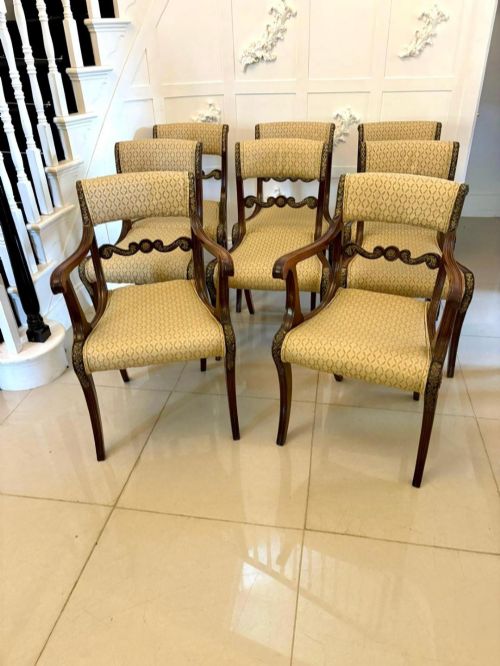
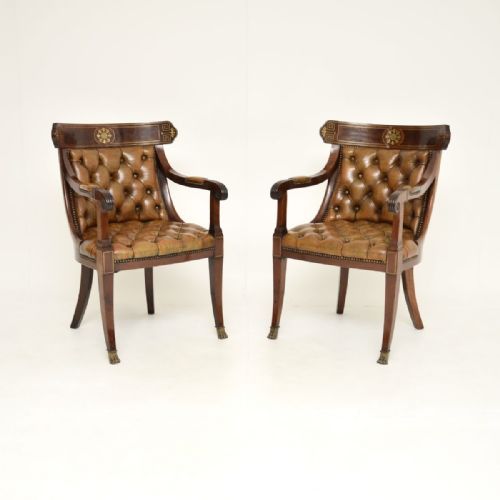


Brass Inlay Armchair
A brass inlay armchair brings striking metalwork and rich timbers together, offering both firm support and distinct decorative presence.
Brass Inlay Armchair
A brass inlay armchair combines timber frames with precise metal detailing set flush into the wood. Buyers searching for a brass inlay armchair encounter seating spanning the Georgian, Regency, and Victorian periods.
The selections on this page feature forms ranging from library armchairs and elbow chairs to dining chairs and horseshoe shapes. Regency and Georgian examples dominate the selection, alongside nineteenth-century Anglo-Indian and Chinese pieces.
Makers utilised various primary timbers including mahogany, rosewood, satinwood, and hardwood. These chairs serve functional seating roles while displaying decorative brass work across splats, rails, and frames.
Materials and construction methods
Cabinetmakers cut precise channels into dense timbers such as mahogany and rosewood to receive shaped brass wire or sheet metal. This metalwork was tapped firmly into place and scraped flush with the surrounding wood surface.
Frames rely on traditional joinery techniques to support daily use alongside the decorative embellishments. Leather, fabric, and upholstery finish the seats of many examples, secured with traditional methods.
Brass Inlay Armchair Retail Price Guide 2026
Typical asking prices for brass inlay armchair among the pieces listed under this phrase on Sellingantiques today, from the lower quarter to the upper quarter. They describe what is for sale here now, not the wider market.
One chair retains its original horseshoe curve, proving that nineteenth-century makers knew how to hug a sitter properly.
Factors influencing quality
Quality rests heavily on the precision of the metalwork and the crispness of the surrounding timber carving. Tighter joints in the brass inlay indicate superior craftsmanship during the period of manufacture.
The choice of primary timber affects the overall presence of the piece, with richly figured rosewood and dense mahogany representing higher tiers. The integrity of the underlying frame construction further separates standard examples from finer works.
HOWARD & SON'S
The Brass Inlay Armchair Glossary
- Regency
- A style and period spanning the early nineteenth century defined by classical restraint and polished timber surfaces.
- Inlay
- A decorative technique where contrasting materials are set into recesses flush with the surface of the base wood.
- Elbow chair
- An armchair featuring lower arms, frequently utilised at a desk or alongside a dining table.
- Savonarola style
- A folding chair design utilising intersecting curved wooden legs, seen in specific nineteenth-century examples.
- Horseshoe shape
- A continuous curved back and arm rail structure found on particular imported seating forms.
Brass Inlay Armchair: Frequently Asked Questions
What periods do these chairs date from?
The pieces span the Georgian, Regency, and Victorian eras, with many originating from the early nineteenth century. Later nineteenth-century examples also reflect international influences and regional workshop traditions.
Specific dates range from around 1800 through to the 1900s, showing consistent use of brass ornamentation across multiple decades of furniture design.
How were brass details fixed into the wood?
Craftsmen carved shallow channels directly into the timber surface following planned decorative motifs. Strips of brass were then cut, fitted into these grooves, and smoothed level with the wood.
This method ensured the metal remained secure during daily handling and seating use over long periods.
Are these chairs suitable for daily seating?
Many examples function well for regular seating provided the underlying frame joinery remains sound and stable. Library chairs and elbow chairs were originally built for sustained comfort and practical use.
Checking the rigidity of the arms and legs helps determine suitability for everyday placement in a modern room.
How do I distinguish regional styles?
British Regency and Georgian pieces typically display classic European classical motifs and mahogany or rosewood timbers. Anglo-Indian and Chinese pieces introduce distinct structural forms like horseshoe shapes and local hardwoods.
Examining the timber species and framing construction reveals the geographic origin of the workshop.