

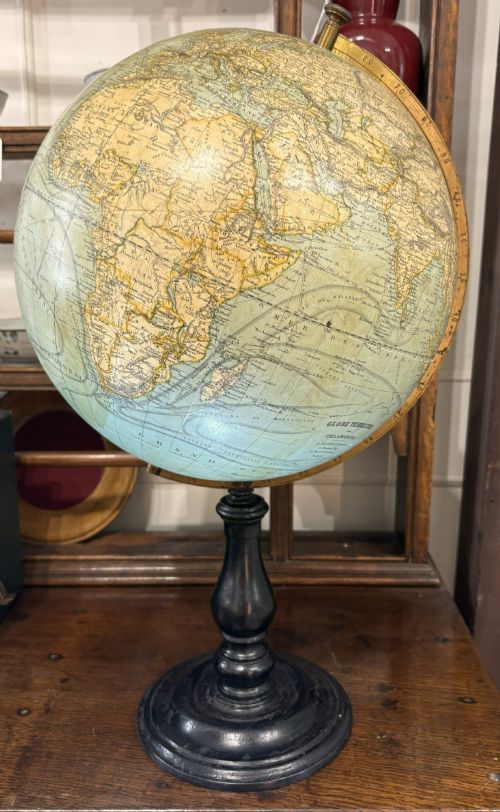


Brass Globe on Stand
A brass globe on stand brings geographical history indoors, offering tangible cartographic records mounted in metal and wood.
Brass Globe on Stand
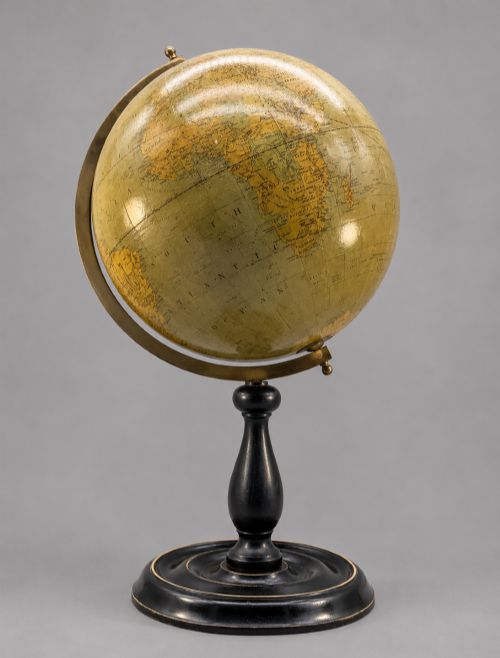
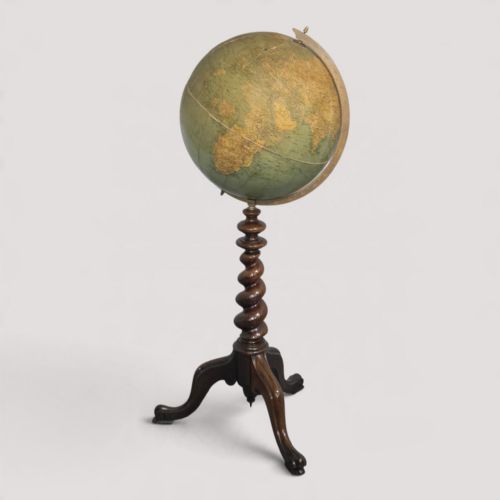
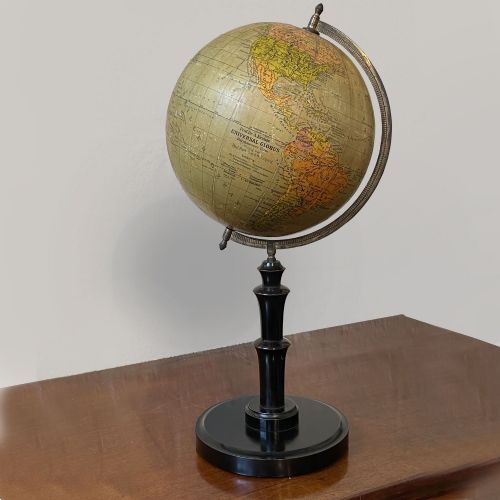
When searching for a brass globe on stand, buyers examine cartographic instruments designed for desktop, table, or floor placement. These pieces combine metal mountings with paper gores applied to spheres, recording the geography of past centuries.
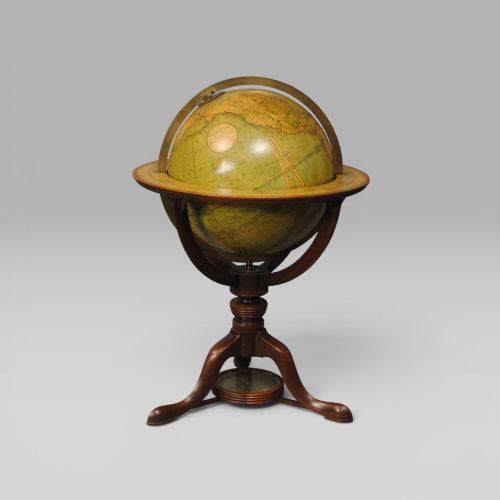
The most common versions met here include table and library globes dating from the eighteenth century through the interwar period. Makers mounted these spheres on mahogany, ebonised wood, or heavy brass stands, creating functional scientific tools for studies and libraries.
Alongside standard terrestrial spheres, collectors encounter specialised celestial pairs and occasional nineteenth-century oil lamps mounted on similar brass stands. Each format reflects the cartographic knowledge and decorative tastes of its specific period of production.
How they were made
Cartographers printed paper gores from engraved copper plates and applied them by hand onto spheres formed from plaster, paper mache, or glass. Artisans then hand-coloured the landmasses and shipping routes before varnishing the surface to protect the paper.
Workshops turned solid mahogany, ebonised wood, and brass to construct the stands, horizon rings, and meridian half-circles that support the globes. Heavy brass castings provided the necessary counterweight and structural integrity for larger library and floor-standing models.
Brass Globe on Stand Retail Price Guide 2026
Typical asking prices for brass globe on stand among the pieces listed under this phrase on Sellingantiques today, from the lower quarter to the upper quarter. They describe what is for sale here now, not the wider market.
Miniature globes measuring just four inches remind us that Georgian travellers wanted the entire world small enough to pack in a portmanteau.
What varies in quality
The precision of the cartographic engraving and the clarity of the historical place names distinguish standard educational spheres from master cartographer output. Finer examples display intricate hand-colouring on the paper gores and robust cast brass meridian rings that hold their alignment over centuries.
The choice of materials in the stand elevates a piece, moving from simple turned wood to elaborate mahogany frames with calibrated brass horizon rings. Original finish preservation on both the paper globe and the metal base dictates the overall integrity of the piece.
Cary·Lebegue and Cie·J Forest·Malby·Geographia·M Vivien
The Brass Globe on Stand Glossary
- Gores
- The paper strips, typically shaped like elongated lites, that cartographers printed and pasted onto a sphere to map the earth.
- Meridian
- The brass ring surrounding the globe that holds it at an angle and is often graduated with degrees for measurement.
- Celestial
- A companion globe to the terrestrial type that maps the constellations, stars, and astronomical coordinates rather than landmasses.
- Horizon ring
- The wooden or metal ring encircling the globe that represents the horizon and often carries astrological or calendar information.
Brass Globe on Stand: Frequently Asked Questions
How do I date an antique globe?
Examine the political boundaries, capital cities, and geographical discoveries printed on the paper gores. Cartographers often updated these details to reflect the era of production.
Look for manufacturer cartouches printed directly on the sphere, which usually name the maker and publication date. Stand styles and wood types also provide strong chronological clues.
How were library globes used?
Library globes served as primary reference tools for scholars, diplomats, and scientists tracking global trade routes and political territories. Users consulted them alongside atlases to understand spatial relationships.
Placed on sturdy floor stands or large tables, they functioned as both working scientific instruments and impressive fixtures in elite domestic spaces.
How should I clean a brass stand?
Dust the brass components regularly with a soft, dry cloth to prevent the accumulation of airborne particles. Avoid harsh chemical polishes that strip away historical patination.
Keep the paper globe completely away from moisture and direct sunlight to prevent the paper gores from fading, staining, or lifting off the plaster sphere.
What is the difference between terrestrial and celestial?
Terrestrial globes map the physical earth, showing oceans, continents, countries, and historical exploration routes. They represent the world as understood at the time of manufacture.
Celestial globes map the night sky, depicting stars, constellations, and astronomical grids from an outside perspective. They were often produced as matching pairs with terrestrial models.