


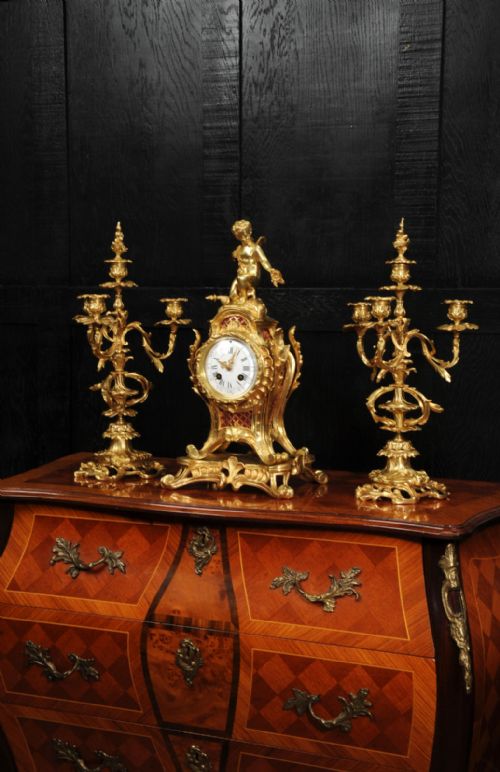


Brass Garniture Candelabra
Brass garniture candelabra sets combine timekeeping and illumination, offering matching mantel furniture that anchors a room with period proportion.
Brass Garniture Candelabra
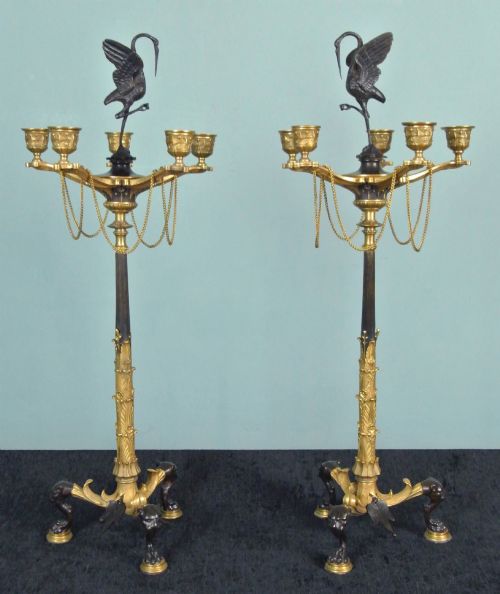
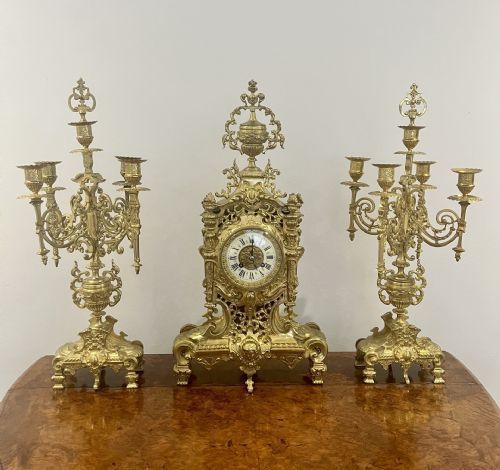
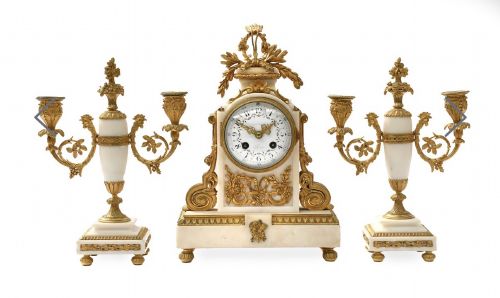
When searching for brass garniture candelabra, buyers encounter three-piece and multi-piece mantel sets uniting a central clock with matching side candelabras or candlesticks. The examples seen here lean heavily toward nineteenth-century French production in styles ranging from Louis XVI Revival and Rococo to Empire, alongside Victorian interpretations.
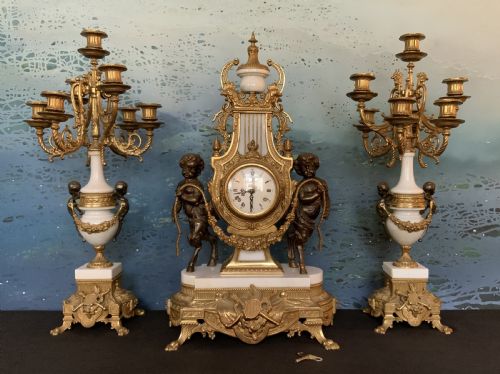
Most pieces pair metalwork with stone bases, frequently combining gilt bronze, ormolu, or brass with white marble, green onyx, or patinated bronze. These matched suites were designed specifically to sit upon a fireplace mantelpiece as a cohesive decorative statement.
Materials and construction
Foundry work relied on cast bronze, brass, and ormolu, often incorporating patinated or parcel-gilt surfaces alongside applied enamel dials and steel movement components. Artisans chased the metal castings by hand to sharpen foliage, cherubs, and scrollwork before applying fire gilding or lacquer.
Stonemasonry formed the structural bases, turning and polishing white marble and green onyx to support the weight of the heavy metal ornaments and clock movements. Precision brass gear trains, strike systems, and visible pendulums completed the functional mechanics housed within the cases.
Many sets include winged putti or cheeky cherubs perched among the candelabra arms, steadfastly ignoring the passage of time on the central clock dial.
Assessing quality and execution
Integration across the garniture determines visual success, where the central clock and flanking candelabra share identical patination, marble selections, and decorative motifs. Movement longevity also separates workshop tiers, marked by signed brass plates and substantial eight-day striking mechanisms.
Barbedienne·Deniere Paris·Vincenti·Japy Freres
The Brass Garniture Candelabra Glossary
- Garniture
- A set of matching decorative objects for a mantelpiece, usually comprising a central clock flanked by two candelabra, vases, or urns. These suites create a balanced arrangement across a fireplace.
- Ormolu
- Finely chopped and ground gold-mercury amalgam fired onto a bronze base, creating a durable golden surface. Also known as gilt bronze, it defines the rich finish on nineteenth-century French pieces.
- Candelabra
- Branched lighting fixtures designed to hold multiple candles, styled to match the central clock in a garniture set. They provide symmetrical height and illumination.
- Patinated bronze
- Bronze treated with chemical solutions to produce a darkened, aged, or coloured surface finish. This technique contrasts with bright ormolu mountings.
- Visible pendulum
- A clock dial design featuring an aperture that reveals the swinging pendulum within the movement. It adds kinetic interest to the mantel display.
Brass Garniture Candelabra: Frequently Asked Questions
What is a brass garniture candelabra set?
A brass garniture candelabra set is a matched ensemble designed for a mantelpiece, consisting of a central clock paired with two matching candelabras. These suites combine timekeeping with auxiliary lighting to create a unified decorative display.
Originating largely in nineteenth-century French workshops, they coordinate materials like marble, ormolu, and bronze across all three matching components.
How were these clock sets used historically?
Historically, these sets occupied the mantelpiece in the principal reception rooms of bourgeois and aristocratic homes. They functioned simultaneously as accurate timekeepers and as ornamental centerpieces that reflected the owner's taste.
On dark evenings, the flanking candelabra could be fitted with candles to provide additional light in the room, though many remained purely decorative.
How do I care for antique ormolu and marble?
Care for antique ormolu and marble requires gentle dusting with a soft, dry cloth to prevent abrasive particles from scratching the gilt surface or the polished stone. Avoid all liquid cleaners, commercial polishes, and harsh chemicals that strip the original fire gilding.
Keep the pieces away from direct heat sources like active fireplaces and direct sunlight, which can dry out stone and damage historic clock movements.
How do I tell Louis XVI style from Rococo Revival?
Louis XVI style pieces feature geometric symmetry, straight lines, classical urns, ribbons, and restrained neoclassical proportions inspired by antiquity. The overall silhouette appears orderly, balanced, and architectural.
In contrast, Rococo Revival pieces embrace asymmetry, scrolling C-curves, naturalistic foliage, and exuberant, flowing forms without straight lines. This style prioritizes dynamic movement and playful ornamentation over classical geometry.