

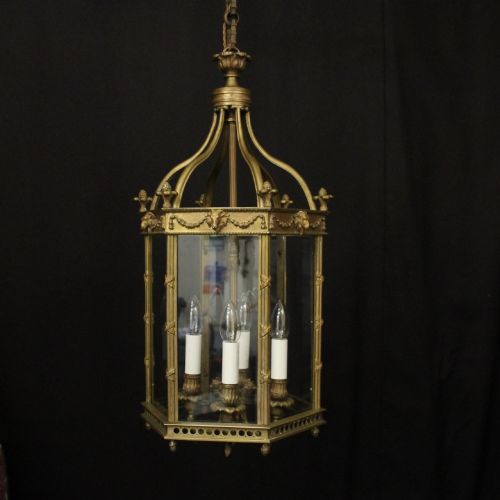
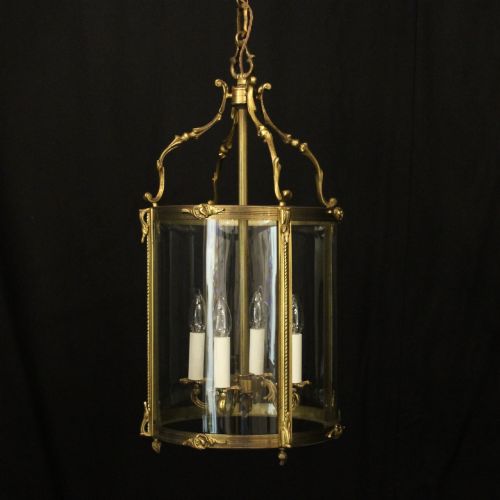
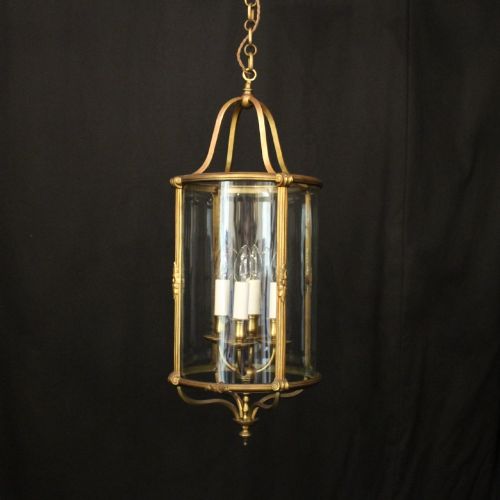
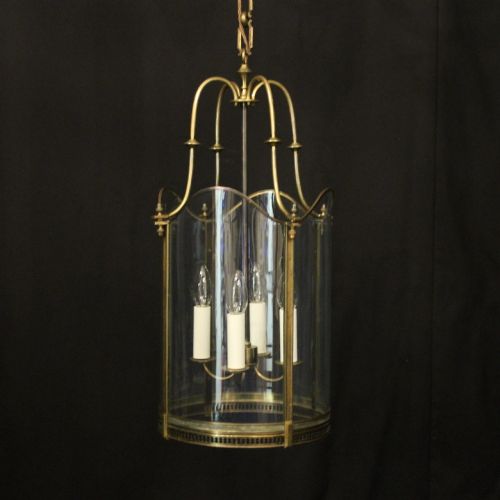


Brass Four Light Lantern
A brass four light lantern commands a hallway with polished presence, offering a functional centrepiece built to illuminate grand spaces.
Brass Four Light Lantern
A brass four light lantern typically takes the form of a hanging ceiling light designed for entrance halls and corridors. These pieces draw upon French Neoclassical, French Chateau, Rococo Revival, English Regency, and Victorian traditions, spanning the nineteenth century through to the interwar decades of nineteen twenty and nineteen thirty.
The most common format on this page is the French or English hall lantern featuring four interior lights. Examples frequently incorporate convex glass panels and heavy metal frames, functioning simultaneously as ceiling lighting, pendant lights, and grand chandeliers.
How they were made
Maker construction relies heavily on brass, bronze, gilded bronze, and gilt brass, often combined with structural steel for larger formats. Metal components are cast, chased, and gilded to achieve a lustrous metallic finish that catches interior light.
Panels are glazed with curved or flat glass, secured tightly within metal framing to enclose the four internal bulb points. Mixed metal creations utilise steel alongside brass to support oversized dimensions safely from the ceiling.
Brass Four Light Lantern Retail Price Guide 2026
Typical asking prices for brass four light lantern among the pieces listed under this phrase on Sellingantiques today, from the lower quarter to the upper quarter. They describe what is for sale here now, not the wider market.
Some lanterns grow so large they require steel framing just to keep their composure.
What varies in quality
The distinction between tiers rests upon the crispness of metal casting and the depth of the original gilding. Pieces featuring heavy cast bronze and hand-finished mounts demonstrate superior craftsmanship compared to simpler folded brass construction.
Proportion and glass clarity further define the hierarchy, particularly where convex glass panels are fitted with precision. Scale also dictates execution, with oversized examples requiring robust internal framing to maintain structural integrity.
The Brass Four Light Lantern Glossary
- Convex glass
- Curved glass panels that project outward to soften internal light diffusion. This technique adds visual volume to the profile of a hanging fixture.
- Gilded bronze
- Bronze metal treated with a thin layer of gold leaf or gilt wash. This process combines durable structural strength with a rich, luminous surface.
- Hall lantern
- An enclosed ceiling fixture specifically scaled for corridors and entranceways. These fittings provide directional illumination from elevated ceiling positions.
- Regency
- An English design period spanning the early nineteenth century characterised by classical restraint and refined proportions. Pieces from this tradition favour clean architectural lines.
Brass Four Light Lantern: Frequently Asked Questions
Where should a brass four light lantern hang?
These fixtures suit high-ceilinged entrance halls, grand stairwells, and spacious landings where their vertical drop can be fully appreciated.
Ensuring adequate clearance beneath the fixture allows the lantern to function as both a primary light source and an architectural statement.
How do I date a brass lantern?
Dating relies upon stylistic markers such as nineteenth century revival details, French Neoclassical motifs, or later nineteen thirty industrial pairings of steel and brass.
Material composition, including the use of heavy gilded bronze versus lighter plated brass, also indicates the period of manufacture.
Are these lanterns suitable for low ceilings?
Most examples are designed with substantial drop chains or suspension rods intended for elevated spaces. Installing them in rooms with restricted headroom requires careful consideration of the overall hanging height.
What is the difference between brass and bronze?
Bronze is an alloy of copper and tin offering heavy, durable structural qualities suited to ornate casting. Brass is primarily an alloy of copper and zinc, yielding a brighter golden tone frequently utilised in decorative mountings.