
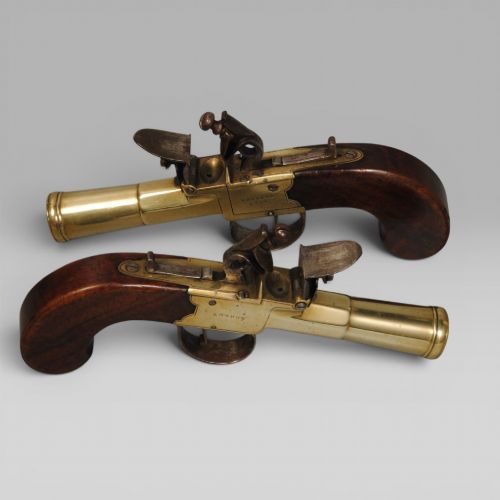

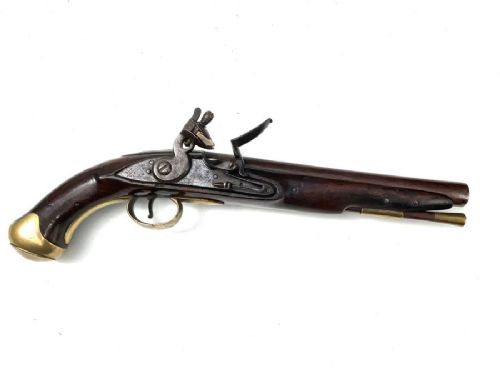


Brass Flintlock Pistol
A brass flintlock pistol carries the weight of eighteenth-century engineering, combining cast metal and carved timber into a functional sidearm.
Brass Flintlock Pistol
When searching for a brass flintlock pistol, a buyer examines historical sidearms featuring copper-alloy barrels, mounts, or frames produced primarily during the eighteenth and early nineteenth centuries. These pieces span military service arms, private duelling pieces, and regional Ottoman or Balkan variations designed for belt carriage.
The version most frequently encountered on this page is the British or European pocket, overcoat, or holster pistol dating from the Georgian and Napoleonic eras. Many combine a brass barrel with a walnut stock, while others exhibit extensive brass furniture and engraved mounts typical of the Balkan frontier.
Materials and construction
Gunmakers cast brass for barrels and furniture because the alloy resisted corrosion from black powder residue better than untreated iron. Stocks were carved from dense hardwoods like walnut, shaped to fit the hand and hollowed internally to receive the lock mechanism and barrel tang.
Lock mechanisms utilised forged steel components, including the frizzen and cock, which struck sparks into the priming pan when the trigger released the sear. Artisans frequently embellished mounts with hand engraving, silver wire inlay, or mother-of-pearl panels secured with brass pins.
Listings feature examples from the seventeenth century through to the nineteenth century, utilising brass, steel, walnut, silver, and mother-of-pearl.
Evaluating craftsmanship and distinction
Quality rests upon the crispness of the maker's signature on the lock plate and the precision with which the brass furniture is fitted to the wooden stock. Finer specimens display deeply struck proof marks, harmonious proportions between barrel length and grip size, and delicate hand-chased relief work on the brass mounts rather than generic casting.
The integrity of the internal mechanism dictates value among collectors, specifically the strength of the mainspring and the correct operation of the flintlock action. Pieces retaining matching serial numbers across components or originating from recognised London and continental workshops stand apart from standard military issues.
Harrison of London·Henry Nock·La Motte·H.W. Mortimer & Son·Thomas Henshaw·Thomas Anelli·J. Robinson·John Rimes·Ketland and Co
The Brass Flintlock Pistol Glossary
- Flintlock
- An ignition system that uses a piece of flint held in a cock to strike a steel frizzen, creating sparks to ignite the gunpowder charge in the pan.
- Boxlock
- A firearm design where the breech and the lock mechanism form a single forged frame, commonly seen on pocket and turn-off pistols.
- Miquelet
- A distinct Mediterranean and Ottoman lock type utilising an external mainspring and a combined steel and pan cover.
- Turn-off
- A barrel design that unscrews from the breech to allow loading from the front without a ramrod, typical of eighteenth-century pocket pieces.
Brass Flintlock Pistol: Frequently Asked Questions
How were these pistols carried?
Civilians carried smaller pocket and overcoat variants in fitted coat pockets or specialised leather holsters to provide personal defence during travel.
Military officers and cavalry troopers instead utilised larger holster pistols secured in saddle holsters or thrust through heavy waist belts.
Why use brass instead of iron?
Brass barrels offered superior resistance to the corrosive acids left by black powder residue and moisture during maritime or tropical service.
Foundries also found brass easier to cast into complex shapes like cannon barrels and integrated breech blocks.
How do I identify the date?
Makers often engraved their names and city locations directly onto the lock plate or top barrel flat, allowing cross-reference with trade records.
Proof marks stamped into the metal by official guild houses provide further chronological markers for British and European workshops.